 A customer looks at clothing for sale at the Pike Place Market in Seattle.
The U.S. economy grew in the second quarter at the fastest pace in nearly two years as the government revised upward its previous estimate of consumer spending.
Inflation-adjusted gross domestic product (GDP), which measures the value of goods and services produced in the United States, increased at a revised 3.8 percent annualized pace, according to a Bureau of Economic Analysis (BEA) report released today. That is stronger than the previously reported 3.3 percent advance and follows an outright contraction in the first quarter.
The BEA also issued its annual update of the national economic accounts, which shows real GDP increased at an average annual pace of 2.4 percent from 2019 to 2024. The revisions paint a picture of an economy that quickly rebounded from the initial shock of the pandemic and has since transitioned to period of steadier, trend growth with lingering inflation.
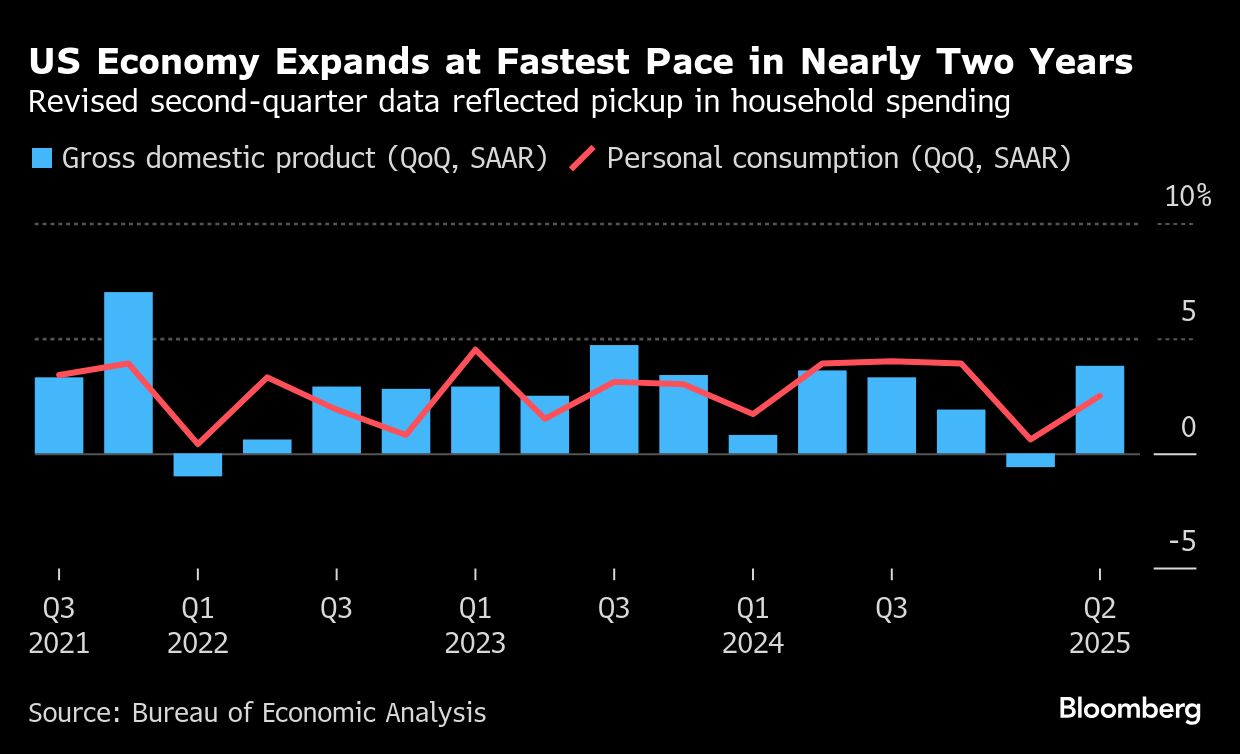
The latest quarterly GDP data confirms that the economy rebounded in the second quarter after a monumental surge in imports at the start of the year, when companies were racing to stock up ahead of President Donald Trump’s tariffs. The third quarter is also looking solid, with recent reports illustrating resilient consumer spending and business outlays for equipment.
“The economy is clearly recovering from the shock of tariff implementation,” Chris Low, chief economist at FHN Financial, said in a note. “Accelerating growth should mean stronger job growth within the next few months.”
Before today’s figures, the Federal Reserve Bank of Atlanta’s GDPNow estimate penciled in a 3.3 percent rate of growth in the July-to-September period. However, some economists are less upbeat about growth in the fourth quarter, as weaker employment dims prospects for consumer spending. And forecasters expect activity to pick up only somewhat in 2026, partly due to Trump’s tax law and lower interest rates; most predict growth below 2 percent for the next few years.
Separate data for the month of August released today shows orders for business equipment increased at a solid clip while the merchandise trade deficit narrowed by more than forecast. Initial applications for unemployment benefits fell last week to the lowest since mid-July.
“The latest GDP and jobless-claims data should ease the bout of anxiety kicked off by the weak August jobs report and downward revisions to benchmark employment data,” Bill Adams, chief economist at Comerica Bank, said in a note. “Hiring is in low gear in 2025, but economic growth is resilient, and the job market does not appear to have weakened in September.”
That may reduce chances that the Fed will cut interest rates at each of its remaining two meetings this year, as policymakers recently projected. Several officials remain wary of aggressive cuts, given persistently high inflation.
| Metric (quarter-over-quarter, seasonally adjusted annual rate) | Latest revision | Prior estimate |
|---|---|---|
| GDP | +3.8% | +3.3% |
| Gross domestic income (GDI) | +3.8% | +4.8% |
| Consumer spending | +2.5% | +1.6% |
| Residential investment | -5.1% | -4.7% |
| Nonresidential investment | +7.3% | +5.7% |
The revisions show the Fed’s preferred inflation metric—the personal consumption expenditures (PCE) price index, excluding food and energy—rose at faster clip throughout 2024 and was also marked up in the second quarter to 2.6 percent. Economists expect monthly PCE data, which is due out tomorrow, to show the metric advanced nearly 3 percent in August from a year ago.
Because swings in trade and inventories have distorted overall GDP this year, economists are paying closer attention to final sales to private domestic purchasers, a narrower metric of consumer demand and business investment. This measure was revised up a full percentage point, to 2.9 percent.
Consumer spending—the main growth engine of the economy—advanced at a 2.5 percent annualized pace. The upward revision reflects more spending on transportation services as well as financial services and insurance.
Business investment expanded at a 7.3 percent rate, driven by the sharpest spending on intellectual property (IP) products since 1999. Investment in data centers, which house the infrastructure for artificial intelligence (AI), quickened to a fresh record of over $40 billion on an annualized basis. Given the sharp increase in this kind of construction in recent years, the BEA’s annual update provides separate detail on data centers, which had previously been included within a broader category of investment in office structures.
While the annual revisions incorporate newer, more complete source data, the agency said it was “unable to purchase” certain statistics related to tax returns for corporations and sole proprietorships.
The latest report includes updated figures on corporate profits, which rose 0.2 percent in the second quarter, much lower than initially projected. That aligns with other data which suggest companies have so far largely shielded U.S. consumers from price hikes due to tariffs, and Fed Chair Jerome Powell said last week the pass-through has been slower and smaller than previously thought.
A measure of after-tax profits for non-financial firms as a share of gross value added—a proxy for margins—has tightened this year, though it remains well above levels that prevailed from the 1950s to the pandemic.
————————————————————
Copyright 2025 Bloomberg. All rights reserved. This material may not be published, broadcast, rewritten, or redistributed.
© Arc, All Rights Reserved. Request academic re-use from www.copyright.com. All other uses, submit a request to TMSalesOperations@arc-network.com. For more information visit Asset & Logo Licensing.