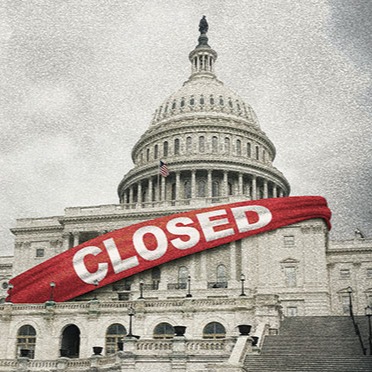
The federal government shutdown began at 12:01 a.m. last Wednesday, and how long it will last is anyone’s guess. While certain essential government services remain available, the shutdown has resulted in a dramatic decrease in the operations of most federal departments and agencies. Here are some ways we can expct the shutdown to impact employers.
New-Employee Onboarding and Immigration Services
While initially still available on the morning of October 1, E-Verify was soon disabled. This was expected, as the E-Verify system was temporarily unavailable during prior shutdowns, as well. When it’s unavailable, employers cannot enroll in E-Verify or verify authorization for new employees to work in the United States.
Even as E-Verify is down, employers are required during the shutdown to follow I-9 compliance procedures when onboarding new employees. U.S. Citizenship and Immigration Services (USCIS) recently confirmed that employers are permitted to continue using the remote I-9 document verification under the USCIS-approved alternative review process. USCIS published additional compliance guidance on its website on October 1.
While USCIS operations will continue, field office staffing is likely to be reduced, and many visa and citizenship applicants who require verification through other agencies are likely to see their applications put on hold. In particular, the U.S. Department of Labor (DOL) will stop processing prevailing wage determinations and other certifications required for many forms of work visas and green cards.
The U.S. Immigration and Customs Enforcement (ICE) is expected to continue its enforcement efforts, including workplace raids, throughout the shutdown.
Agency Actions Relating to Alleged Unlawful Employment Practices
Most federal agencies that enforce federal employment laws have halted their investigation and enforcement actions during the shutdown. This includes agencies under the DOL. Among others, the Bureau of Labor Statistics (BLS), Office of Federal Contract Compliance Programs (OFCCP), and Office of Administrative Law Judges (OALJ) “will completely cease operations,” according to the DOL’s Shutdown Contingency Plan issued on September 26.
The DOL has indicated that its agencies will pursue only those legal cases and investigations that are in jeopardy of being lost due to statutes of limitations or as ordered by the courts. This means that most investigations, enforcement actions, litigation, and training offered by the Wage and Hour Division (WHD), Occupational Safety and Health Administration (OSHA), and Office of the Solicitor (SOL) are now on hold. OSHA will, however, have a subset of employees available to investigate and address workplace situations involving imminent threat to human life and fatalities.
Similarly, the Equal Employment Opportunity Commission (EEOC) has confirmed that more than 90 percent of its workforce has been furloughed, which means that no charges of discrimination will be investigated, mediations will be canceled, and the EEOC will not respond to correspondence. The EEOC also intends to ask courts to suspend pending lawsuits.
National Labor Relations Board (NLRB)
Spencer Fane has received communication from an NLRB agent stating that all but five of the NLRB’s employees are, or will be, furloughed during the shutdown. Pending NLRB cases will be stayed and hearings postponed.
Federal Employment Litigation
We expect federal courts to remain open, at least for now. Federal District Courts are taking a mixed approach to pending cases involving a federal agency or employee. Some courts have announced that all civil litigation is expected to proceed, whereas at least one court issued an order clarifying that any lawsuits involving the U.S., a federal agency, or a federal employee as a party will be automatically stayed.
The U.S. Department of Justice will continue to prosecute criminal cases.
Should the shutdown continue beyond a few weeks, it remains possible that federal court operations may become limited or cease, too.
With their continued work and payment from the federal government in jeopardy, employers that have significant federal contracts may begin furloughing or laying off workers whose services are not needed due to the shutdown. If such furloughs or layoffs are significant, such contractors may need to issue advance notice under the Worker Adjustment and Retraining Notification Act (WARN) and/or similar state laws.
Federal Contractors
Federal contractors will also need to be mindful of pay requirements under the Fair Labor Standards Act (FLSA), particularly for salaried employees whose work is paused in the middle of a workweek. While it is usually permissible to require an employee to use paid time off for partial-week absences, it is ordinarily not permissible to reduce an employee’s weekly salary when they work only part of a workweek.
These employers will also need to consider their obligations to continue employee benefits and/or issue COBRA notices triggered by reductions in hours and work opportunities.
Key Takeaways
Employers remain subject to federal employment laws even while the government is shutdown. However, investigations, enforcement actions, and potentially even litigation arising from suspected violations of such laws will likely be postponed until normal federal government operations resume.
© Arc, All Rights Reserved. Request academic re-use from www.copyright.com. All other uses, submit a request to TMSalesOperations@arc-network.com. For more information visit Asset & Logo Licensing.