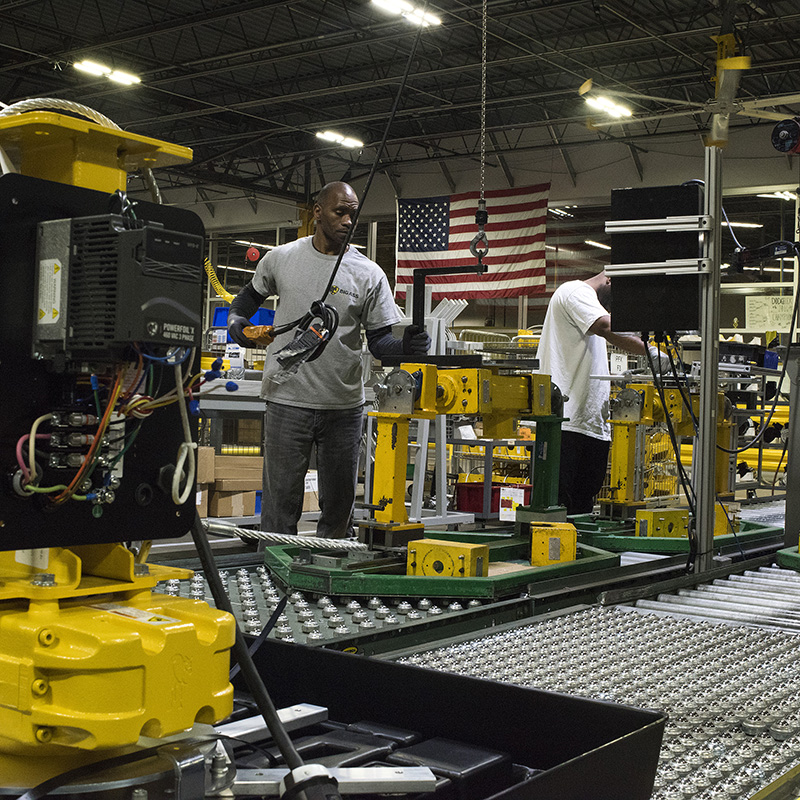
 Employees assemble industrial fans at a manufacturing facility in Lexington, Kentucky.
U.S. factory activity shrank in October for an eighth straight month, driven by a pullback in production and tepid demand. The Institute for Supply Management’s (ISM’s) manufacturing index eased 0.4 point, to 48.7, according to data released yesterday. Readings below 50 indicate contraction, and the measure has been stuck in a narrow range for most of this year.
Meanwhile, the group’s production index slid 2.8 points, to 48.2, marking the second month in the last three that output has contracted. This weakness is keeping headcounts depressed. The ISM’s employment gauge shrank for a ninth straight month, albeit at a slightly slower pace than in September.
Manufacturers are still concerned about the general lack of clarity around trade policy from the Trump administration, Susan Spence, chair of the ISM Manufacturing Business Survey Committee, said on a call with reporters. “It’s the overall tone of ‘We don’t know what country is coming next, we don’t know what commodity is coming next,’” Spence said.
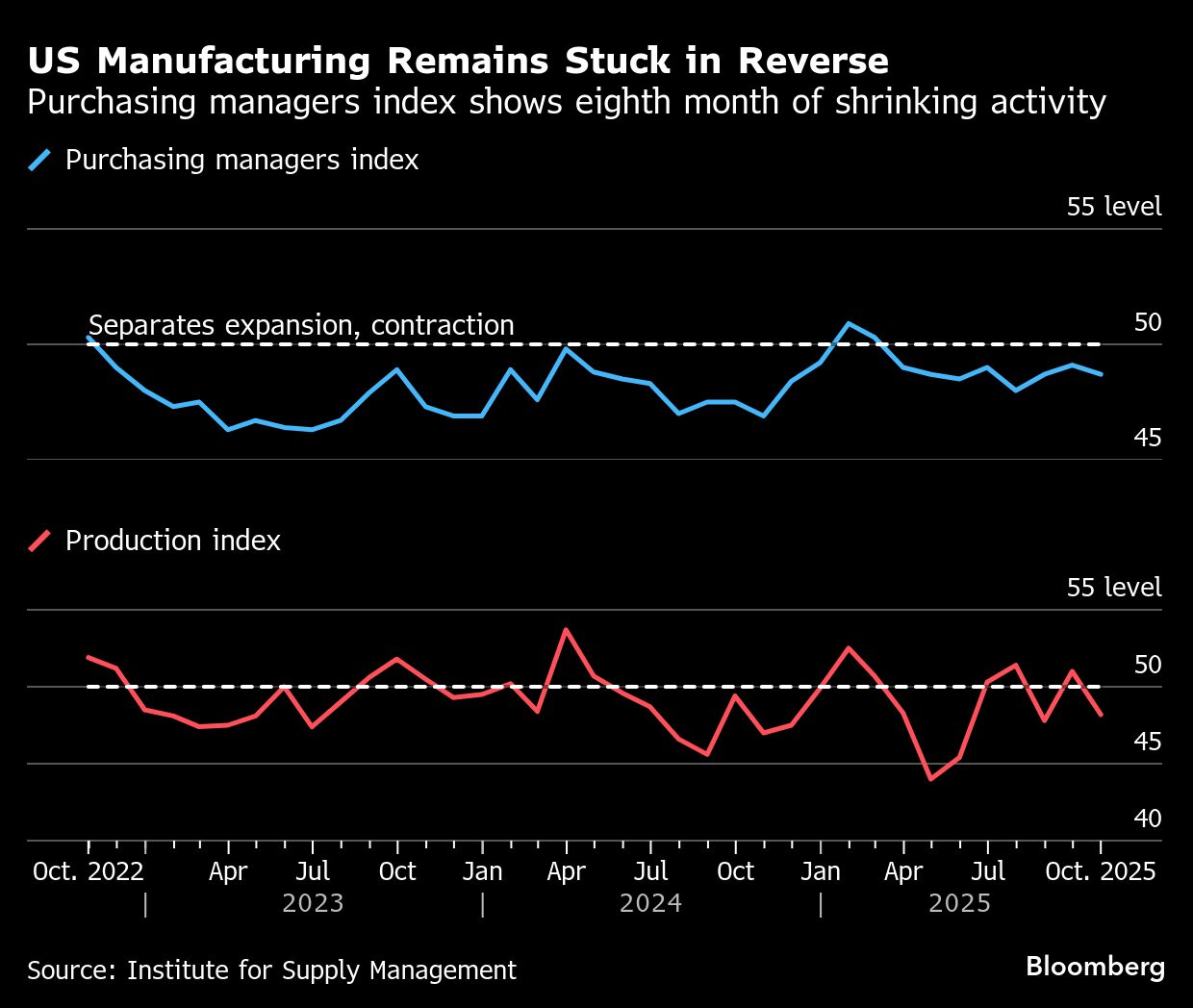
Meanwhile, inflationary pressures continued to ease. The index of prices paid for raw materials fell nearly 4 points, to 58, the lowest since the start of the year. Since a recent peak in April, during the height of the tariffs rollout, the price gauge has dropped nearly 12 points.
“The most encouraging aspect of the report was the 3.9-point fall in the prices paid index to 58.0, its lowest level since tariffs were imposed,” Thomas Ryan, North American economist at Capital Economics, said in a note. “This brings the index back in line with its 10-year average and indicates the worst of the tariff-driven pressure on manufacturers’ input costs is likely behind us.”
Economists and policymakers are relying more on private reports such as the ISM survey for clues on the economy and job market in the absence of official data because of the U.S. government shutdown. Friday’s scheduled employment report is also poised to be delayed.
“For every comment on hiring, there were 3.4 on reducing employment,” Spence said in a statement. “Companies continued to focus on accelerating staff reductions due to uncertain near- to mid-term demand. Layoffs and not filling open positions remain the main headcount-management strategies.”
A dozen manufacturing industries contracted in October, led by textiles, apparel, and furniture. Six industries, including primary metals and transportation equipment, reported growth.
The survey illustrates general malaise among the nation’s manufacturers, which are contending with lingering uncertainty around trade policy. Producers are navigating evolving supply chains as they source materials. The ISM measure of supplier deliveries rose to a four-month high, indicating longer lead times.
.Select Comments from the ISM Report“Business continues to remain difficult, as customers are canceling and reducing orders due to uncertainty in the global economic environment and regarding the ever-changing tariff landscape.” — Chemical Products “Decrease in domestic demand for finished products has resulted in slower manufacturing and an increase of raw material in inventory.” — Petroleum & Coal “In general, business is really strained. Money is sitting tighter, and geopolitical changes add to the uncertainty/risk factor. Even medical fields are feeling the pressure.” — Miscellaneous Manufacturing “Sales continue to underperform in our automotive OEM [original equipment manufacturing] and industrial divisions. Our aerospace and automotive aftermarket are the only areas performing slightly above budget. This is the third month of lower-than-expected sales, and the remainder of the year outlook is not looking better.” — Fabricated Metals “The products we import are not readily manufactured in the U.S., so attempts to re-shore have been unsuccessful. Overall, prices on all products have gone up, some significantly. We are trying to keep up with the wild fluctuations and pass along what costs we can to our customers.” — Machinery “The unpredictability of the tariff situation continues to cause havoc and uncertainty on future pricing/cost. But even with the tariffs, the cost to import, in many cases, is still more attractive than sourcing within the U.S. Challenges with tariffs on production equipment necessary for internal production makes it difficult to justify expansion of capacity.” — Computer & Electronic Product |
Bookings shrank for a second month in October, though at a slower pace, the ISM report showed. Order backlogs, another indicator of demand, also contracted. Inventories at manufacturers shrank by the most in a year. Customers’ stockpiles also remained low, suggesting some scope for orders to pick up and support production.
————————————————————-
Copyright 2025 Bloomberg. All rights reserved. This material may not be published, broadcast, rewritten, or redistributed.
© Arc, All Rights Reserved. Request academic re-use from www.copyright.com. All other uses, submit a request to TMSalesOperations@arc-network.com. For more information visit Asset & Logo Licensing.