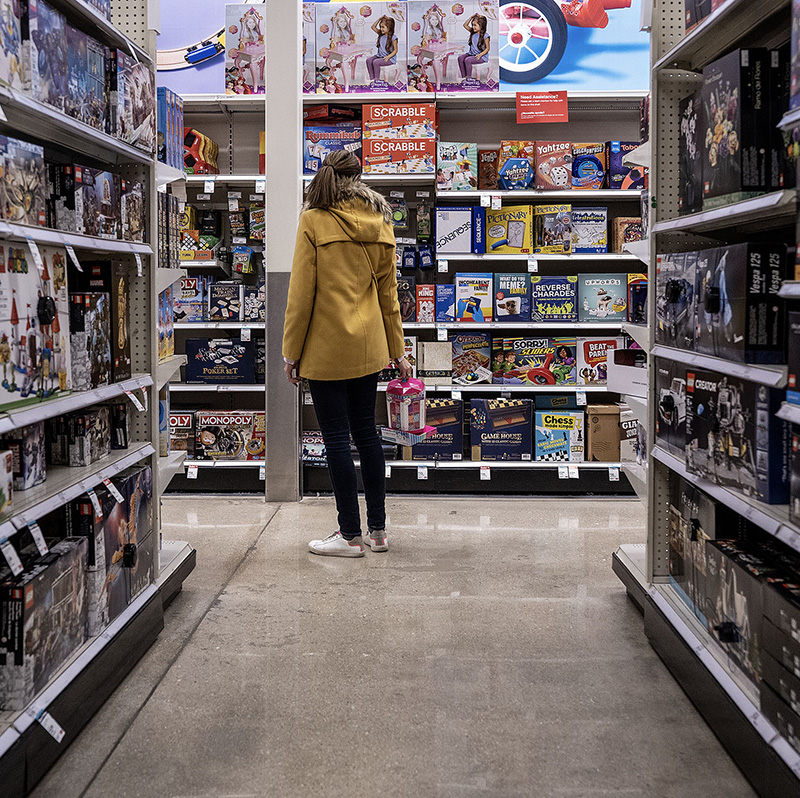
 A shopper in the toy aisle of a store on Black Friday in Chicago.
The U.S. economy appears remarkably resilient right now, but if you look closer, you’ll see a different picture emerge: a growing divide between America’s wealthiest consumers and everyone else. Economists call this kind of bifurcated economy “K-shaped.” And as the top and bottom of the K have diverged, the overall economy has become more top-heavy and more fragile.
On today’s Big Take podcast from Bloomberg News, host Sarah Holder is joined by Peter Atwater—the economist who popularized the idea of a “K-shaped economy” during the pandemic—and Bloomberg reporter Catarina Saraiva, who covers the Federal Reserve and the U.S. labor market. They examine why this gap is widening, how it’s showing up in company earnings reports, and what it means for the country’s overall financial health. Here is a lightly edited transcript of the conversation:
Sarah Holder: If you squint at enough data about the U.S. economy right now—on income, and spending, and consumer confidence—there’s a shape that starts to emerge: the letter K.
Peter Atwater: A K-shaped economy is the result of bifurcation in consumer confidence. We should have hoped for a V-shaped recovery coming out of Covid, where all ships rose together. Even a U-shaped recovery, where there's a delay in the recovery but ultimately it all rises together.
Holder: But we didn’t get a V. We didn’t get a U. We didn’t even get an L, where things stay bad for everyone. Instead, we got a K.
Catarina Saraiva: So if you think about the letter K, it has a vertical line obviously, and then two lines diverging from the center of that vertical line.
Holder: The divergence is a split in the paths of Americans at the top and bottom of the U.S. economy, with the fortunes of those at the top rising, and those at the bottom getting worse. That’s how the economy looked during the recovery from Covid, and it’s how it looks again now.
Saraiva: Fast forward to 2025. We’re again talking about the K shape because we are seeing, kind of, a return to that. We’re seeing consumer spending really slow down for folks at the lower ends of the income spectrum, while rich folks are doing really well.
Holder: And this time around, the two sides of that K are getting even farther apart.
Atwater: Early on in Covid, I saw white-collar workers’ confidence immediately pop when they could work from home. On the other hand, blue collar workers, factory workers, hospital workers, their confidence kept deteriorating. And so based on that divergence in confidence, I expected that the economy would follow.
Holder: And Catarina is saying, it did follow.
Saraiva: You had one group of people that were kind of in the upper echelons of the economy—high-income earners, people with a lot of wealth—and those people were really doing well. The stock market was rising a lot already by the end of 2020. So people with wealth and people with jobs where they could work from home, for example, were doing really well. Now, the other half of the economy really wasn't. We still had like 11 million people unemployed at the end of 2020. The unemployment rate was above 6 percent. So for anyone who didn’t have stocks, maybe didn’t own a home, things were not going great.
Holder: Eventually, the government rolled out stimulus programs, lockdowns lifted, and companies started rehiring workers again.
Saraiva: And that especially benefited the lower-income folks because those were the people that had the most impact from the pandemic layoffs. So when you had companies trying to hire them again for a lot of these service-industry jobs that had to shutter in the pandemic, you saw big wage gains. That has changed now. And, in fact, it has reversed. The largest wage increases right now are for the highest-income earners.
Holder: Those high earners are also the people who tend to be making the most from the stock market.
Saraiva: It’s been just surging this year. So that obviously gives people confidence. There’s research showing that each additional dollar of stock market wealth raises consumption by about 5 to 15 cents.
And then not just the stock market: You also have to look at wealth that’s been created through home ownership—again, something that disproportionately impacts wealthier people. Home prices have increased so much over the past five years. That also helps people feel like they can spend more.
Holder: Would you say that there’s a capital K-shaped economy and then there are other lowercase k-shaped economies playing out in other sectors like the housing market?
Saraiva: Yeah, absolutely. We’re in a moment where it’s becoming a popular metaphor, and it’s being used across a variety of industries. So yeah, you can look at home buying, where things are going really well for that upper part of the market, because folks are able to sell their homes and are able to have more wealth through the stock market so they can go buy a bigger home. And not as much at the lower edges.
I've heard it talked about, for example, [in] how airlines are performing right now. Look at the legacy carriers—American Airlines, Delta—they’re doing really well, and they’re reporting that high-end consumers and business travelers are spending. People are flying internationally, even if not as much domestically. So they’re still seeing a lot of revenue from that. And then some of the smaller, low-cost carriers are really not doing well—like Spirit filing for bankruptcy. So it’s an interesting dynamic that I think is playing out in a lot of different areas.
Holder: You can see a similar trend in the food and hospitality industries, too.
Saraiva: So you have some of these fast casual places that are a bit more expensive—not the cheapest option out there—really not doing well. And then restaurant chains like McDonald’s are reporting that they’re doing OK, because a lot of consumers that would be going somewhere like Chipotle or sweetgreen, for example, are now trading down to something like a McDonald’s. You’re also definitely hearing corporations talk about how their luxury consumers are supporting their growth. I’m hearing this from the hotel chains, also from Ethan Allen, the furniture company on the higher end. They’re still seeing robust consumption, and that’s supporting the rest of their business.
Atwater: Businesses have found a way to cater to this divergence. Meanwhile, for those at the bottom, it’s becoming a monthly, if not weekly, exercise in juggling their finances.
Holder: The Atlanta Fed has reported that some shoppers are shifting to liquid or powder laundry detergent instead of using pre-portioned pods so they can ration it out in smaller amounts. The grocery chain Kroger has found that lower- and middle-income shoppers are using more coupons and buying cheaper brands. People are trying to find ways to spend less.
But the thing about a K-shaped economy is that even as the top and bottom are getting further apart, looking at the big picture can be misleading. Because when it comes to overall spending or overall growth, the economy looks like it’s doing okay.
Saraiva: We had stronger economic growth this year than most people thought we would. We still have a pretty low unemployment rate—like 4.3 percent. Things still look really good. It’s just that when you look under the hood, you realize it’s really being driven by a small number of people. And this is important because the U.S. economy is a consumer economy. Two-thirds of economic activity in the U.S. is driven by the consumer. So when you start to concentrate that in an increasingly small number of people, it just means you have a more fragile system.
Holder: In the early ’90s, the top 10 percent of earners accounted for about 35 percent of the country’s consumer spending. Today, they account for nearly 50 percent. We’ve talked a lot about how the current economy is bifurcating, splitting—with the wealthy and everyone else on separate tracks, moving away from each other. The letter K. But economist Peter Atwater has another image to consider: a Jenga tower.
Atwater: I feel like the blocks in the Jenga tower, particularly at the very foundation, are being pulled away. At the top, so much is happening financially, and that would be OK if there were some level of robustness at the bottom, if the K represented strength at the top and the bottom. But what we have now is all of this oversized activity at the very top, while below it is becoming more and more fragile.
Holder: In October, Fed Chair Jerome Powell said that this bifurcated economy is something he’s watching very, very carefully. And Peter’s watching closely, too. He believes that if something causes the wealthiest consumers to pull back on spending—say, a big decline in the stock market—it could send the Jenga blocks toppling.
Atwater: We think of these markets as being representative of strength, and as a researcher, what I know is that invincible markets are incredibly fragile. As confidence falls, scrutiny will intensify.
Holder: One area that Peter thinks is especially vulnerable to scrutiny right now is AI [artificial intelligence].
Atwater: I think what it would take to topple is a relatively small event that challenges the confidence in AI. Individuals will challenge the benefits of all of this AI abstraction and demand immediate, tangible results that AI does not appear to be able to deliver yet.
Holder: So, what would it take to bolster the Jenga tower’s foundations and to start narrowing the diverging parts of the K?
It’s no easy task. The government shutdown has put new immediate strains on lower-income Americans, with SNAP benefits on hold. And longer-term fixes haven’t found much political momentum, at least at the federal level.
Saraiva: Things like reforming the tax code. Looking at things like the capital gains tax, which really is very low in this country. Looking at things like the payroll tax, estate tax, corporate tax rates. There are a lot of ways you could change tax law to make it more progressive, I think economists would argue. I don’t know right now how widespread of support there is for doing things like that at the federal level. We just had a massive tax reform package go through that, in some ways, was the opposite of what we’re talking about, that was perhaps more helpful to higher-income individuals and to corporations.
Holder: Is a K-shaped economy just a euphemism for an unequal economy? Is the K just measuring inequality?
Saraiva: Yeah, absolutely. We talked to some economists who noted that inequality is not new for the U.S. economy. We’ve had widening inequality for decades. But widening inequality, when it gets to levels like what we’re seeing right now, tends to not be good for an economy because it can mean that you can actually have slower growth, and it can even lead to things like social unrest.
Atwater: It’s not just inequality in an economic sense. This is inequality in multiple dimensions at once, because those at the bottom have scarcity in education, in healthcare, in childcare, in job opportunity. They have what I call stacked vulnerability, where the economic piece is just one more thing. And at the same time, those at the top have overabundance in everything: power, money, influence. And so it’s become very difficult for those at the bottom to ignore what’s happening around them.
————————————————————
Copyright 2025 Bloomberg. All rights reserved. This material may not be published, broadcast, rewritten, or redistributed.
© Arc, All Rights Reserved. Request academic re-use from www.copyright.com. All other uses, submit a request to TMSalesOperations@arc-network.com. For more information visit Asset & Logo Licensing.