 Attendees at a job and resource fair hosted by the Asheville Area Chamber of Commerce in partnership with NCWorks in Fletcher, North Carolina, on April 9, 2025.
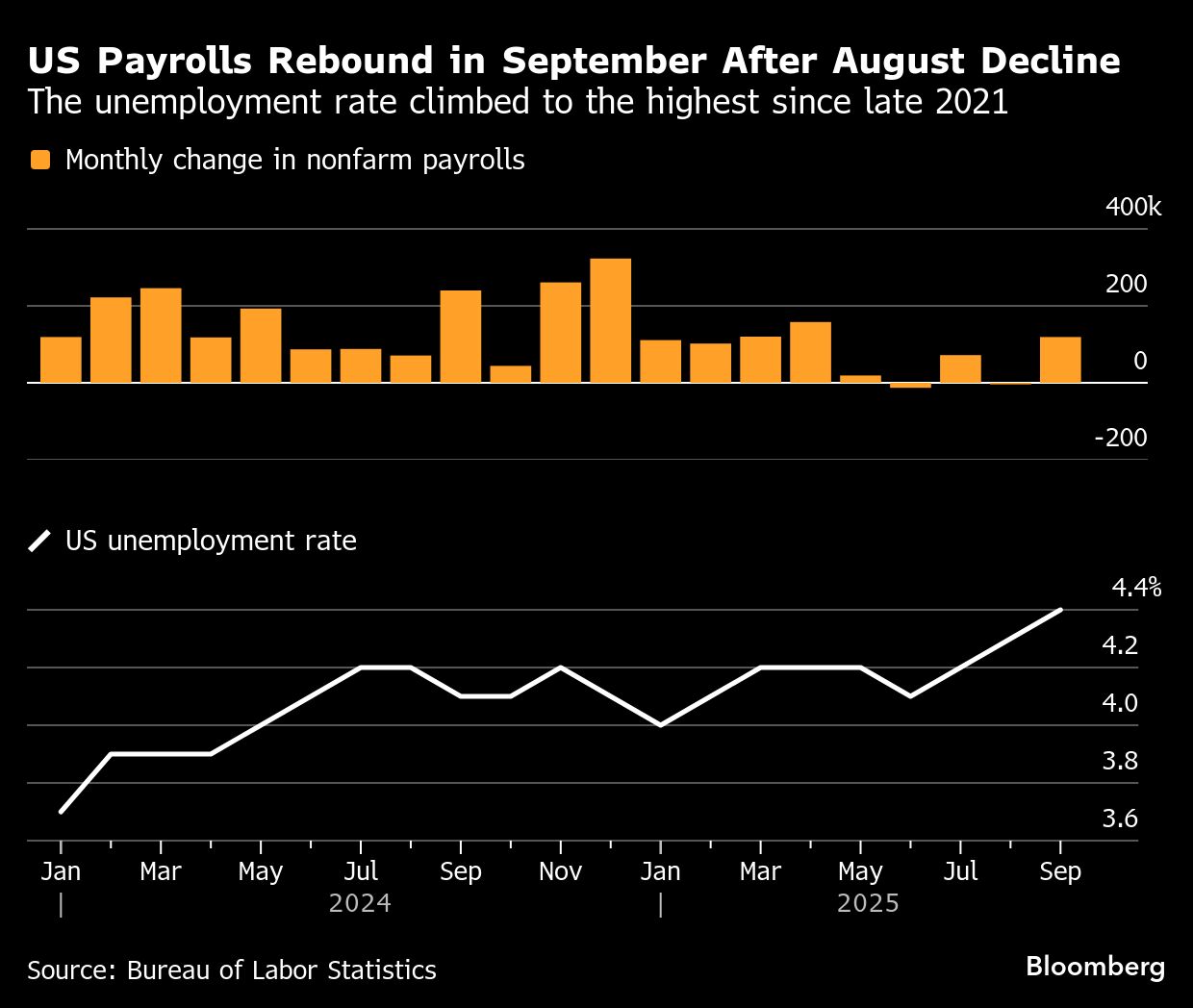
U.S. job growth topped expectations in September, but the unemployment rate continued its march higher, underscoring the lingering fragility of the labor market. The Bureau of Statistics’ (BLS’s) latest jobs report, long delayed due to the government shutdown, showed non-farm payrolls rose 119,000 in the month after declining in August. The unemployment rate, meanwhile, rose to its highest level in nearly four years—reflecting both the positive dynamic of more Americans participating in the workforce and the gloomier reality of more people losing their jobs.
The dated snapshot likely doesn’t change much for Federal Reserve officials, many of whom were already leaning away from cutting interest rates again next month. But it does illuminate the variety of cross-currents at play heading into the final months of the year.
“At first glance, September’s headline payroll gain appears reassuring, but a closer look reveals that job growth remained fragile and narrowly concentrated heading into the longest government shutdown on record,” EY-Parthenon Senior Economist Lydia Boussour said in a note.
Job gains were narrow, fueled primarily by hiring in healthcare and leisure and hospitality. Other sectors, like manufacturing, transportation and warehousing, and business services, shed jobs. For many firms, the low-hire, low-fire environment of earlier this year has given way to a rash of layoff announcements, exacerbating Americans’ concerns about their job security.
| Metric | Actual | Median estimate |
|---|---|---|
| Change in payrolls (month-over-month) | +119,000 | +51,000 |
| Unemployment rate | 4.4% | 4.3% |
| Average hourly earnings (month-over-month) | +0.2% | +0.3% |
Separate data released today showed that applications for U.S. unemployment benefits fell to a three-week low in the period ended November 15, the Labor Department said. Continuing claims, a proxy for those receiving benefits, climbed in the prior week to the highest since late 2021. “I expect that’s going to mean October payrolls are a lot weaker,” said Veronica Clark, an economist at Citigroup Inc.
The September jobs report, originally due October 3, was the first major missed data point in the government shutdown. But because BLS had already completed data collection by the time the shutdown began, the report is among the first to be published following the government’s reopening.
The BLS said yesterday that the October jobs report, which was due on November 7, won’t ever be published. Instead, those payrolls figures will be incorporated into the November report, which is due December 16—after the Fed’s next meeting. Key statistics like the unemployment rate, however, won’t be included. The survey of households that informs those figures couldn’t be collected due to the shutdown, and the BLS said it can’t gather the data retroactively.
Given the sharp slowdown in immigration seen this year, the household survey may offer a clearer picture of U.S. labor market dynamics. The labor market participation rate—the share of the population that is either working or looking for work—increased to a four-month high in September. The rate for workers age 25 to 54, also known as prime-age workers, held at a one-year high. Meanwhile, the number of people working part-time for economic reasons declined by the most in a year, while the share of long-term unemployed fell. Private payrolls increased in September by the most in five months. Even so, permanent job losers rose to the highest since late 2021.
.What Bloomberg Economists Say...“Outdated as it is, September’s strong non-farm payrolls report didn’t add to the case for a rate cut at the FOMC [Federal Open Market Committee] meeting December 9 and 10. The increase in the unemployment rate may raise some eyebrows, but it was due more to increased participation than to weak job creation.”— Anna Wong, Chris G. Collins & Eliza Winger |
At the same time, the report showed the monthly gain in average hourly earnings was the smallest since June after an upwardly revised August increase. Economists pay close attention to this metric as a driver of household spending, which has become even more bifurcated, with the wealthiest Americans propelling nearly half of total spending.
Looking ahead, while the October payroll figures will be published, they won’t necessarily offer a clear picture either. Economists expect a sharp decline in government employment as the federal workers who took the administration’s deferred resignation offers formally roll off payrolls.
————————————————————
Copyright 2025 Bloomberg. All rights reserved. This material may not be published, broadcast, rewritten, or redistributed.
© Arc, All Rights Reserved. Request academic re-use from www.copyright.com. All other uses, submit a request to TMSalesOperations@arc-network.com. For more information visit Asset & Logo Licensing.