 Chris Seofield, right, pours melted aluminum in the foundry at the Super Vac Manufacturing facility in Fort Collins, Colorado, on March 21, 2017. Photographer: Matthew Staver/Bloomberg.
U.S. wholesale prices rose by more than forecast in December, suggesting companies are increasingly passing on tariff costs—at the risk of keeping inflationary pressures elevated. The producer price index (PPI) rose 0.5 percent, the most in three months, while an underlying gauge that strips out food and energy jumped at one of the fastest rates of the year. The Bureau of Labor Statistics (BLS) report out Friday showed that annual price changes also rose firmly, defying economists' expectations for an easing.
Services costs jumped, as a measure of trade profit margins surged from a month earlier by the most since mid-2024. Much of the increase in that category was due to higher machinery and equipment wholesaling margins. Goods prices, however, were unchanged after rising in the prior month, restrained by cheaper energy.
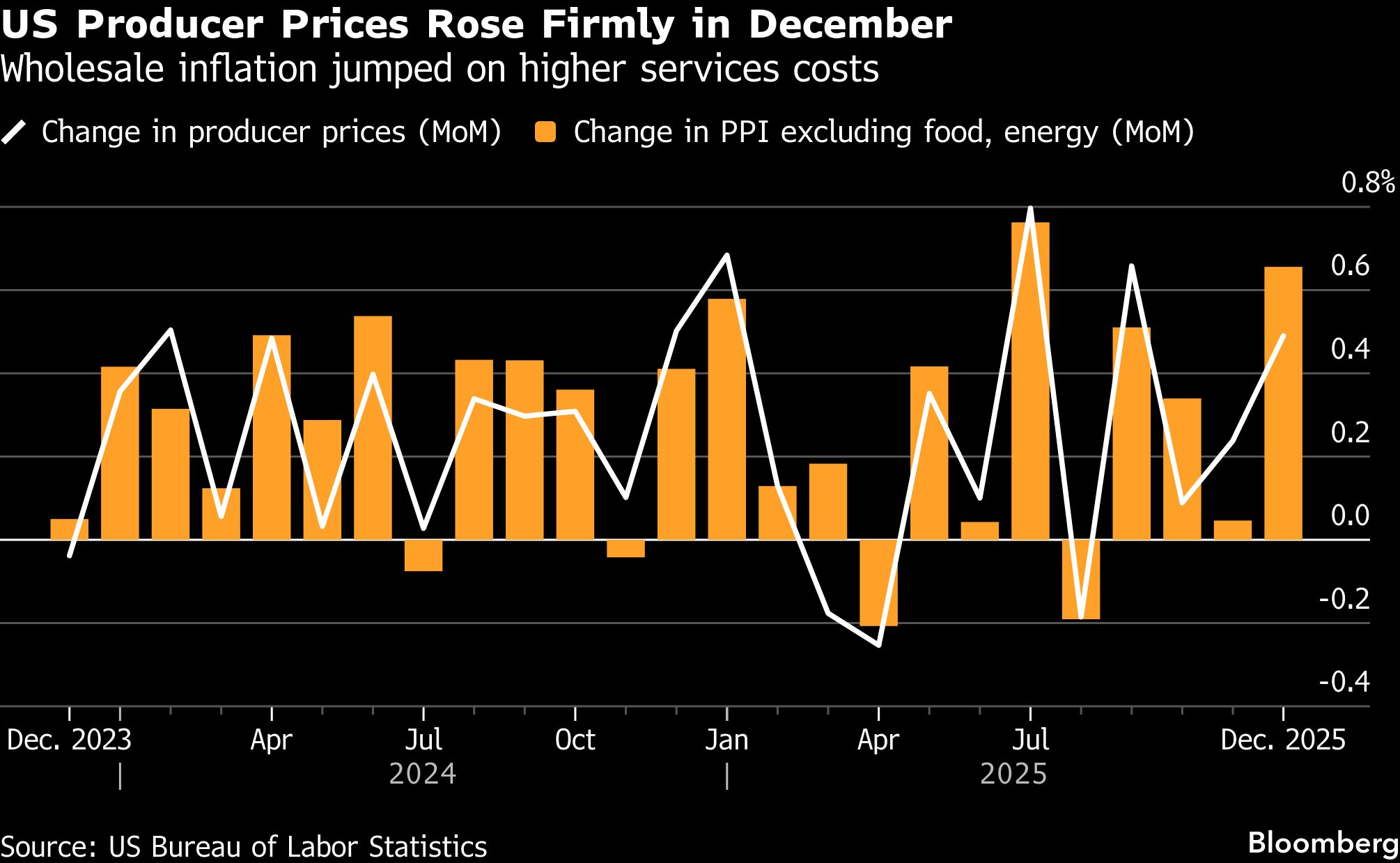
Excluding energy and food, so-called core goods prices accelerated from a month earlier, boosted by household appliances, construction machinery, industrial chemicals, and light trucks.
The producer price data follows figures out earlier this month that showed underlying consumer inflation rose in December by less than projected. The latest PPI suggests some companies are passing along higher duties on imported materials used in the production process.
| Metric | Actual | Estimate |
|---|---|---|
| PPI final demand (month-over-month) | +0.5% | +0.2% |
| PPI excluding food & energy (month-over-month) | +0.7% | +0.2% |
| PPI final demand (year-over-year) | +3.0% | +2.8% |
| PPI excluding food & energy (year-over-year) | +3.3% | +2.9% |
Economists and investors closely track the PPI because several of its components feed into the Federal Reserve's preferred inflation gauge, the personal consumption expenditures (PCE) price index. Among those categories, costs of portfolio management and domestic airfares rose firmly in December. Healthcare services prices were generally tame.
The Bureau of Economic Analysis (BEA) is scheduled to release December PCE price data, along with income and spending figures, on February 20.
After delivering three rate cuts at the end of 2025, the Fed paused on Wednesday, with Chair Jerome Powell noting at a post-meeting news conference that economic activity was solid and the labor market was showing signs of steadying.
A less-volatile PPI measure that excludes food, energy, and trade services also exceeded forecasts, rising 0.4 percent last month.
Costs of processed goods for intermediate demand, which reflect prices earlier in the production pipeline, fell 0.1 percent—the second drop in three months—on declines in food and energy. Excluding those categories, however, those costs climbed by the most since March.
—————————————————————
Copyright 2026 Bloomberg. All rights reserved. This material may not be published, broadcast, rewritten, or redistributed.
© Arc, All Rights Reserved. Request academic re-use from www.copyright.com. All other uses, submit a request to TMSalesOperations@arc-network.com. For more information visit Asset & Logo Licensing.