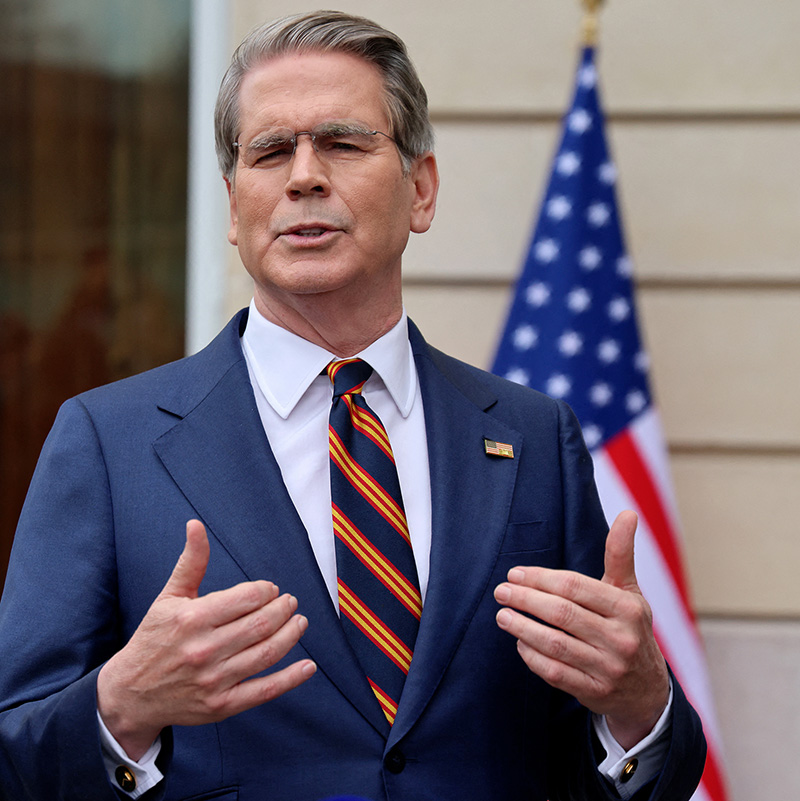
 Scott Bessent. Photographer: Ludovic Marin/Getty Images.
Treasury Secretary Scott Bessent regularly says his motivation to get "out from behind my desk" and enter public service was concern about the growing U.S. debt. Developments over the past several weeks have left those alarms ringing louder than ever before.
First came the Supreme Court's ruling against President Donald Trump's sweeping tariffs—a significant source of revenue for the federal government. While the administration aims to rebuild its trade regime via other laws, economists caution that the new levies wouldn't bring in as much money. As it was, the duties had already peaked in October.
Then Trump's war on Iran drove up the government's spending needs and clouded the outlook for growth, raising risks for federal revenue flows. The Pentagon has already asked for an additional $200 billion to finance the Iran conflict. And the surge in oil prices has added to inflation pressures, curbing expectations for the Federal Reserve interest rate cuts that would otherwise have helped shrink one of the deficit's key drivers.
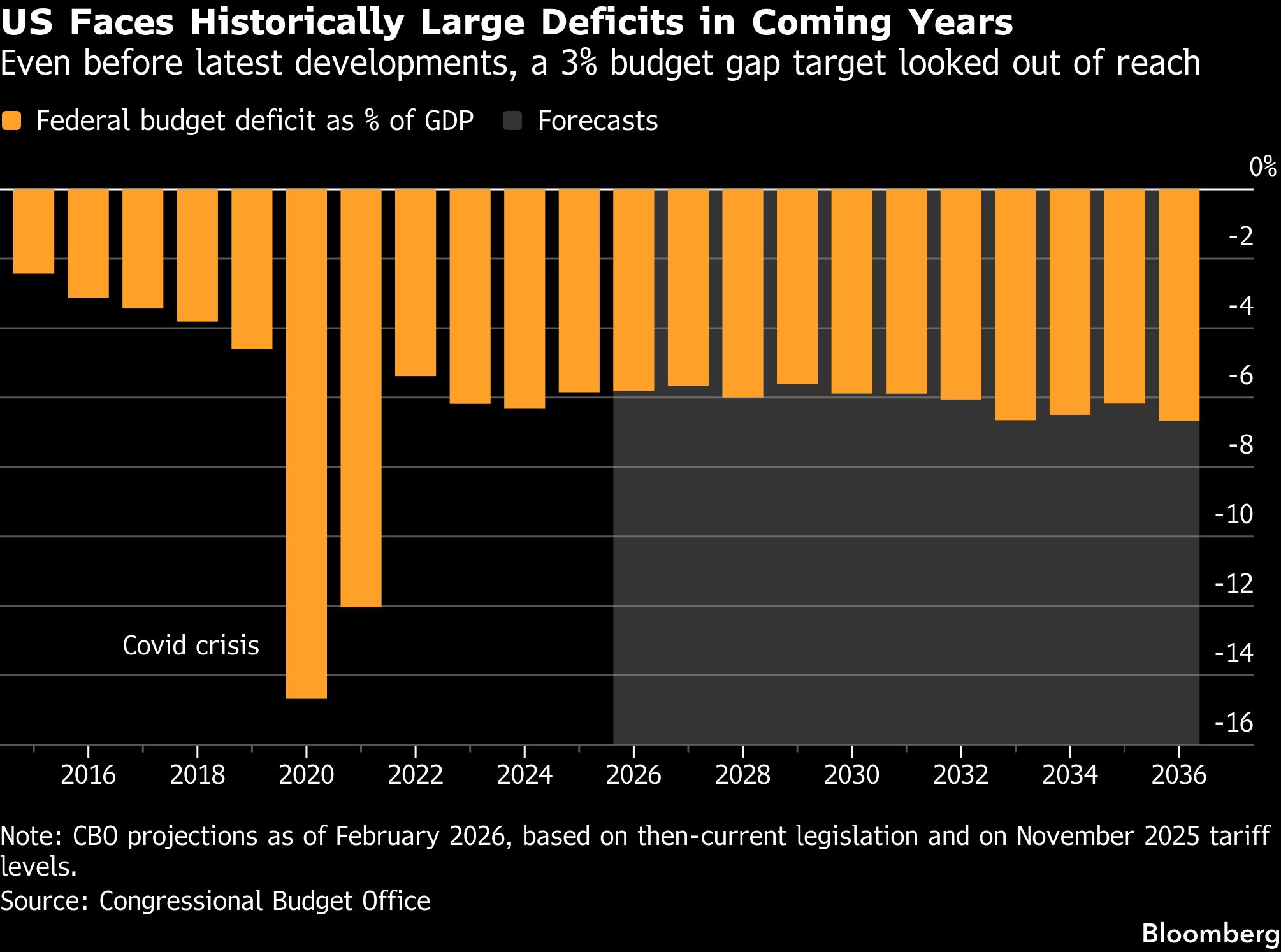
It all means Bessent's objective of getting the fiscal deficit-to-GDP ratio below 4 percent—as he says, to "something with a 3 in front of it"—by the time Trump leaves office in January 2029 looks even tougher than it was previously. Before the latest news, the nonpartisan Congressional Budget Office (CBO) was penciling in deficits around 6 percent, on average, for the coming decade.
"The ruling on the tariffs, along with the war, both make a very bad fiscal trajectory even worse," said Maya MacGuineas, who heads the nonprofit, nonpartisan Committee for a Responsible Federal Budget. "The ruling is going to lessen the revenue coming in for the federal government, and it's not at all clear that replacement tariffs will be able to make that up. And clearly, the war is going to lead to significant new costs."
Bessent played down the budget impact of the Iran conflict in an interview with NBC's Meet the Press on Sunday, saying that "we have plenty of money to fund this war," citing the wherewithal from $1 trillion in annual appropriations for the military. In a statement last Thursday on the release of the government's annual financial report, Bessent said, "Through growth, we can over time reduce the federal deficit to 3 percent of GDP." He also said, "This administration inherited an unsustainable fiscal trajectory."
In recent months, the Treasury chief has trumpeted that the deficit fell below 6 percent last year, but that was driven in part by a one-time change in the way federal student loans are accounted for—reducing the calculation for spending. Without that change, JPMorgan Chase & Co. is among those estimating that the gap again surpassed 6 percent in 2025.
By 2036, the CBO expects the deficit to hit 6.7 percent, according to a February projection that preceded the Iran war. That estimate also assumed that tariff rates in effect as of November would be unchanged for the coming decade, but they've already gone down—reducing revenue—due to the Supreme Court ruling. The post-Trump tariff outlook, meantime, is unpredictable.
Challenges for the Trump Budget
"Borrowing trillion after trillion at this rapid pace, with no plan in place, is the definition of unsustainable," said Michael Peterson, CEO of the Peter G. Peterson Foundation, a research group that aims to build support for a sustainable fiscal path. The administration may provide an update of its fiscal plans and expectations in an annual budget proposal that's typically released in the spring.
Over time, any impact from the Iran war and the Supreme Court tariff ruling is likely to be dwarfed by other long-running deficit drivers, such as automatic spending on entitlement programs, said Jessica Riedl, a fiscal expert at the the Brookings Institution. "In the context of the current $1.8 trillion budget deficit, the war in Iran has not yet been a budget buster," she said.
The U.S. fiscal position deteriorated dramatically in the wake of Covid and the upsurge in inflation that followed it. Large-scale spending to sustain the pandemic-hit economy added trillions of dollars in debt, and the higher interest rates needed to contain the jump in consumer prices then jacked up the cost of servicing that debt.
That double whammy came on top of the powerful underlying pressure of the rising number of retired Americans, which is steadily boosting outlays for Social Security and Medicare. In the two years before Trump returned to the White House, the deficit exceeded 6 percent of GDP—unprecedented in the modern era at a time of low unemployment and solid economic growth.
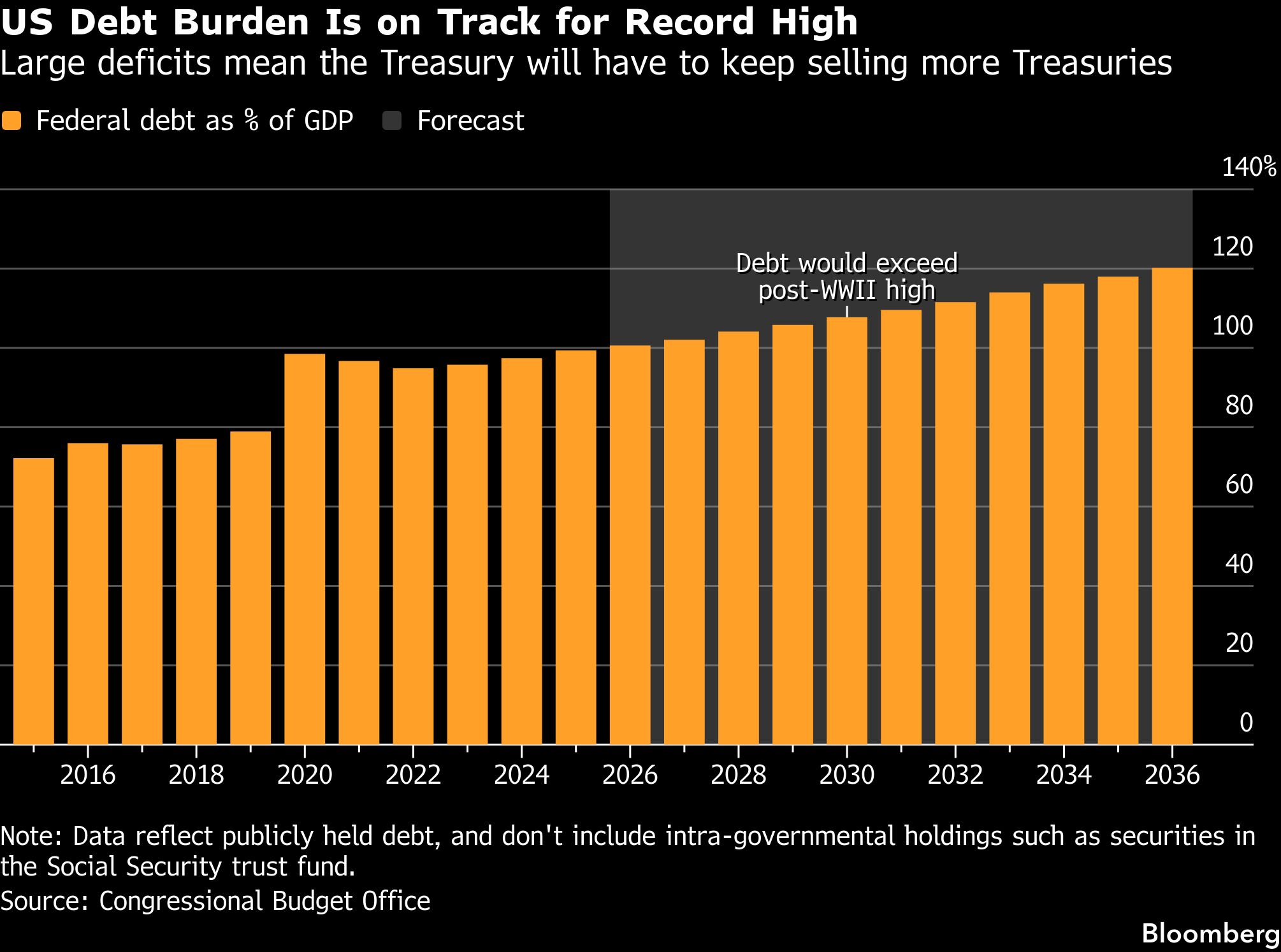
Large deficits mean the debt burden keeps rising. It's now about equal to U.S. gross domestic product (GDP). While there are no signs of a buyer's strike against Treasuries, market participants warn that at some point investors may demand higher yields to keep absorbing federal securities. Benchmark 10-year yields were, as of Monday, up roughly 40 basis points (bps) since the Iran war began.
Bessent, a former hedge-fund manager, told lawmakers last year that "when and if the markets were to rebel against" the supply of Treasuries "is very difficult to know."
Last month, the CBO predicted that total debt held by the public would reach $32 trillion this year, up from roughly $29 trillion at the start of the Trump administration. Net interest payments are on track to exceed $1 trillion for fiscal 2026, which is more than half the estimated overall budget gap.
The lack of political will to address Social Security and Medicare cash shortfalls—on track to hit $2.5 trillion annually within a decade—is front and center to the fiscal challenge over the longer haul, Riedl said. "Neither party has a serious plan to stop the flood of red ink."
————————————————————
Copyright 2026 Bloomberg. All rights reserved. This material may not be published, broadcast, rewritten, or redistributed.
© Arc, All Rights Reserved. Request academic re-use from www.copyright.com. All other uses, submit a request to TMSalesOperations@arc-network.com. For more information visit Asset & Logo Licensing.