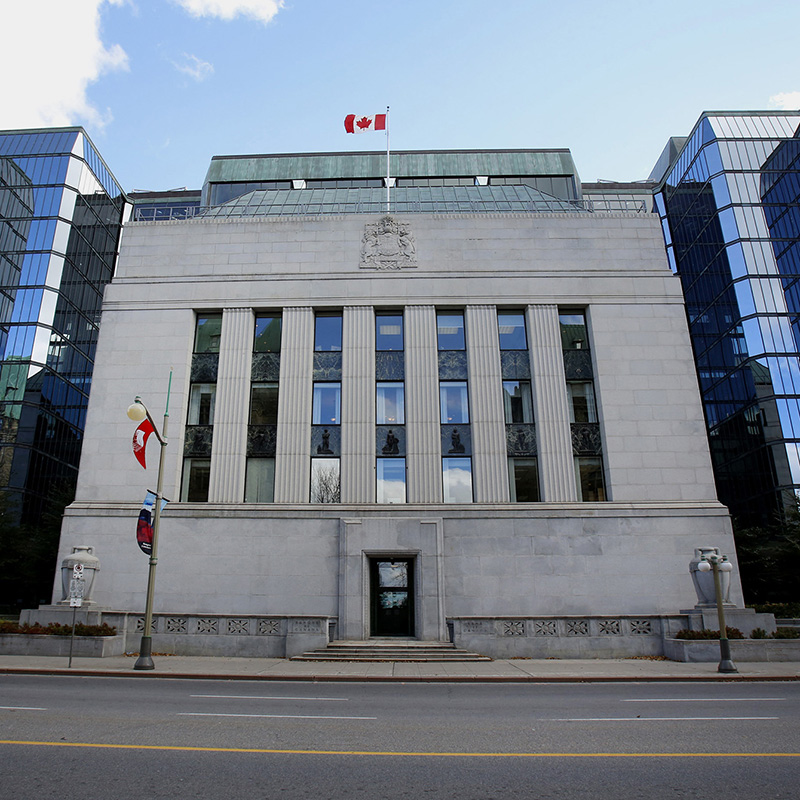
 The Bank of Canada in Ottawa.
The Bank of Canada's second-in-command reiterated that policymakers see higher oil prices boosting inflation in the coming months, and said the central bank is reviewing how it communicates core measures of price pressures to the public.
Senior Deputy Governor Carolyn Rogers said the war in Iran and subsequent oil shock will "push inflation higher in the near term," but repeated that the central bank needs to "guard against" higher petroleum costs spreading to other goods and services and becoming "ongoing, persistent inflation."
"We will be monitoring the unfolding conflict in the Middle East closely, assessing its effect on growth and inflation," she said in prepared remarks in Brandon, Manitoba, today. "As the outlook evolves, we stand ready to respond as needed."
At the same time, she reiterated that officials think it's too early to assess the impact of higher oil prices on Canada's growth, saying that while the increase could eventually boost income from energy exports, consumers and businesses will be squeezed. She also addressed the tightening of financial conditions amid the conflict, saying that, coupled with rising uncertainty, the effect will weigh on firms and Canadians.
Combined, her comments suggest the central bank is comfortable holding borrowing costs steady until it has a better understanding as to the duration and severity of the oil price spike. Last week, the bank held the policy rate at 2.25 percent and said it would look through the near-term increase in petroleum costs.
In today's wide-ranging speech centered on the bank's monetary policy framework review, Rogers also discussed the communications challenge the Bank of Canada faces when headline inflation and core metrics diverge. Last year, officials shifted focus from the bank's so-called preferred measures of core inflation—which were running hotter—to a broader concept of "underlying inflation," which officials said was running at about a 2.5 percent annual pace. Rogers acknowledged that may have led to misunderstanding among the public and markets.
"What we intended as more transparency added complexity that sometimes led to confusion or even a sense that we were moving the goalposts," she said.
Rogers added that the bank is taking a hard look at the effects of monetary policy on housing demand and supply, and on how imbalances in the market affect inflation. Interest rates are not the ideal tool to address housing affordability, as monetary policy is designed to control economy-wide inflation, she noted. But the bank could do more to explain the interaction of monetary policy and housing imbalances. "We are also taking a close look at how shelter inflation is measured in Canada. Different countries approach this differently," Rogers said, adding every methodology has pros and cons.
Rogers said policymakers are "improving our ability to detect and assess supply shocks," including by incorporating more real-time data and increasing outreach to businesses. She also pointed to the bank's use of so-called scenario analysis instead of central baseline forecasts during big shocks, as was done during the initial U.S. tariff announcements.
The Bank of Canada next sets rates on April 29.
————————————————————
Copyright 2026 Bloomberg. All rights reserved. This material may not be published, broadcast, rewritten, or redistributed.
© Arc, All Rights Reserved. Request academic re-use from www.copyright.com. All other uses, submit a request to TMSalesOperations@arc-network.com. For more information visit Asset & Logo Licensing.