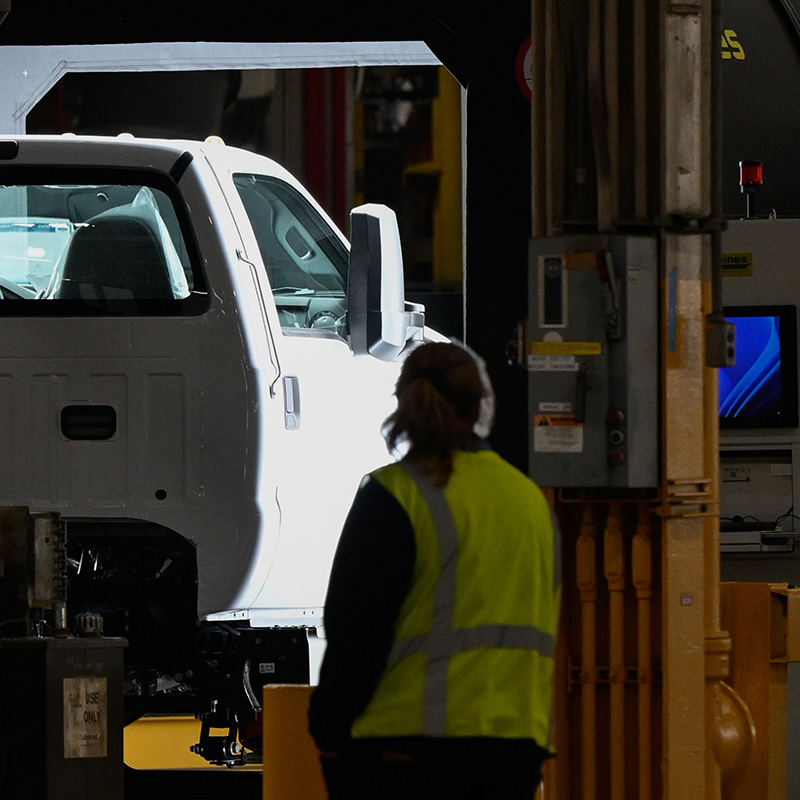
 A commercial truck goes through error inspection prior to the final stages of the assembly process at Ford's Ohio Assembly Plant in Sheffield Lake, Ohio, on January 16, 2026.
U.S. manufacturing activity expanded in March by the most since 2022, while input prices continued to surge amid the war with Iran.
The Institute for Supply Management's (ISM's) gauge of prices paid for manufacturing inputs climbed another 7.8 points, to 78.3, remaining at its highest level since mid-2022. Over the past two months, the index has advanced 19.3 points, the most in nearly a decade.
The Strait of Hormuz is effectively closed due to the war with Iran, preventing the transportation of oil and other products critical to manufacturing. That's fueled a surge in oil prices.
Still, ISM's measure of factory activity edged up to 52.7, boosted by firmer production growth and flattered by an increase in a gauge of supplier deliveries. The pickup in prices paid and longer lead times likely reflects the impact of trade disruptions related to the conflict.

"In March, 64 percent of comments overall were negative," Susan Spence, chair of the ISM Manufacturing Business Survey Committee, said in a statement. "Among the negative comments, about 20 percent cited tariffs and about 40 percent the war in the Middle East."
Thirteen manufacturing industries reported growth last month, including primary metals and transportation equipment, while three noted contraction.
The supplier deliveries index rose to the highest since May 2022. Beyond energy, the Strait of Hormuz is a choke point for products including aluminum, fertilizer, and even helium, which is used in the production of semiconductors.
"Even if the conflict does reach some form of resolution in the coming days, strong price pressures will drag on, given displacement in global shipping networks and damage to energy infrastructure," Bradley Saunders, North America economist at Capital Economics, said in a note.
Higher input costs may put pressure on U.S. manufacturers to raise prices, suggesting that overall inflation will run hotter through the year. Economists in a recent Bloomberg survey revised their forecasts for inflation upward.
The ISM report also showed new orders and backlogs grew at a solid, yet slower, pace in March.
.Select ISM Industry Comments"This is expected to be a transition year for the U.S. trucking market, with gradual stabilization driven by capacity tightening and replacement demand instead of growth. Demand should stay constrained by weak carrier profitability and high equipment costs, but improve modestly late in the year." — Transportation Equipment "We're seeing steady increases in activity, but geopolitical issues and the Iran war are already waning sentiment." — Fabricated Metals "Customer orders have increased considerably as the construction market remains strong, resulting in higher production volume and increased forecasts to suppliers." — Machinery "Current Middle East unrest is already starting to impact business operations by increasing lead times, costs, container delays, and the like." — Food, Beverage & Tobacco Products "Geopolitical tensions related to the conflict in Iran are contributing to rising manufacturing supply costs, and ongoing tariff uncertainty is negatively impacting purchasing strategies and cost forecasts." — Chemical Products "We anticipate strategic realignment of supply chains as organizations respond to energy market volatility and shifting trade policies. In light of these macroeconomic headwinds, we—like most organizations—are maintaining a cautious posture regarding investment commitments while continuing to monitor market conditions closely." — Chemical Products "Metal commodity prices continue to put pressure on mechanical commodities. Memory price escalation is causing large cost increases that cannot be mitigated in other areas of the product cost." — Computer & Electronic Products "The Middle East war has created domestic and global turmoil for the olefins and polyolefins business. Feedstocks and finished product pricing are accelerating dramatically as Middle Eastern and Asian producers suffer from shipping blockages." — Plastics & Rubber Products |
Meanwhile, the group's factory employment index was little changed. While it remains near the highest level in over a year, the measure signaled that factory headcount continued to shrink in March. The Bureau of Labor Statistics will release the March jobs report tomorrow.
"Folks are just hesitant to hire because of the uncertainly now with the Middle East war on top of tariffs," Spence said on a call with reporters.
————————————————————
Copyright 2026 Bloomberg. All rights reserved. This material may not be published, broadcast, rewritten, or redistributed.
© Arc, All Rights Reserved. Request academic re-use from www.copyright.com. All other uses, submit a request to TMSalesOperations@arc-network.com. For more information visit Asset & Logo Licensing.