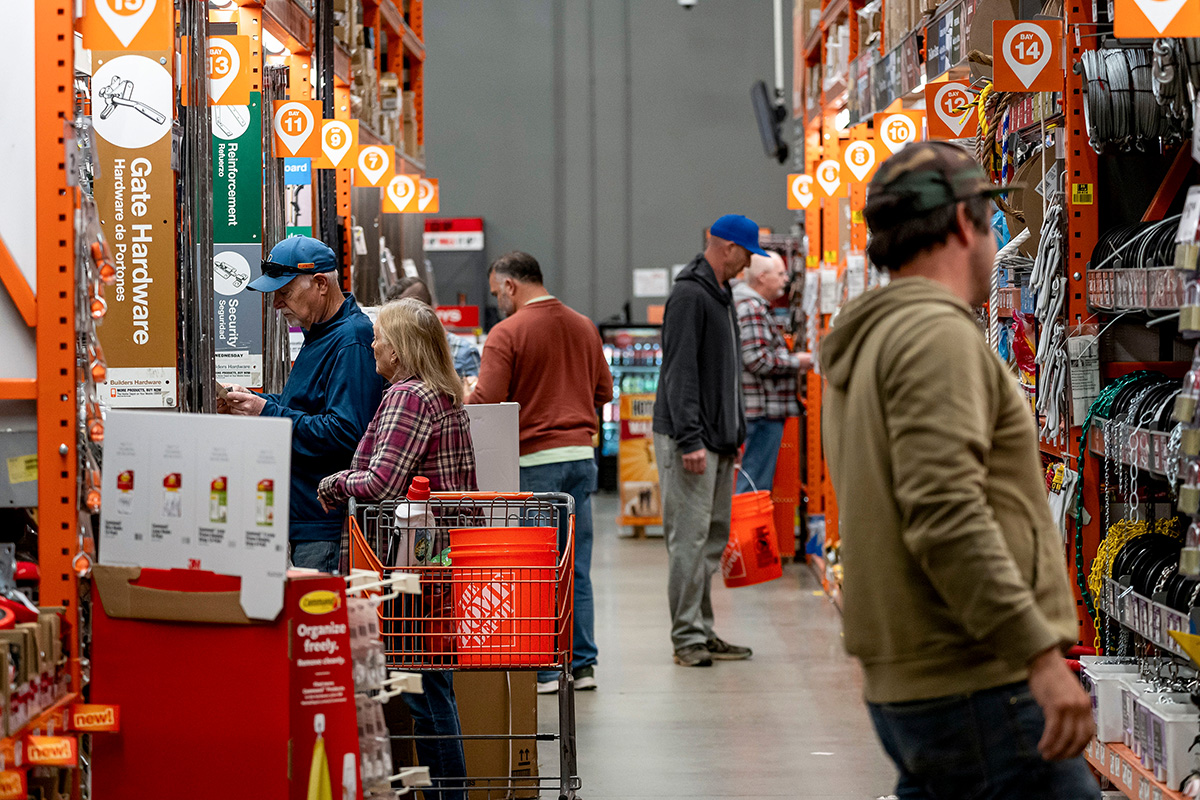
 Shoppers inside a Home Depot store in Roseville, California, on February 24, 2025. Credit: David Paul Morris/Bloomberg.
A growing number of Americans are beginning to expect that prices will stay high or even rise—a bad omen for the Federal Reserve and its years-long fight to stifle inflation.
Consumer inflation expectations have been rising for the past month or two across several reports. Some surveys point to businesses anticipating higher prices as well. If those expectations become reality, it could prove catastrophic for the Fed’s attempt to stabilize prices without causing a recession.
“It’s something that has to concern the Fed, and it should concern the administration too,” said Stephen Stanley, chief U.S. economist at Santander U.S. Capital Markets LLC.
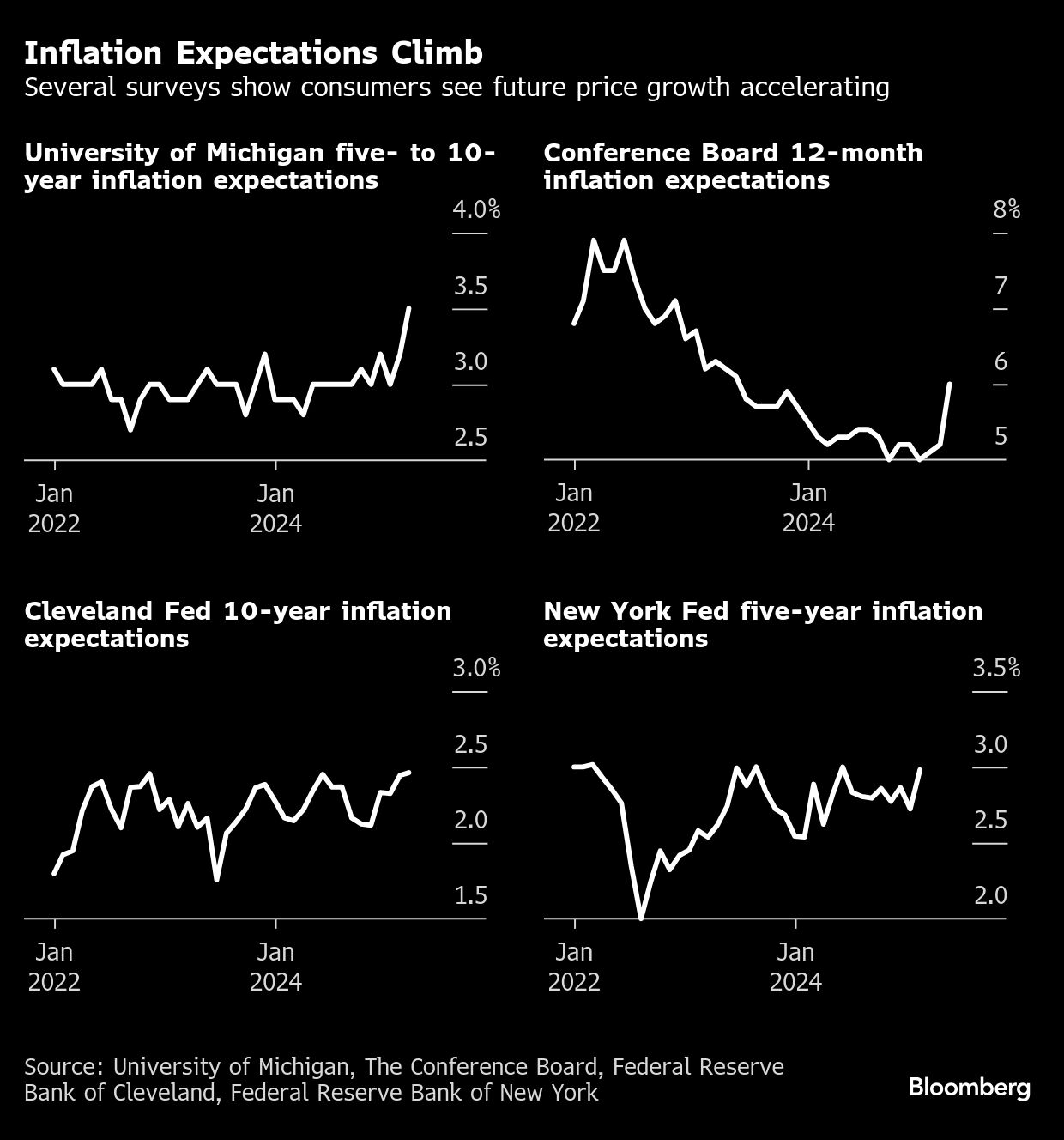
One survey in particular has raised eyebrows. According to the University of Michigan, Americans’ expectations of price growth over the next 5 to 10 years rose to the highest level in nearly three decades. But the alarming statistic came with a surprising political twist that has complicated how policymakers might interpret it.
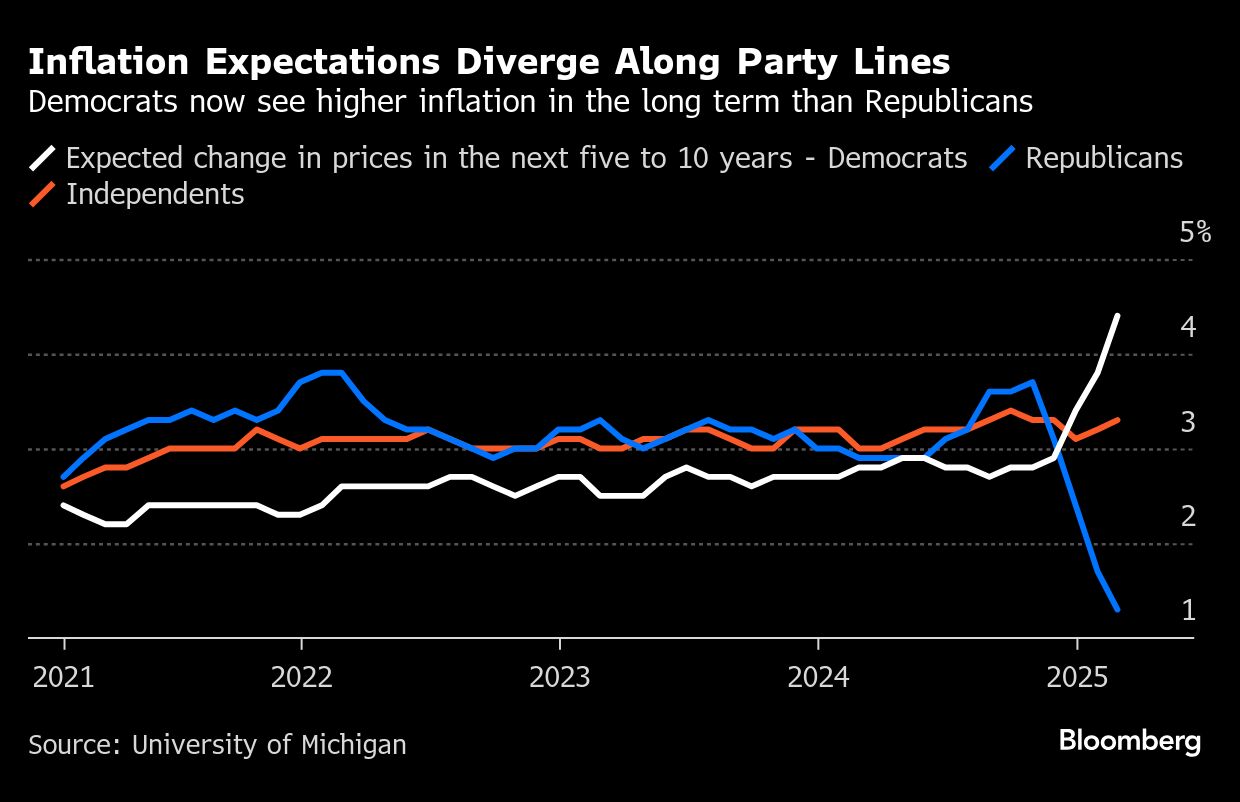
Inflation expectations have long shown a gap between Republicans and Democrats, with slightly lower projections from the side that controls the White House. Economists tend to ignore the gap and focus on the median. But recently, the divergence has become striking, especially in the short term. One-year inflation expectations for Democrats rose to 5.4 percent in February, from 1.6 percent in October. Meanwhile, Republican expectations dropped—from 3.7 percent in October to -0.1 percent in February.
That has some questioning whether the data is so distorted by politics as to be useless. Others say it’s valid as long as the sentiment captured in the survey tells you something about how the respondent behaves as a shopper and a worker.
“Ultimately it doesn’t matter if you think that and you’re a Democrat or a Republican, if it affects how you’re actually consuming or asking for wage increases and things of that nature,” said Omair Sharif, president of Inflation Insights LLC. “It’s still going to potentially affect inflation.”
It’s hard to overemphasize how important inflation expectations are to any central bank’s mission to keep price growth low and stable. The last time price pressures got truly out of control in the United States, in the 1970s and 1980s, they were not vanquished by high interest rates forcing down actual inflation numbers. The threat dissipated only after inflation expectations had been wrestled to the ground following multiple rounds of high rates, an effort that had a devastating impact on the labor market.
This history is top of mind for Kansas City Fed President Jeff Schmid. He warned about the “sharp upward” movement in price expectations in a speech Thursday, noting the data had made him more cautious about the inflation outlook than he was even a month prior. “Certainly, survey measures of inflation expectations are imperfect and subject to noise, but with inflation just recently at a 40-year high, now is not the time to let down our guard,” Schmid said. “I am not willing to take any chances when it comes to maintaining the Fed’s credibility on inflation.”
Other officials agree it’s important to focus on inflation expectations but aren’t yet concerned. “It was a bad month,” Chicago Fed President Austan Goolsbee said in an interview with Bloomberg News on Wednesday, referring to the University of Michigan data. “If we got a lot of months of data like that, and it started reflecting in the market expectations, that would be a bad sign for monetary policy.”
That said, “if expectations did seem to unanchor, on a medium-term basis, that would be something that would be of significant importance,” Richmond Fed President Tom Barkin told reporters in Arlington, Virginia, on Wednesday.
Surveys of consumer expectations can be skewed by many factors—not just politics. The University of Michigan also switched its methodology last year, making historical comparisons a bit less reliable, Sharif said.
The Impact of Tariffs
The Fed has thus far had a relatively easy job in bringing inflation nearly back to its 2 percent target after a pandemic-triggered price surge. That’s partly because expectations have remained largely in check. Inflation has declined by nearly 5 percentage points since mid-2022, all while unemployment has remained historically low. But there’s another reason inflation expectations are crucial just now: tariffs.
In 2018, when Trump was in his first term, Fed staffers advised policymakers they could ignore the inflationary impact of tariffs because it would prove temporary—but only if inflation expectations were firmly anchored. New tariffs, which seem to be playing the biggest role in inflation expectations, are being announced almost every week. Other policies, including deregulation, increased deportations, and broader tax cuts could also help re-accelerate inflation. The increase in expectations also comes alongside rising concerns about the economy’s growth outlook.
But economists stress that because the climb in inflation expectations has just happened in the past month or two, it might still fade after the early shock of Trump’s proposed policies wears off. Furthermore, market-based measures of inflation expectations, which some economists consider more reliable than survey ones, haven’t risen. The spread between yields on ordinary Treasuries and inflation-protected Treasuries, a measure known as “break-evens,” has actually declined slightly this year.
“It’s early days,” said Veronica Clark, an economist at Citigroup Inc. The Fed’s “not going to be reading so much into just a couple months of data, but this is the kind of thing that if you do see it sustained at higher levels—and definitely if it keeps increasing—that’s the kind of worrying inflation for the Fed.”
————————————————————
Copyright 2025 Bloomberg. All rights reserved. This material may not be published, broadcast, rewritten, or redistributed.
© Arc, All Rights Reserved. Request academic re-use from www.copyright.com. All other uses, submit a request to TMSalesOperations@arc-network.com. For more information visit Asset & Logo Licensing.