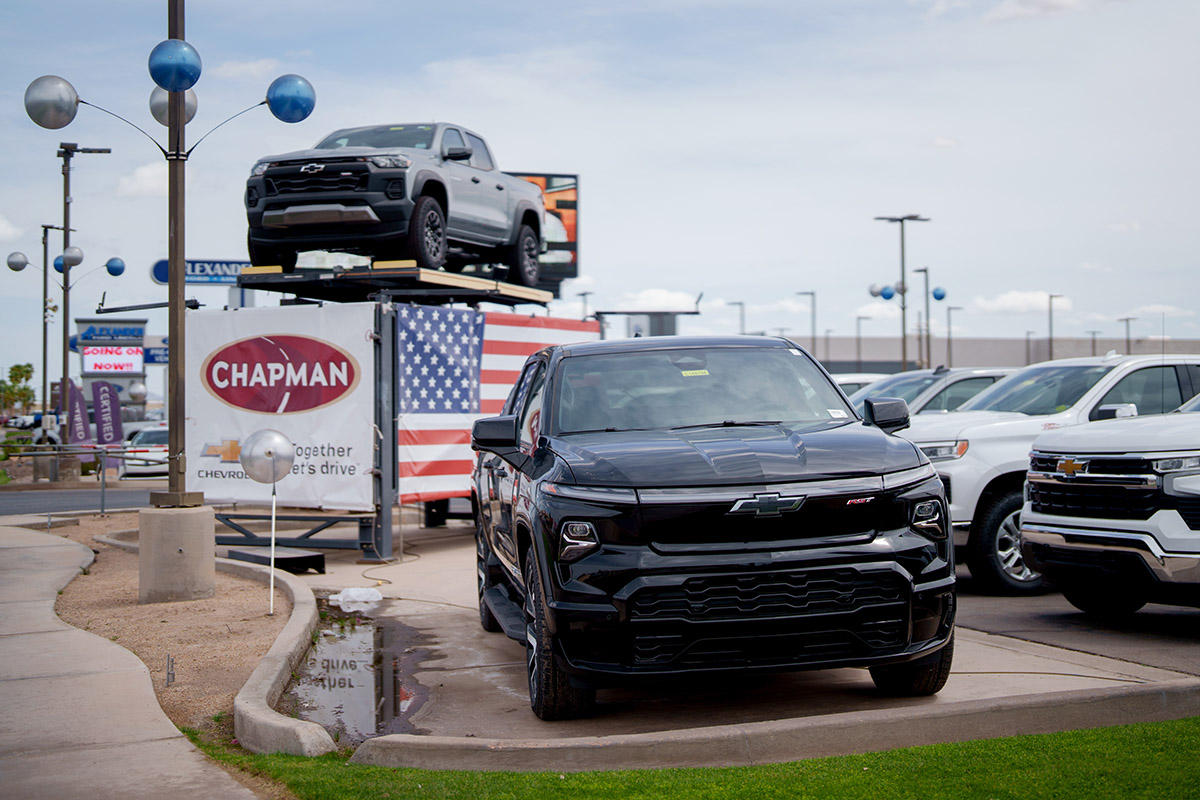
 New vehicles for sale at a GMC Chevrolet dealership in Yuma, Arizona. Photographer: Eric Thayer/Bloomberg.
General Motors Co. said it suffered a $1.1 billion profit hit from President Donald Trump’s tariffs and revealed no plan for a near-term fix to return to pre-tariff profit levels. The Detroit-based automaker announced today that it earned $2.53 per share, on an adjusted basis, in Q2/2025. That is above the Bloomberg consensus forecast of $2.33 but well short of the $3.06 per share that GM made a year ago. GM’s profits also suffered from higher warranty costs and a buildup in inventory of electric vehicles (EVs), which are set to lose federal subsidies under Trump’s recently passed budget bill.
GM’s results showcase the difficulty automakers face in attempting to maintain profitability in an environment that penalizes globally integrated parts supply chains and cross-border vehicle sales. Even though the automaker beat profit expectations, earnings in its all-important U.S. business suffered as a result of import duties on vehicles made in Canada, Mexico, and South Korea.
CEO Mary Barra hinted at the challenges of adjusting to the new reality in a letter to shareholders. “We are positioning the business for a profitable, long-term future as we adapt to new trade and tax policies, and a rapidly evolving tech landscape,” Barra said, noting an announcement in June that GM will shift some production to the U.S. from Mexico—investing $4 billion to add more production to factories in Michigan, Kansas, and Tennessee. Part of that move includes building more small SUVs and large pickups in the United States.
GM hasn’t moved to raise already high sticker prices enough to recoup tariff costs, instead opting to absorb the blow by cutting costs and repatriating some production. The carmaker said it can offset one-third of its $4 billion to $5 billion in tariff exposure later this year as more of its mitigation efforts begin to take hold. But it also indicated that the toll from trade levies might be higher in the current quarter than in the April-to-June period.
Likely as a result of its absorption of some cost increases, GM grew U.S. vehicles sales in the second quarter despite the higher tariffs. It also achieved a second straight quarterly profit in China, which improved by $175 million over a year ago. Still, the company’s net income declined 35 percent, to $1.9 billion compared with $2.9 billion in the second quarter of last year. The company kept its current full-year forecast for earnings before interest and taxes (EBIT) in a range of $10 billion to $12.5 billion. That new 2025 outlook, released in May, is down significantly from the company’s initial projection released in January, which anticipated earnings as high as $15.7 billion this year.

Evercore analyst Chris McNally said in a research note to investors that the unchanged forecast “may be the slight disappointment” to some investors who had hoped for an improvement.
It’s worth noting that some non-tariff costs also hurt GM in the most recent quarter. The company said in April that it would recall nearly 600,000 trucks due to an engine defect, which contributed to $300 million in costs in Q2. GM had also built up EV inventory as it launched new models and worked to spur plug-in sales, but that added $600 million in costs, as those cars lose money. Plus, weaker pricing on fleet sales weighed on profits to the tune of $200 million.
All told, EBIT in GM’s North America business fell $2 billion in the quarter compared with the same period a year ago. Revenue fell 1.8 percent, to $47.1 billion, partly due to weaker pricing.
————————————————————
Copyright 2025 Bloomberg. All rights reserved. This material may not be published, broadcast, rewritten, or redistributed.
© Arc, All Rights Reserved. Request academic re-use from www.copyright.com. All other uses, submit a request to TMSalesOperations@arc-network.com. For more information visit Asset & Logo Licensing.