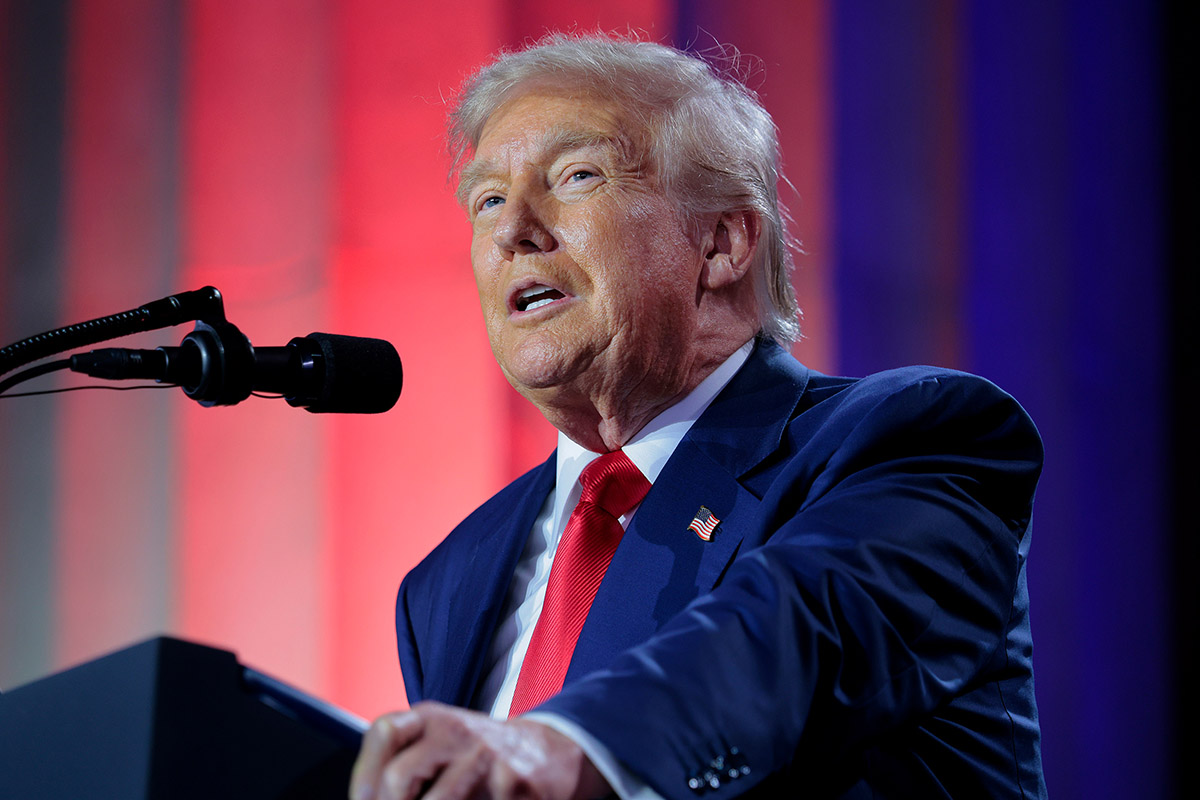
 President Donald Trump speaks during the “Winning the AI Race” summit hosted by All‑In Podcast and Hill & Valley Forum at the Andrew W. Mellon Auditorium in Washington, D.C. Photo by Chip Somodevilla/Getty Images.
U.S. President Donald Trump suggested he will not go below 15 percent as he sets so-called “reciprocal tariff” rates ahead of an August 1 deadline, an indication that the floor for the increase in import taxes is rising. “We’ll have a straight, simple tariff of anywhere between 15 percent and 50 percent,” Trump said yesterday at an artificial intelligence (AI) summit in Washington, D.C. “A couple of—we have 50 because we haven’t been getting along with those countries too well.”
Trump’s comment declaring that the tariffs would begin at 15 percent represents the latest twist in his effort to impose import duties on products coming in from nearly every U.S. trading partner, and it’s the latest indication that Trump is looking to more aggressively impose the levies on imports coming from countries outside the small group that so far has been able to broker trade frameworks with Washington.
Earlier this month, Trump said that more than 150 countries would receive a letter including a tariff rate of “probably 10 or 15 percent, we haven’t decided yet.” Commerce Secretary Howard Lutnick told CBS News on Sunday that small countries including “the Latin American countries, the Caribbean countries, many countries in Africa” would have a baseline tariff of 10 percent. And at the first announcement of the tariffs in April, Trump unveiled a universal tariff of 10 percent on nearly every country. Although Trump and his advisers initially expressed hopes of securing bilateral deals with many different countries, the president has recently been touting the tariff letters themselves as “deals” and suggesting that he is uninterested in back-and-forth negotiations. Still, he has left the door open for countries to make agreements that could lower tariff rates.

On Tuesday, Trump announced he was reducing a threatened 25 percent tariff on Japan to 15 percent in exchange for the country removing restrictions on some U.S. products and offering to back a $550 billion investment fund.
The White House has discussed a similar fund with South Korea, a nation also focused on reaching a 15 percent tariff rate, including on autos, according to people familiar with the matter. And the Philippines is aiming to bring down its own tariff rate to the 15 percent level, from the current 19 percent rate, according to the country’s ambassador to the United States, Jose Manuel Romualdez.
Meantime, officials in Vietnam are weighing the likely cost of their deal. Hanoi estimates that its exports to the U.S. could decline by as much as a third if the higher tariffs announced by Trump take effect, an internal government assessment shows.
Other nations, including India and members of the European Union, are still pushing for an agreements before the heightened tariffs go into effect.
On Wednesday, Trump said he would “have a very, very simple tariff for some of the countries” because there were so many nations that “you can’t negotiate deals with everyone.” He said talks with the European Union were “serious.” He added, “If they agree to open up the union to American businesses, then we will let them pay a lower tariff,” Trump said.
————————————————————
Copyright 2025 Bloomberg. All rights reserved. This material may not be published, broadcast, rewritten, or redistributed.
© Arc, All Rights Reserved. Request academic re-use from www.copyright.com. All other uses, submit a request to TMSalesOperations@arc-network.com. For more information visit Asset & Logo Licensing.