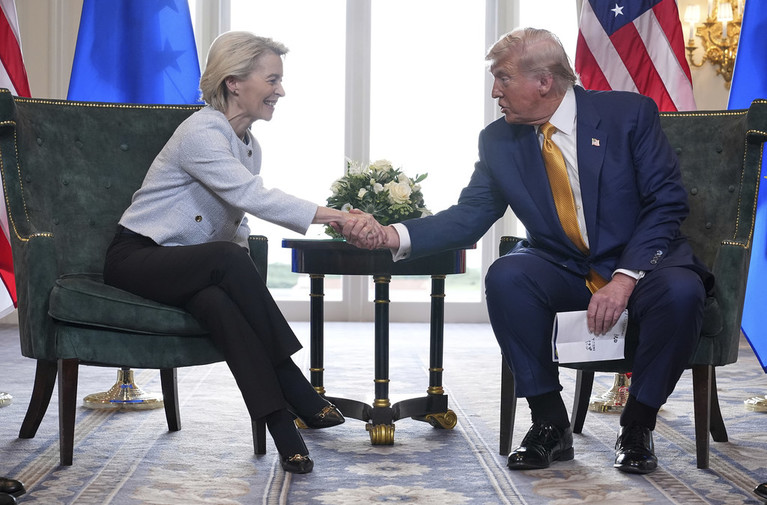
 Trump and European Commission President Ursula von der Leyen reach a trade deal, July 27, 2025. Photo: Jacquelyn Martin/AP
The United States and European Union (EU) agreed on a hard-fought deal that will result in a 15 percent tariff on most of imports from the EU bloc, including automobiles, staving off a trade war that could have delivered a hammer blow to the global economy. The pact was concluded less than a week before this Friday’s deadline for President Donald Trump’s higher tariffs to take effect. It was quickly praised by several European leaders, including German Chancellor Friedrich Merz and Italian Prime Minister Giorgia Meloni, who called it “sustainable.”
Trump and European Commission President Ursula von der Leyen announced the deal Sunday at his golf club in Turnberry, Scotland, although they didn’t disclose the full details of the pact or release any written materials. The 15 percent tax rate will take effect on August 1, according to a U.S. official. “It’s the biggest of all the deals,” Trump said, while von der Leyen added it would bring “stability” and “predictability.”
“The EU played a bad hand about as well as it could have,” said Stephen Olson, a former U.S. trade negotiator now with the ISEAS–Yusof Ishak Institute. “The EU sees value in healthy, robust, and open North Atlantic trade relations; President Trump does not. That simple dynamic put the EU behind the eight ball throughout the negotiations.”
The deal will leave imports to the U.S. from the EU facing much higher tariffs than the bloc will charge for imports from the United States, with von der Leyen saying the aim is to rebalance a trade surplus with the U.S. But those kinds of tradeoffs in the agreement angered some European industry groups, with Germany’s main lobby saying it “sends a fatal signal to the closely intertwined economies on both sides of the Atlantic.”

Von der Leyen and Trump also differed on some of the key terms of the deal they announced. The U.S. president said the tariff level would apply to “automobiles and everything else,” but not pharmaceuticals and metals. The chief of the EU’s executive arm said later at a news conference that the 15 percent rate will be all-inclusive; won’t stack on top of industry-specific tariffs; and will cover drugs, chips, and cars. Metals duties “will be cut and a quota system will be put in place,” she said.
“We have 15 percent for pharmaceuticals. Whatever the decision later on is, of the president of the U.S., how to deal with pharmaceuticals in general globally, that’s on a different sheet of paper,” von der Leyen said, adding that the overall rate “is not to be underestimated, but it was the best we could get.”
Senior U.S. officials later said that the two sides agreed on a 15 percent tariff level for the EU’s pharmaceutical exports. A separate Section 232 probe on pharmaceuticals is still coming over the next three weeks, but the EU tariff level will remain at 15 percent, the officials added.
The EU agreed to purchase $750 billion in American energy products, invest $600 billion in the U.S. on top of existing expenditures, open up countries’ markets to trade with the U.S. at zero tariffs, and purchase “vast amounts” of military equipment, Trump said. Von der Leyen said no decisions have been made on European wine and spirits, but the matter would be sorted out soon.
Ahead of the meeting, the EU was expecting the 15 percent tariff to also apply to most pharmaceuticals. The products had been one of the negotiation’s main sticking points. Key to getting the 15 percent rate to apply to pharmaceuticals and semiconductors was the bloc’s promise to make investments in the United States, according to people familiar with the matter.
Without a deal, Bloomberg Economics estimated that the total U.S. average effective tariff rate would rise to nearly 18 percent on August 1, from 13.5 percent under current policies. The new deal brings that number down to 16 percent.
The deal doesn’t cover the EU’s steel and aluminum exports, which will remain subject to 50 percent tariffs, according to senior U.S. officials. Aerospace tariffs, meanwhile, will remain at 0 percent pending the outcome of a Section 232 probe, the officials added.

Officials had discussed terms for a quota system for steel and aluminum imports, which would mean they would face a lower import tax below a certain threshold and the regular 50 percent rate for imports above that volume. The EU had also been seeking quotas and a cap on future industry-specific tariffs.
For months, Trump has threatened most of the world with high tariffs, with the goal of shrinking U.S. trade deficits. But the prospect of those new import taxes—and Trump’s unpredictable nature—have put world capitals on edge. In May, he threatened to impose a 50 percent import duty on nearly all EU goods, adding pressure that accelerated negotiations, before lowering that rate to 30 percent.
The trans-Atlantic pact removes a major risk for markets and the global economy—a trade war involving $1.7 trillion worth of cross-border commerce—even though it means European shipments to the United States are getting hit with a higher tax at the border. The goals, Trump said, were more production in the U.S. and wider access for American exporters to the European market. Von der Leyen acknowledged part of the drive behind the talks was a reordering of trade, but cast it as beneficial for both sides.
“The starting point was an imbalance,” von der Leyen said. “We wanted to rebalance the trade we made, and we wanted to do it in a way that trade goes on between the two of us across the Atlantic, because the two biggest economies should have a good trade flow.”
The announcement capped off months of often tense shuttle diplomacy between Brussels and Washington, D.C. The two sides appeared close to a deal earlier this month when Trump made his 30 percent threat. The EU had prepared to put levies on about €100 billion ($117 billion)—about a third of American exports to the bloc if a deal wasn’t reached and Trump followed through on his warning.
The EU for weeks indicated a willingness to accept an unbalanced pact involving a reduced rate of around 15 percent, while seeking relief from levies on industries critical to the European economy. The U.S. president has also imposed 25 percent duties on cars and double that rate on steel, aluminum, and copper.
Not all EU members were pleased with the accord reached on Sunday. France’s junior minister for European affairs, Benjamin Haddad, called the agreement “unbalanced” on social media and said the bloc should activate its anti-coercion instrument, which would allow it to retaliate against U.S. technology companies. Dutch Minister for Foreign Trade Hanneke Boerma said the deal was “not ideal” and called on the commission to continue negotiations with the U.S.
What Bloomberg economists say...“Details are still emerging, but our early assessment is the agreement offers Europe limited economic relief. Threats of higher reciprocal tariffs have been dodged, but the overall effective tariff rate on imports from the EU remains broadly unchanged relative to current policy. The deal, meanwhile, does little to ease concerns that the pharmaceutical sector could still be targeted by additional tariffs.”— Simona Delle Chiaie, Antonio Barroso & Rana Sajedi |
Several exporters in Asia—including Indonesia, the Philippines, and Japan—have negotiated reciprocal rates between 15 percent and 20 percent. The EU saw Japan’s deal for a 15 percent tariff on autos as a breakthrough worth seeking as well. Washington’s talks also continue with Switzerland, South Korea, and Taiwan.
Trump said he is “looking at deals with three or four other countries,” but “for the most part” others with smaller economies or less significant trading relationships with the U.S. will receive letters simply setting tariff rates. Trump announced a range of tariffs on almost all U.S. trading partners in April, declaring his intent to revive domestic manufacturing, help pay for a massive tax cut, and address economic imbalances he has said are detrimental to U.S. workers. He put them on pause a week later when investors panicked.
Trump’s decades-old complaints about the global trading system heap particularly sharp scorn on the EU, which he has accused of being formed to “screw” the United States. The bloc was established in the years following World War II in order to establish economic stability on the continent.
The president has lashed out at non-tariff barriers for American companies to do business across the 27-nation bloc. Those include the EU’s value-added tax, levies on digital services, and safety and environmental regulations. Weeks of negotiations tested the EU’s willingness to digest what is seen as an asymmetrical outcome, a senior EU diplomat said, but one that offers an opportunity to continue the talks without escalating further.
————————————————————
Copyright 2025 Bloomberg. All rights reserved. This material may not be published, broadcast, rewritten, or redistributed.
© Arc, All Rights Reserved. Request academic re-use from www.copyright.com. All other uses, submit a request to TMSalesOperations@arc-network.com. For more information visit Asset & Logo Licensing.