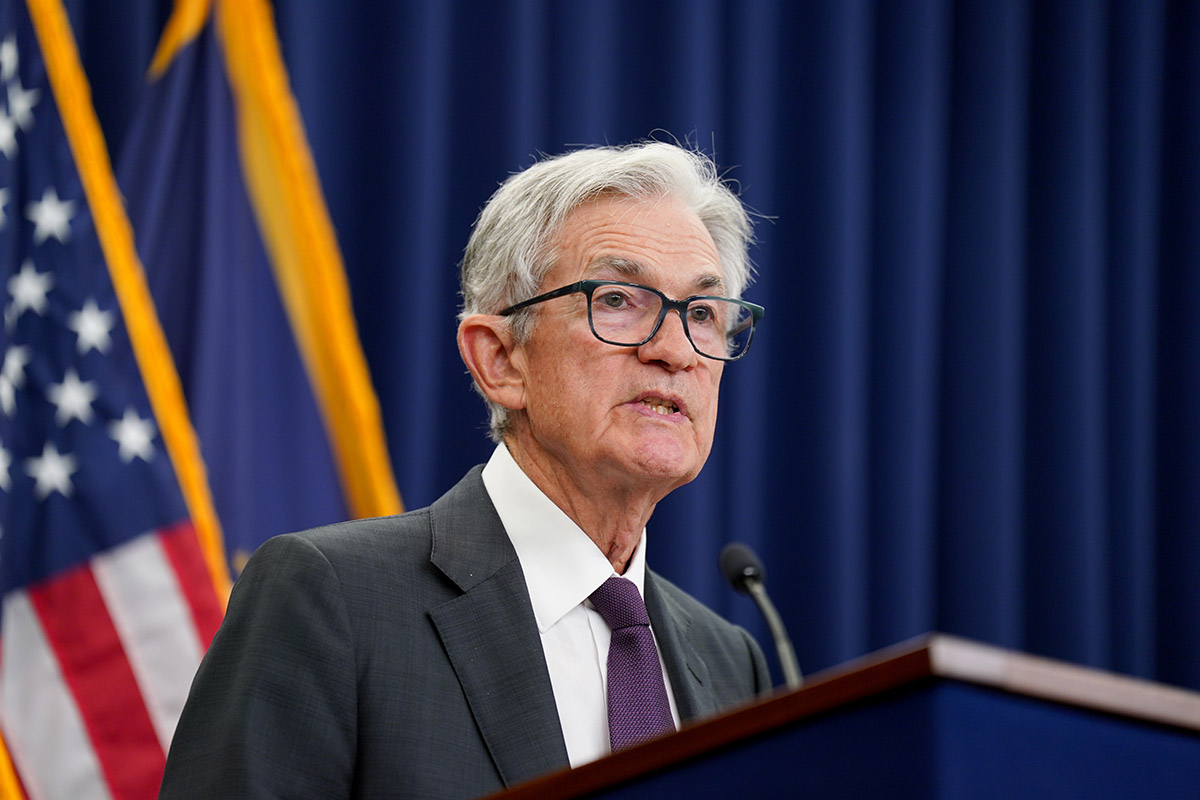
 Jerome Powell, chairman of the U.S. Federal Reserve, during a news conference following a Federal Open Market Committee (FOMC) meeting in Washington, D.C., on July 30, 2025. Photographer: Al Drago/Bloomberg.
Federal Reserve Chair Jerome Powell said interest rates are in the right place to manage continued uncertainty around tariffs and inflation, tempering expectations for a rate cut in September. “There are many, many uncertainties left to resolve,” Powell told reporters yesterday following the central bank’s decision to once again keep rates unchanged. “It doesn’t feel like we are very close to the end of that process.”
The Federal Open Market Committee (FOMC) voted 9–2 to hold its benchmark federal funds rate in a range of 4.25 percent to 4.5 percent, as it has at each of its meetings this year. Governors Christopher Waller and Michelle Bowman voted against the decision in favor of a quarter-point cut.
As Powell spoke, traders pared back their expectations for rate cuts later this year. Interest-rate futures indicated roughly even odds on a reduction at the next meeting in September, down from about 60 percent likelihood earlier in the day. Treasuries extended losses, the dollar surged to its highest since May, and the S&P 500 fell.
In their post-meeting statement, officials downgraded their view of the U.S. economy, saying “recent indicators suggest that growth of economic activity moderated in the first half of the year.” The Fed had previously characterized growth as expanding “at a solid pace.” He said that moderation “largely reflects a slowdown in consumer spending.” But when asked to expand on that, he said it had been long expected and consumers were still in “solid shape.”
He also acknowledged but played down risks to employment, pushing back against concerns raised recently by Waller that the labor market was showing signs of deterioration. “It seems to me, and to almost the whole committee, that the economy is not performing as though a restrictive policy is holding it back inappropriately,” Powell said.

The committee’s decision to hold steady once again defies the intense pressure from President Donald Trump to cut rates. Moments before the decision, Trump predicted the Fed would lower rates in September and criticized the central bank again for not moving more quickly.
Most policymakers have argued the Fed should hold off on rate cuts to gauge the impact of tariffs on inflation. Several have also emphasized that a strong labor market has allowed them to remain patient. In their statement, central bank officials repeated the view that the labor market is “solid” and inflation “remains somewhat elevated.” They dropped the observation in a previous statement that uncertainty over the economic outlook had diminished, while repeating that uncertainty “remains elevated.”
Waller and Bowman’s dissents mark the first time since 1993 that two members of the Board of Governors voted against a committee decision. The FOMC’s voting ranks include seven governors and five of the 12 regional reserve bank presidents.
Tariff Impact
For months Fed officials have been bracing for higher unemployment and inflation as a result of an aggressive set of tariffs from the Trump administration. Data released yesterday showed gross domestic product (GDP) increased an annualized 3 percent in the second quarter after shrinking at a 0.5 percent rate in the previous period. The swing was caused largely by the front-loading of imports in the first quarter as companies moved to get ahead of tariffs. Consumer spending advanced at its slowest pace over consecutive quarters since the onset of the pandemic.
But the levies haven’t yet had a significant impact on inflation and employment data. Inflation came in below estimates for a fifth straight month in June, though prices of some goods directly exposed to tariffs—including toys, apparel, and electronics—jumped. Unemployment ticked lower to 4.1 percent, as the administration’s crackdown on immigration reduced labor supply.
While Waller and Bowman voted against the committee decision yesterday, they may not be too far ahead of several other officials. In June, rate projections showed two policymakers favored three cuts this year, and eight more expected two cuts.
Fed Governor Adriana Kugler didn’t attend the meeting due to a personal matter, according to a central bank spokesperson.
————————————————————
Copyright 2025 Bloomberg. All rights reserved. This material may not be published, broadcast, rewritten, or redistributed.
© Arc, All Rights Reserved. Request academic re-use from www.copyright.com. All other uses, submit a request to TMSalesOperations@arc-network.com. For more information visit Asset & Logo Licensing.