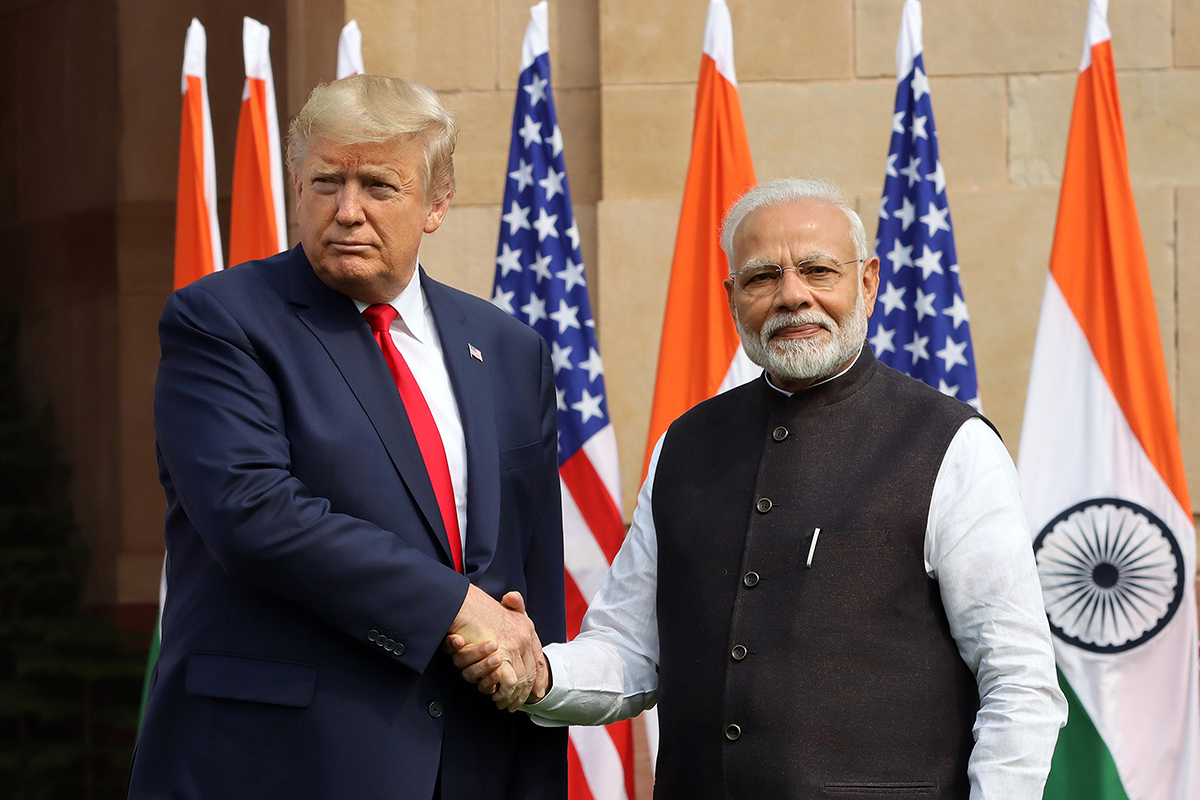
 Donald Trump with Narendra Modi in 2020. Photographer: T. Narayan/Bloomberg.
U.S. President Donald Trump doubled tariffs on Indian goods, to 50 percent, as a penalty for the country’s purchases of Russian oil, escalating a fight with a key Asian partner and sparking outrage in New Delhi.
Yesterday, Trump signed an executive order imposing a 25 percent tariff on Indian imports that will stack on top of the 25 percent import tax he announced last week, the White House said. The higher duty will take effect within 21 days, according to the order, providing some time for negotiation.
Prime Minister Narendra Modi’s government fired back after the announcement, saying India’s purchases of Russian oil are necessary for the nation’s energy security and blasting Trump for singling out India when other countries are also buying Russian oil. The nation’s opposition leader, Rahul Gandhi, also lambasted Trump as a “bully.”
“We reiterate that these actions are unfair, unjustified, and unreasonable,” a spokesperson for India’s Ministry of External Affairs said in a statement. “India will take all actions necessary to protect its national interests.”
Trump has given Russian President Vladimir Putin an August 8 deadline to reach a ceasefire with Ukraine or face sanctions, and has threatened Moscow’s key trading partners like India in a bid to secure leverage. While talks between U.S. and Russian officials on didn’t provide an immediate breakthrough yesterday, Trump said afterward there was a “very good chance” he would meet with Putin and Ukrainian President Volodymyr Zelenskiy soon in another bid to broker peace.
Although a deal is still possible to avoid the higher rate, Trump’s recent barrage against India has quickly damaged ties with a nation that successive administrations have sought to court as a counterweight to China. He’s called India’s economy “dead,” its tariff barriers “obnoxious,” and its people indifferent to the plight of Ukrainians—adding to tensions after Trump angered India earlier this year by claiming to have brokered peace with Pakistan.
If implemented, the higher rates would be a further hit to India’s economy. Bloomberg Economics estimates that a 50 percent tariff may cut U.S.-bound exports by 60 percent, putting 0.9 percent of India’s gross domestic product at risk. It would particularly hit labor-intensive industries such as gems and jewelry, textiles, footwear, carpets, and agricultural goods.
“The move appears less about pressuring Moscow and more about forcing Delhi’s hand in stalled trade talks,” Chetna Kumar and Adam Farrar of Bloomberg Economics said in a report. “Notably, Trump hasn’t imposed similar penalties on other major buyers of Russian crude—including China—or on Russia itself, and has delayed implementation by three weeks, signaling this is leverage, not policy.”

While India is still open to talks, Trump’s tariff threats are eroding goodwill and risk prompting Modi to shift closer to Russia and China. He’s planning to visit China later this month for the first time in more than seven years, Reuters reported yesterday, a trip that had been flagged earlier this year in high-level visits by key cabinet members to Beijing prior to the deterioration in ties with the United States.
Although Modi has refrained from mentioning Trump by name, he has struck a defiant tone in the wake of the tariff threats, warning that the international situation is volatile and urging his citizens to buy local goods. The U.S. president’s move to impose a 50 percent tariff sparked a rare moment of unity across India’s political spectrum. “Trump’s 50 percent tariff is economic blackmail—an attempt to bully India into an unfair trade deal,” Gandhi, leader of the opposition Congress party and Modi’s main rival, said in a post on X. “PM Modi better not let his weakness override the interests of the Indian people.”
Shashi Tharoor, another opposition lawmaker, urged Modi’s government to look at alternative trading partners and said he expects pressure to arise within India to impose reciprocal tariffs on American shipments to the South Asian nation.
Trump’s threat to impose tariffs on the pharmaceutical sector also deal another major blow to India, as that industry ranks among the country’s top three exports to the U.S. The Asian nation exported over $10.5 billion worth of pharmaceuticals in 2024 to 2025, according to Indian Commerce Ministry data. Duties on drugs would leave over 40 percent of India’s exports to the United States adversely affected, adding to existing levies on steel, aluminum, and autos.
Ajay Sahai, director general of the Federation of Indian Export Organisations, said Trump’s moves are a “severe setback” for Indian companies as orders already have been on hold. “This additional blow could force exporters to lose long-standing clients,” he said.
Trump has also turned to tariffs as a tool to try and force the end of Putin’s invasion of Ukraine, now in its fourth year. The president boasted during his 2024 campaign he could end the conflict on his first day in office, but he has increasingly vented frustration as efforts to broker a truce have made little progress. Ukraine’s allies have said energy purchases by India, China, and other nations have propped up Putin’s economy and undercut pressure on Moscow to end the war.
Asked Wednesday about why he’s not putting tariffs on China over its purchases of Russian oil, Trump said it “could happen.” Still, White House adviser Peter Navarro downplayed that possibility in a separate appearance with reporters. “We have over 50 percent tariffs on China,” Navarro said. “We don’t want to get to a point where we hurt ourselves.”
————————————————————
Copyright 2025 Bloomberg. All rights reserved. This material may not be published, broadcast, rewritten, or redistributed.
© Arc, All Rights Reserved. Request academic re-use from www.copyright.com. All other uses, submit a request to TMSalesOperations@arc-network.com. For more information visit Asset & Logo Licensing.