 Shoppers at a shopping center in Walnut Creek, California. Photographer: David Paul Morris/Bloomberg.
Underlying U.S. inflation accelerated in July, but the cost of tariff-exposed goods didn’t rise as much as feared, boosting expectations that Federal Reserve officials will lower interest rates when they meet in September.
The core consumer price index (CPI), which excludes the often volatile food and energy categories, increased 0.3 percent from June, the strongest pace since the start of the year, according to Bureau of Labor Statistics (BLS) data out Tuesday. That was in line with economists’ forecasts, as was the overall CPI on a monthly basis.
“Inflation was broadly in line with expectations, as tariffs continue to be largely absorbed within profit margins,” James Knightley, chief international economist at ING, said in a note. “This gives the Fed the room to respond to the weaker jobs backdrop and cut interest rates from September.”
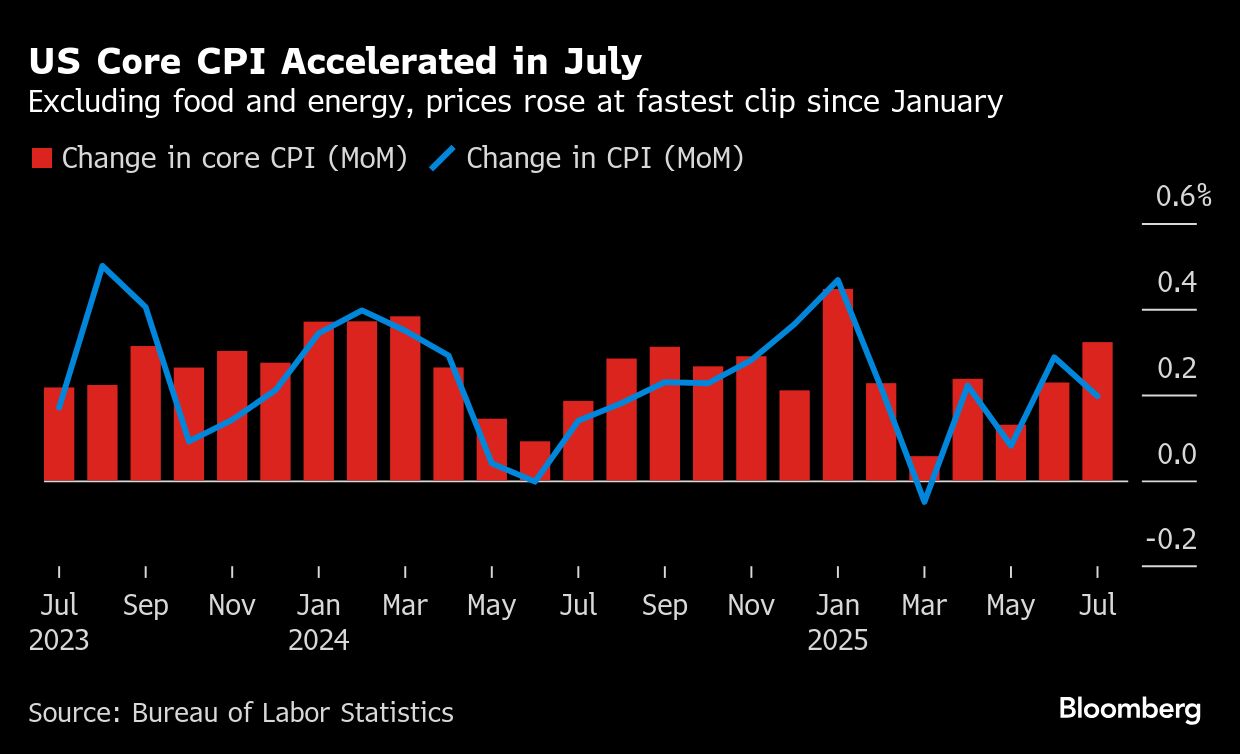
The pickup in the core CPI was fueled by services prices. Excluding energy, they climbed the most since the start of the year. Airfares jumped by the most in three years, while medical care and recreation also advanced.
Goods prices, excluding food and energy commodities, rose at a tame pace. Some categories exposed to tariffs—such as toys, sporting goods, and household furnishings and supplies—continued to increase, albeit at a slower pace than the prior month. Meanwhile, used car prices rebounded from a series of declines.
| Metric | Actual | Estimate |
|---|---|---|
| CPI month-over-month | +0.2% | +0.2% |
| Core CPI month-over-month | +0.3% | +0.3% |
| CPI year-over-year | +2.7% | +2.8% |
| Core CPI year-over-year | +3.1% | +3.0% |
The reacceleration in services prices, after months of more subdued prints, underscores the lingering difficulties in taming inflation. Economists and policymakers have been largely concerned about rising goods prices given President Donald Trump’s sweeping tariffs, but a pickup in consumer demand could fuel services inflation.
The president again called on Fed Chair Jerome Powell to lower borrowing costs after the report. But a sustained rise in services prices would pose an additional challenge to Fed policymakers as they debate whether tariffs will lead to more enduring inflationary pressures. Officials have left rates unchanged this year as they seek more conviction as to how tariffs will impact inflation—defying repeated calls from Trump to cut.
One of the key drivers of inflation in recent years has been housing costs—the largest category within services. Shelter prices rose 0.2 percent for a second month, reflecting steady housing costs and a continued decline in prices of hotel stays.
Another services gauge closely tracked by the Fed, which strips out housing and energy costs, climbed 0.5 percent, one of the strongest paces since early 2024. While central bankers have stressed the importance of looking at such a metric when assessing the overall inflation trajectory, they compute it based on a separate index. That measure—known as the personal consumption expenditures (PCE) price index—doesn’t put as much weight on shelter as the CPI does. A government report on producer prices due tomorrow will offer insights on additional categories that feed directly into the PCE, which is scheduled for release later this month.
What Bloomberg economists say...“Even though levies didn’t account for the hotter print, as Fed officials have worried, we think the firm print, which will translate to an even hotter core PCE inflation reading, leaves a September rate cut far from assured.”— Anna Wong & Chris G. Collins |
After months of chaotic threats and reversals, higher tariff rates for almost all countries began last week. That may keep pressure on inflation readings going forward, even as Trump continues to negotiate with some major trading partners like China.
Some companies have been holding off on price increases for fear that consumers will pull back on spending, which will heighten interest for Friday’s reports on retail sales and consumer sentiment.
“Tariffs have had limited effects on inflation so far,” Bill Adams, chief economist at Comerica Bank, said in a note. “But since tariff rates are up one day, down the next, then up even more the day after, it is too early to say how large their effect on prices will ultimately be.”
Central bankers also pay close attention to wage growth because it can help inform expectations for consumer spending—the main engine of the economy. A report out Tuesday that combines the inflation figures with recent wage data showed that real average hourly earnings climbed 1.2 percent in July from the year before.
The report was issued after Trump named E.J. Antoni, chief economist of the conservative Heritage Foundation, to lead the BLS after firing the former head of the agency earlier this month. Antoni has been vocal about his concerns with BLS jobs data and revisions, and the president has accused the agency, without evidence, of rigging the numbers.
————————————————————
Copyright 2025 Bloomberg. All rights reserved. This material may not be published, broadcast, rewritten, or redistributed.
© Arc, All Rights Reserved. Request academic re-use from www.copyright.com. All other uses, submit a request to TMSalesOperations@arc-network.com. For more information visit Asset & Logo Licensing.