President Donald Trump’s pick to lead the Bureau of Labor Statistics (BLS) caused a stir when it surfaced that he suggested the traditionally nonpartisan agency should suspend the monthly jobs report—something only the president himself could do.
A White House spokesperson suggested Trump has no plan to stop releasing the jobs data that policymakers, financial markets, and businesses rely on each month to make decisions, but that he wants to look at how the data is collected. His nominee for the position, E.J. Antoni, is a critic of the BLS who has called for a “top to bottom” review of the agency.
Past commissioners and high-ranking officials said in interviews that there are changes the next leader can try to push through—such as improving the low response rates to government surveys that has contributed to big data revisions and tweaking the language of press releases published along with the numbers. But if confirmed by the Senate, Antoni may find larger reforms tougher to implement.
“There’s still this bureaucracy within the White House and OMB [Office of Management and Budget] that could frustrate every one of those efforts to make the system better. And it probably would,” said William Beach, a former commissioner appointed by Trump during his first term. “Those things have to be brought into the calculus of how much control the new commissioner would have.”
The system of checks and balances in place at the agency relies in part on a staff of roughly 2,000 career employees and on multiple directives that dictate how the nation’s most prized numbers are handled. Those rules are part of why a commissioner couldn’t suspend the monthly jobs report unless “unforeseen circumstances arise.” An important caveat is that few of the regulations ensuring that statistical agencies provide “objective, accurate, and timely information” are enshrined in law. In addition, an executive order gives Trump more power to hire and fire policymaking employees at will across federal agencies, and could strip career statisticians of civil service protections if applied to BLS.
Trump’s firing of former BLS Commissioner Erika McEntarfer this month after a weak jobs report—that the president said she rigged—has raised alarms about political interference.
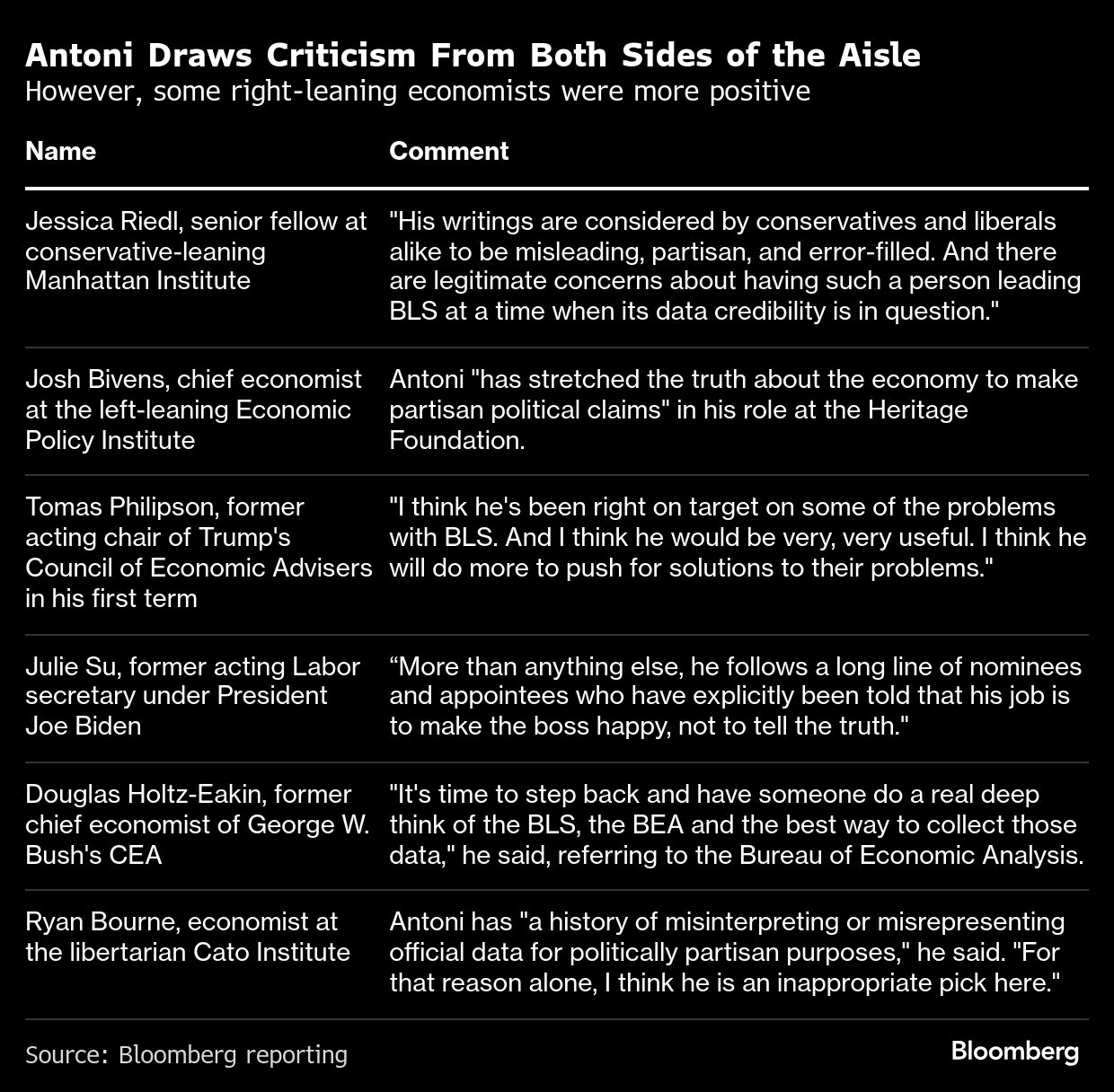
Antoni, Trump’s choice to replace her, is chief economist at the Heritage Foundation and contributed to its Project 2025 conservative policy rubric. The pick drew criticism from right- and left-leaning economists, who said his MAGA Republican views could threaten the longstanding tradition of nonpartisanship at the agency.
“BLS data from this point onward is sketch given the overt politicization of the agency,” Derek Holt, head of capital markets economics at Scotiabank, said in a note Tuesday. Its reports “will have a dark cloud over each of them because of the firing of the former BLS head, her replacement by a politicized Trump acolyte, the fear that likely exists across BLS staff when it comes to giving numbers that Trump may not like, and the possibility of coming methodological changes that will be viewed skeptically.”
Michael Strain, director of economic policy studies at the conservative-leaning American Enterprise Institute, said it’s imperative that, before he’s confirmed, Antoni “demonstrates his commitment to independence of BLS and his commitment to keeping the agency and keeping the data the agency produces free from influence from the White House.”
The experience of past commissioners sheds some light on what changes a new head may be able to undertake. Commissioners are appointed for four years and are the only political appointee at BLS, yet they don’t typically work with the president directly, past officials said. They brief the White House economic team the day before major releases, but they are barely involved in the highly computerized processes of compiling data. They see the numbers only once they’re finalized by statisticians, not long before the president does.
Erica Groshen, who held the role in the Obama administration, said she inserted changes into the monthly employment report, including calling out two-month net revisions in the press release and adding the three-month moving average of job growth to one of the tables. Drawing from her past experience at the Federal Reserve, she knew those details were important to policymakers and said it took a few months to get them through. She also tried to liven up the language of the press release, which was met with resistance from employees who stressed the importance of providing a clear description of the data without judgment.
“I appreciated why this was the case and learned from it. Another commissioner might be insistent,” Groshen said. “In those circumstances, there’d be some negotiation. If the staff felt this was in real violation of the mission of BLS, then the staff would push back.”
Beach, who was commissioner from 2019 to early 2023, recalled getting a lengthy transition document full of rules when Trump appointed him. There were small changes he could make through what’s known as a “commissioner’s order.” He said the next commissioner can try to address the decline in response rates to government surveys by making the forms easier for businesses to fill out. But even that would require involving the White House’s OMB, which coordinates the statistical system, and would probably take months to put in place, he said.
Some economists wonder whether Trump could withhold an employment report should he not like the numbers. That report is considered among the so-called Principal Federal Economic Indicators, which Congress requires, by law, to be published according to a prescribed date on a calendar that statistical agencies submit to the White House a year in advance, past commissioners said.
For now, former officials believe that BLS data is still trustworthy and take comfort in the protections that do exist, no matter how loose they may be. “The thing we want to avoid is the appearance or belief that everything coming out of bureau now is going to be slanted or tainted,” said Michael Horrigan, who spent over a decade at BLS overseeing its employment and inflation programs. “There’s a world in which it’s going to be hard to avoid that, and there’s also a world in which it calms down and goes back to being normal and boring. I’m hoping for the latter.”
————————————————————
Copyright 2025 Bloomberg. All rights reserved. This material may not be published, broadcast, rewritten, or redistributed.
© Arc, All Rights Reserved. Request academic re-use from www.copyright.com. All other uses, submit a request to TMSalesOperations@arc-network.com. For more information visit Asset & Logo Licensing.