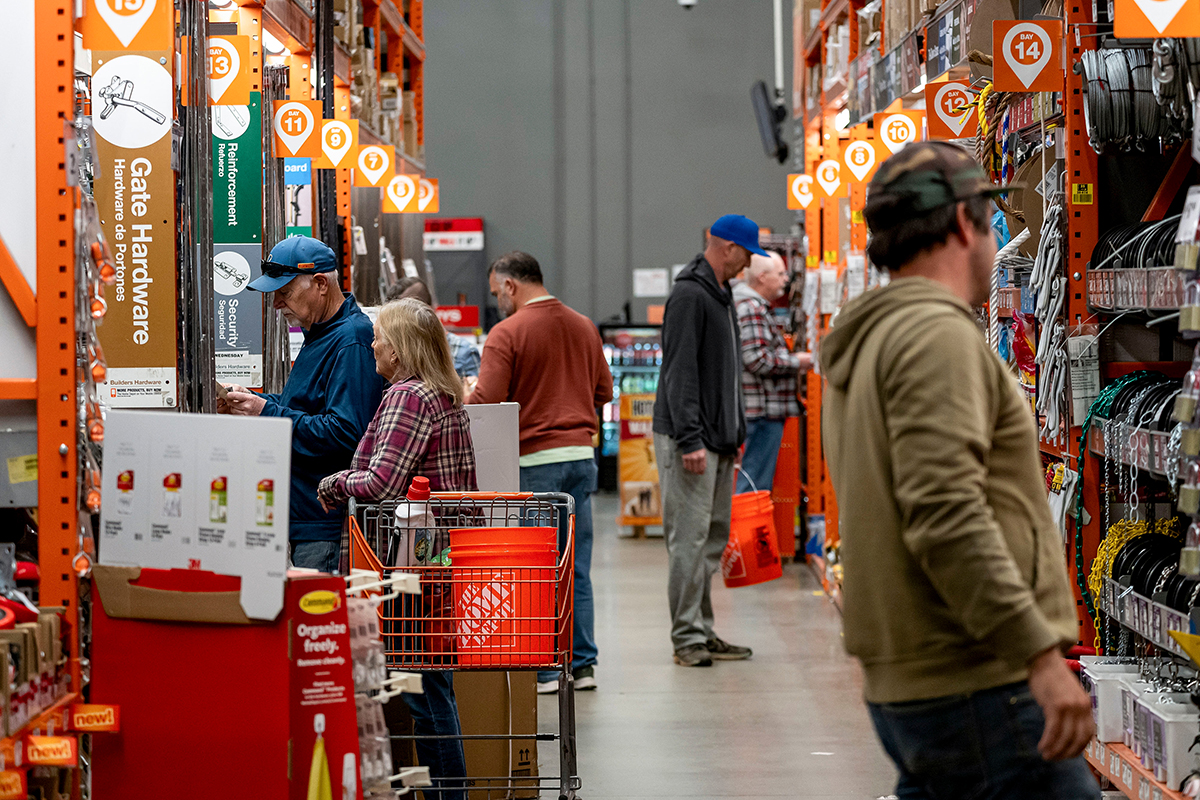
 U.S. Shoppers. Photographer: David Paul Morris/Bloomberg.
The impact of President Donald Trump’s tariffs on consumer prices is just getting started, according to research by Goldman Sachs Group Inc., adding more uncertainty to a Treasuries market that has been gripped by shifting bets on the pace of interest rate cuts. U.S. companies have so far taken the bulk of the hit from Trump’s tariffs, but the burden will increasingly be passed on to consumers as companies hike prices, economists including Jan Hatzius wrote in a note. Consumers in the United States have absorbed an estimated 22 percent of tariff costs through June, but their share will rise to 67 percent if the latest tariffs follow the pattern of levies in previous years, they wrote.
The net result: faster inflation. The core personal consumer expenditure (PCE) index, one of the Federal Reserve’s favorite measures of inflation, will hit 3.2 percent year-on-year in December, according to the analysts. They said underlying inflation net of tariffs would be 2.4 percent. The rate was 2.8 percent in June.
The report adds weight to a widespread view among economists that Trump’s sweeping tariffs will fuel inflation at a time when Fed policy has become a hot topic not just for bond traders but even for the president himself. Trump has broken convention by publicly calling for the Federal Reserve to cut rates, suggesting Fed Chair Jerome Powell should resign and adding an ally—at least temporarily—to the monetary policy committee.

Most economists consider tariffs to be inflationary, since logic suggests companies will pass the additional costs on to their customers. But the view isn’t unanimous—and the debate partly comes down to definitions.
“Inflation, certainly as it’s relevant to a central bank setting monetary policy, concerns an ongoing increase in the overall price level,” said Oren Cass, founder and chief economist at American Compass, in a recent episode of Bloomberg’s Trumponomics podcast. “If you choose a specific policy that, by design, makes a one-time change in the price of certain things, that is not inflation in a sense that you would want a central bank to worry about.”
Goldman’s analysis, which suggests businesses have held back from an all-at-once increase in prices, supports the argument that tariffs will ultimately be inflationary. The bank said tariff effects have boosted core PCE by 0.2 percent so far, with another 0.16 percent expected in July and an additional 0.5 percent over the rest of the year.
While American businesses have taken around 64 percent of the hit from tariffs so far, their share will fall to less than 10 percent as they pass on more of the costs to consumers, according to the report.
The analysts added that the impact on U.S. businesses has been mixed—while some have taken a larger share of the tariff hit, domestic producers shielded from competition have raised prices and benefited. Those opportunistic price increases also push up inflation.
Foreign exporters have absorbed an estimated 14 percent of the cost of tariffs through June, but their share may rise to 25 percent, Goldman said. The impact on foreign exporters can be gauged from a slight decline in import prices on tariffed goods, they said.
————————————————————
Copyright 2025 Bloomberg. All rights reserved. This material may not be published, broadcast, rewritten, or redistributed.
© Arc, All Rights Reserved. Request academic re-use from www.copyright.com. All other uses, submit a request to TMSalesOperations@arc-network.com. For more information visit Asset & Logo Licensing.