 A worker carries a metal door during production at a metal manufacturing facility in Sacramento, California. Photographer: David Paul Morris/Bloomberg.
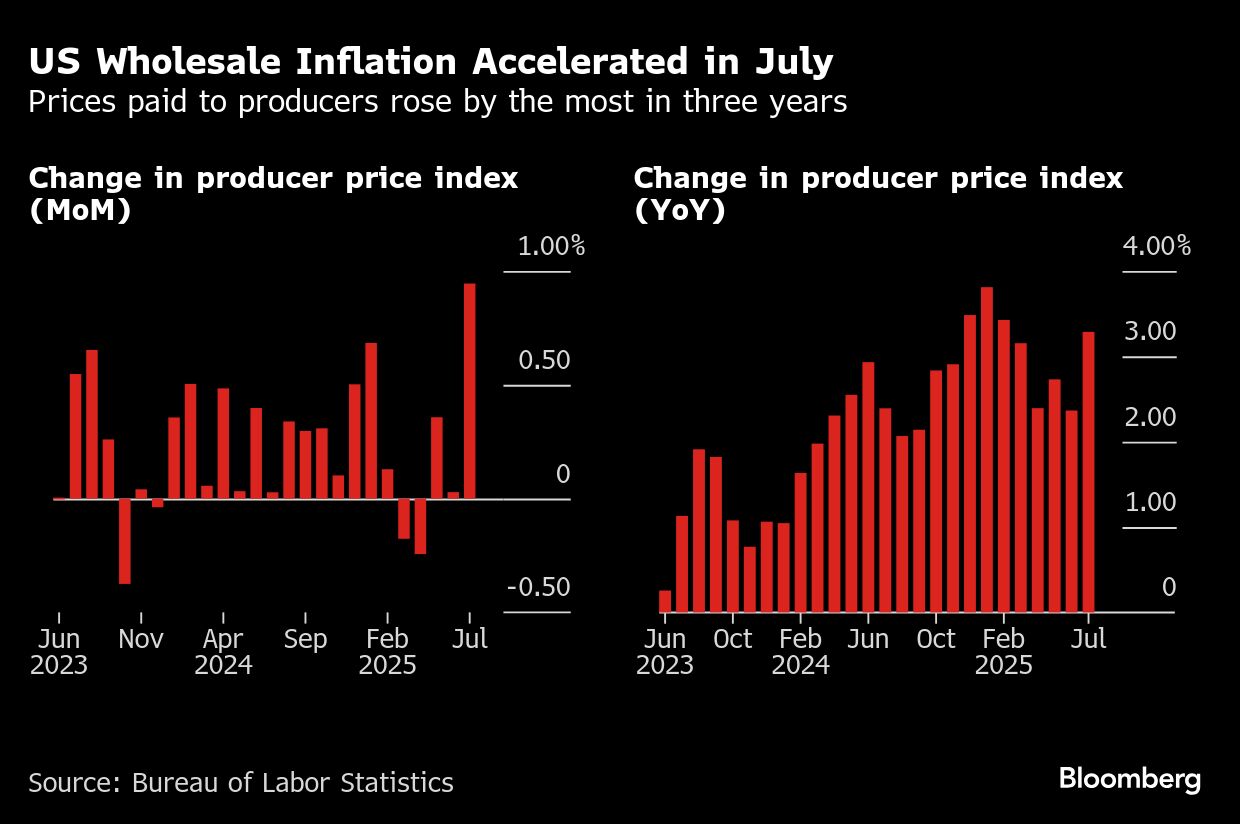
U.S. wholesale inflation accelerated in July by the most in three years, suggesting companies are passing along higher import costs related to tariffs.
The producer price index (PPI) increased 0.9 percent from a month earlier, the largest advance since consumer inflation peaked in June 2022, according to a Bureau of Labor Statistics (BLS) report out Thursday. The PPI rose 3.3 percent from a year ago.
Services costs increased 1.1 percent last month—the most since March 2022. Within services, margins at wholesalers and retailers jumped 2 percent, led by machinery and equipment wholesaling. Goods prices excluding food and energy rose 0.4 percent.
“While businesses have assumed the majority of tariff cost increases so far, margins are being increasingly squeezed by higher costs for imported goods,” Ben Ayers, senior economist at Nationwide, said in a note. “We expect a stronger passthrough of levies into consumer prices in coming months, with inflation likely to climb modestly over the second half of 2025.”
The PPI report indicates companies are adjusting their pricing of goods and services to help offset costs associated with higher U.S. tariffs, despite the softening of demand in the first half of the year. The extent to which companies pass the tariff burden on to consumers will be key in defining the path of interest rates. While Federal Reserve officials generally expect import levies to push inflation higher in the second half of the year, they’re divided over whether it will be a one-time adjustment or more enduring.
With consumer price data earlier this week pointing to a milder passthrough in July, and the labor market now shifting to a lower gear, Fed officials are widely expected to lower borrowing costs when they meet next month. However, the firm wholesale inflation data may give some policymakers pause that price pressures are rearing up again. “The question for policymakers, still to be resolved, is how much of these price increases are absorbed by wholesalers, retailers, and resellers,” Carl Weinberg, chief economist at High Frequency Economics, said in a note. “This report is a strong validation of the Fed’s wait-and-see stance on policy changes.”
Economists pay close attention to the PPI report because some of its components are used to calculate the Fed’s preferred measure of inflation—the personal consumption expenditures (PCE) price index. While healthcare categories came in soft, airline passenger services and portfolio management jumped. The latter was largely expected due to a rising stock market. The BLS data showed food prices accounted for 40 percent of the advance in final goods costs, largely due to vegetables. A less-volatile PPI metric that excludes food, energy, and trade services also rose from a month earlier by the most since 2022.
The PPI report showed the costs of processed goods for intermediate demand, which reflect prices earlier in the production pipeline, jumped 0.8 percent—the most since the start of the year and largely due to diesel fuel.
A separate report showed initial claims for unemployment benefits were little changed last week.
————————————————————
Copyright 2025 Bloomberg. All rights reserved. This material may not be published, broadcast, rewritten, or redistributed.
© Arc, All Rights Reserved. Request academic re-use from www.copyright.com. All other uses, submit a request to TMSalesOperations@arc-network.com. For more information visit Asset & Logo Licensing.