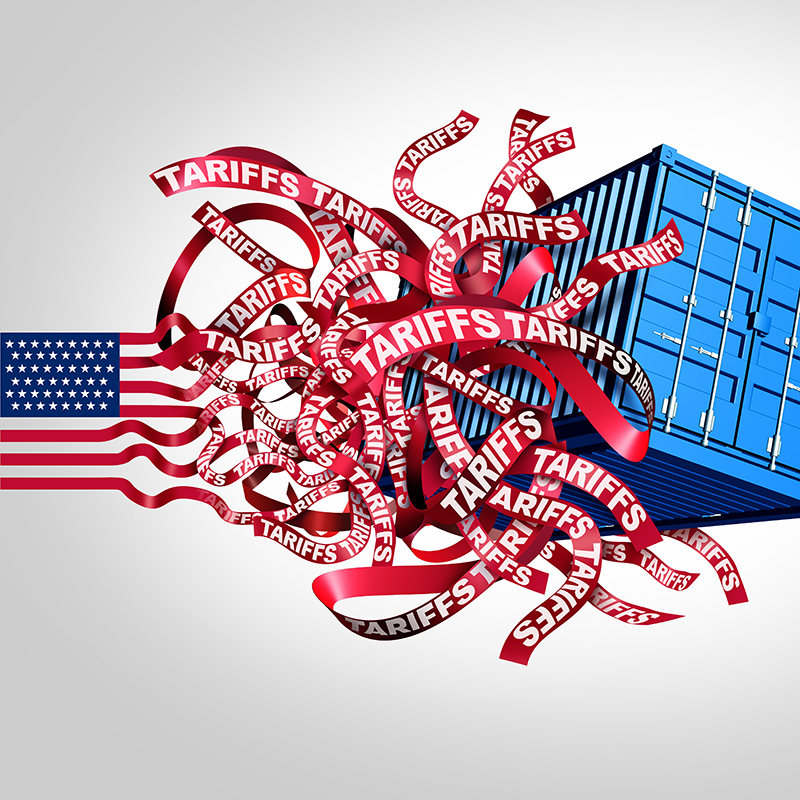
 United Trade Tariff Confusion and US Tariff Concept as confused policy strategy as American tariffs uncertainty and government tax trade war imposed on imports and exports.
In today’s volatile global economy, companies are being forced to rethink their entire approach to risk, especially when it comes to the financial uncertainties created by the U.S.’s ever-changing tariff regime. As trade tensions ebb and flow, and geopolitical dynamics shift, the financial implications of tariffs are becoming increasingly complex and unpredictable. For CFOs and treasurers, the question is no longer whether tariffs will impact their business, but how to effectively manage the financial risks these import taxes create.
Tariffs introduce a layer of unpredictability to financial management because of their potential to disrupt supply chains, inflate costs, and distort revenue and expense forecasts. Several financial leaders have told us that they believed they had tariff risks under control until sudden policy reversals, such as when a duty was imposed on the European Union (EU) and then quickly walked back. Such changes reminded them that nothing is done until it’s done.
Currency volatility adds another dimension to managing these financial risks. Weakness in the U.S. dollar, which some view as an opportunity to boost exports, is a double-edged sword. While it may benefit U.S.-based manufacturers, the falling dollar complicates financial planning for multinational firms with exposure to multiple currencies.
Further Diversification of Financial Risks
To navigate this uncertainty, companies are increasingly diversifying their capital and funding sources. Even in stable times, CFOs and treasurers should routinely evaluate alternative capital and funding ideas. The current volatile environment makes these analyses more important than ever.
We’re hearing from a lot of our multinational clients that they’re considering diversifying in terms of where they issue debt. So, for example, if a multinational is based in the United States and has only ever issued U.S.-dollar debt, treasury might now be wondering whether they should consider a Eurobond issuance. This would provide a natural hedge for any euro exposure the company has on the operations side, and it would provide access to a new group of investors. Another benefit is that, should demand for U.S.-dollar–denominated issuance decrease, the company would have experience accessing liquidity and funding in a different market.
Of course, the downside to geographic diversification is that, for a company which has never done such an issuance before, moving into a new market can be costly. There are a lot of factors to consider. As credit spreads ebb and flow with market dynamics, issuing outside the United States may look cost-effective, but first-time issuers in a market usually pay an issuance premium. If prospective buyers of the debt do not know the issuing company, bonds might end up costing 10 to 15 basis points more than a similarly rated, but more familiar, company would pay. Likewise, complying with a whole new reporting regime can lead to substantially higher reporting costs than a first-time issuer might expect.
Another challenge is that alternative markets may not provide as many options as U.S. debt markets—and below a certain size, an issuance may simply not be viable. In the Eurobond market, a first-time issuer that wanted the equivalent of US$500 million in debt might be pushed by its advisers to increase that amount, anticipating that investors would need more liquidity or secondary trading in the debt to be interested. Thoroughly understanding these types of risks takes time, but failing to understand them can result in suboptimal efficiency in the execution of the transaction.
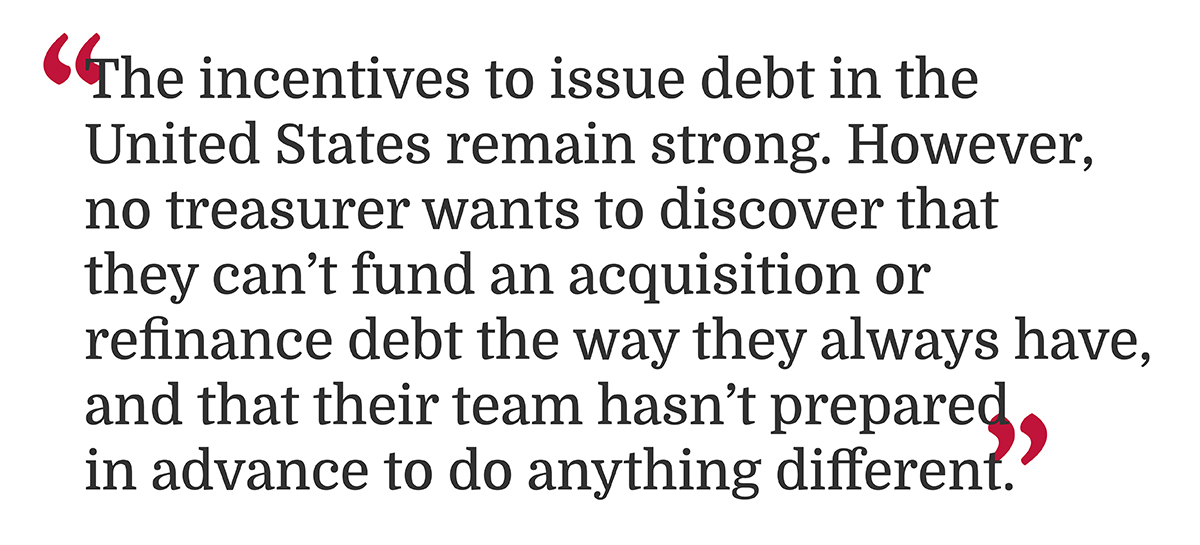
To be clear, the incentives to issue debt in the United States remain strong. However, no treasurer wants to discover that they can’t fund an acquisition or refinance debt the way they always have in the past, and that their team hasn’t prepared in advance to do anything different.
An alternative approach to debt diversification is the use of private credit, particularly for investment-grade companies undertaking significant capital expenditures. In the public-credit space, banks facilitate transactions whereby other institutional investors—insurance companies, hedge funds, etc.—will ultimately buy the bonds. In the private credit markets, a company can issue a large amount of debt—well above $1 billion—directly to a single lender or a consortium of lenders.
Private credit doesn’t work for everybody, but it does offer flexibility and risk-sharing benefits, which can be highly valuable in an environment where traditional funding avenues are constrained or cost-prohibitive. This is very different from a currency diversification, but it comes back to the idea of finding different types of investors. We are seeing the growth of private credit have a meaningful impact on high-yield companies’ financing, especially as it enables these businesses to fund specific projects, such as infrastructure or IT buildouts, without over-leveraging the entire balance sheet.
Operational Adjustments and Hedging Strategies
For companies looking at issuing debt elsewhere in the world, the ability to create natural hedges is a key consideration. Geographic diversification typically makes sense only for companies that have an exposure to the market where they’re issuing. For example, a business that issued Eurobonds but didn’t have operations in Europe would be creating unnecessary currency risk for itself. It could hedge that risk away, but doing so would increase costs and complexity.
Even organizations that currently have an operational footprint in a region where they’re considering issuing bonds should evaluate whether their operational footprint in that currency is likely to change faster than their debt capital structure. Treasurers considering this strategy should ask a couple of questions: First, is what we have today going to be what we have tomorrow? Can we reasonably expect to continue to have business units in this currency for the foreseeable future? And second, what’s the tenor of debt I want to issue? And does that match what’s available in the market?
For years, companies looking for an alternative to locking in debt in a foreign market have synthetically created local-currency debt by layering cross-currency swaps on top of their U.S.-dollar debt. This approach doesn’t take nearly as long as issuing new debt would, and it creates more flexibility because derivatives are available in a wide array of sizes and tenors in most markets.
Another approach that some companies are exploring involves changing their invoicing practices. They might start billing in local currencies rather than U.S. dollars everywhere they have factories or other sizable operations, in order to reduce their exposure to currency fluctuations when dollar revenue offsets local-currency operational costs. This approach hasn’t gained widespread traction yet, but in many cases that’s because nobody is paying close attention to whether natural hedges are viable. Fundamentally, matching revenues’ and expenses’ currencies should be easier and cheaper than financial hedging. We expect this strategy to get more attention if currency volatility continues to increase and the dollar continues to weaken.
Embracing Flexibility and Resilience
In a world where tariff policies can shift overnight and currency markets frequently swing wildly, companies must adopt a more flexible and resilient approach to financial risk management. This means not only diversifying funding sources and exploring alternative credit options, but also rethinking operational practices and hedging strategies.
Corporate treasury and finance teams need to be examining every currency their organization does business in and evaluating their options for mitigating the risks they face in that currency. As changing global trade patterns impact both foreign exchange and nations’ macroeconomic performance, one key takeaway for financial leaders is clear: Don’t rely on a single tool or market. Instead, build a financial risk management program that allows for adaptability in the face of uncertainty.
Finding ways to mitigate exposures and become more resilient within the organization’s capital structure is always a crucial responsibility of treasury and finance. The companies that will thrive in the current uncertainty are those whose treasury and finance teams are proactively managing risk, not just reacting to it.
© Arc, All Rights Reserved. Request academic re-use from www.copyright.com. All other uses, submit a request to TMSalesOperations@arc-network.com. For more information visit Asset & Logo Licensing.