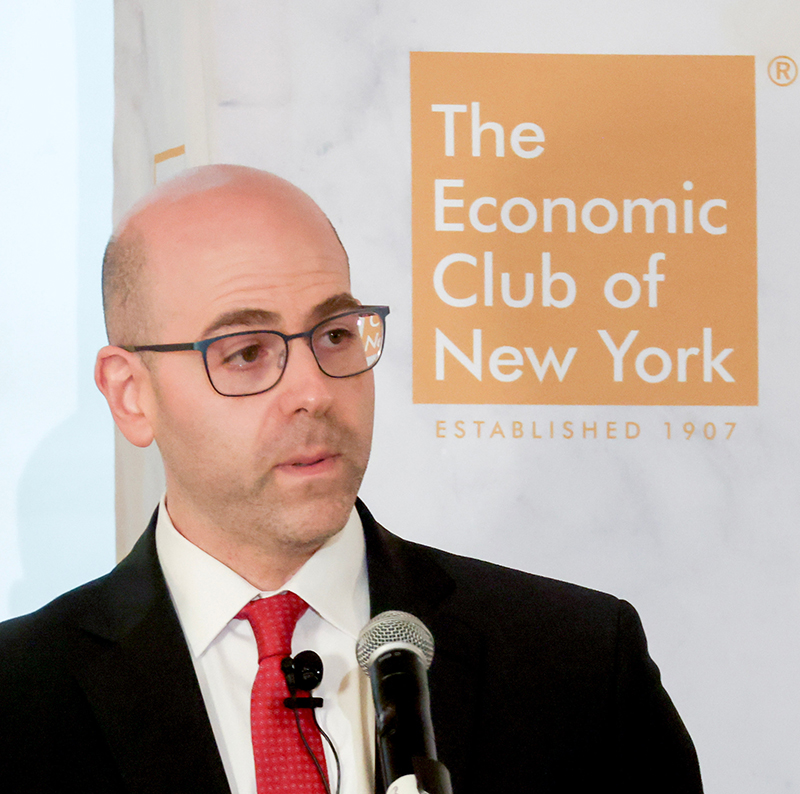
 Stephen Miran, governor of the U.S. Federal Reserve, during an Economic Club of New York luncheon in New York on Monday.
The Federal Reserve’s newest policymaker, appointed by President Donald Trump, laid out his argument for aggressively lowering interest rates, presenting a view that aligns with the president’s demands but that makes him an outlier at the central bank. In his first policy speech since joining the Fed, Governor Stephen Miran argued that the neutral rate of interest—where the policy rate neither stimulates nor weighs on the economy—has been pushed lower this year by tariffs, immigration restrictions and tax policy. That means interest rates should be much lower to prevent damaging the economy, he said.
“The upshot is that monetary policy is well into restrictive territory,” Miran said Monday in prepared remarks for an event at the Economic Club of New York. “Leaving short-term interest rates roughly 2 percentage points too tight risks unnecessary layoffs and higher unemployment.”
Miran participated in last week’s Federal Open Market Committee (FOMC) meeting, where policymakers lowered interest rates by a quarter percentage point for the first time since December, to a range of 4 percent to 4.25 percent. Miran dissented, preferring instead to lower rates by a half percentage point. He indicated in rate projections released last week that he preferred to cut rates by a total of 1.5 percentage points this year. Since his estimate of the neutral rate is so low, it would be better, he argued, to move toward it more quickly.
By contrast, the median projection of the Fed’s 19 officials has them lowering rates by another half percentage point before year-end.
“It’s not a panic—a panicky move would be something like 75 basis points or more,” Miran said in a question-and-answer session following his speech. “I’m not panicked, I just see that the risks grow the longer you remain significantly above neutral.”
Miran added that he’d likely continue to dissent at future Fed meetings. “Until my view changes, I will continue arguing for that view, and if that means continuing to dissent, that means continuing to dissent,” he said. “I’m not going to vote for something I don’t believe in just for the sake of creating an illusion of consensus where there is none.”
Initial reaction to Miran’s speech was skeptical. “I’m having a hard time buying the idea that Fed policy right now is even mildly restrictive,” said Joe Brusuelas, chief economist at RSM. Financial conditions, he said, are accommodative, and the labor market remains near full employment—neither of which supports the idea that rates are highly restrictive.
However, Miran outlined several reasons why he believes the neutral rate of interest is lower now. A sharp decrease in immigration, revenue from tariffs, and increased economic growth from this year’s tax legislation should all press the rate lower, he said. “In my view, insufficiently accounting for the strong downward pressure on the neutral rate resulting from changes in border and fiscal policies is leading some to believe policy is less restrictive than it actually is,” he said. He said policies like lifting regulations— which he called a “material impediment to growth”—might raise the neutral rate, but fiscal policies are likely more significantly lowering the neutral rate.
His estimate of a neutral policy rate of around 2.5 percent is now much lower than the median Fed official’s projection of 3 percent, though other policymakers also project that the neutral rate is under 3 percent. Still, Miran is the only one calling for getting there quickly.
On Monday, Miran also indicated he might be supportive of doing away with the Fed’s precise 2 percent inflation target, saying that inflation is very difficult to measure. He emphasized that such a change could only be implemented after the Fed achieves the target for a sustained period of time, to avoid giving the impression that the Fed is moving the goalpost.
Until his appointment to the Fed, Miran served as chair of the White House Council of Economic Advisers. He didn’t resign from that post but is taking an unpaid leave of absence. His term as governor expires at the end of January, though it’s unclear how long he might stay.
Stark Differences Within the Fed
Miran’s views differ starkly from other Fed officials who spoke on Monday, none of whom said they are prepared to support another rate cut when policymakers gather on October 28 and 29 in Washington.
Three policymakers who have previously expressed greater concern about inflation said the Fed should approach further easing cautiously as long as prices are still running above the central bank’s 2 percent target.
St. Louis Fed President Alberto Musalem said he’d support additional cuts only under certain circumstances. “Should further signs of labor market weakness emerge, I would support additional reductions in the policy rate, provided the risk of above-target inflation persistence has not increased and longer-term inflation expectations remain anchored,” said Musalem.
Cleveland Fed President Beth Hammack said inflation remains too high and officials should be cautious about cuts to avoid overheating the economy. Policy is only “very mildly” restrictive after this month’s rate cut, she said. “It worries me that if we remove that restriction from the economy, things could start overheating again.”
And Atlanta Fed President Raphael Bostic, in an interview published Monday in the Wall Street Journal, said he was hesitant to declare his support for another rate cut: “I am concerned about the inflation that has been too high for a long time, and so I today would not be moving or in favor of it, but we’ll see what happens.”
—————————————————————
Copyright 2025 Bloomberg. All rights reserved. This material may not be published, broadcast, rewritten, or redistributed.
© Touchpoint Markets, All Rights Reserved. Request academic re-use from www.copyright.com. All other uses, submit a request to TMSalesOperations@arc-network.com. For more information visit Asset & Logo Licensing.