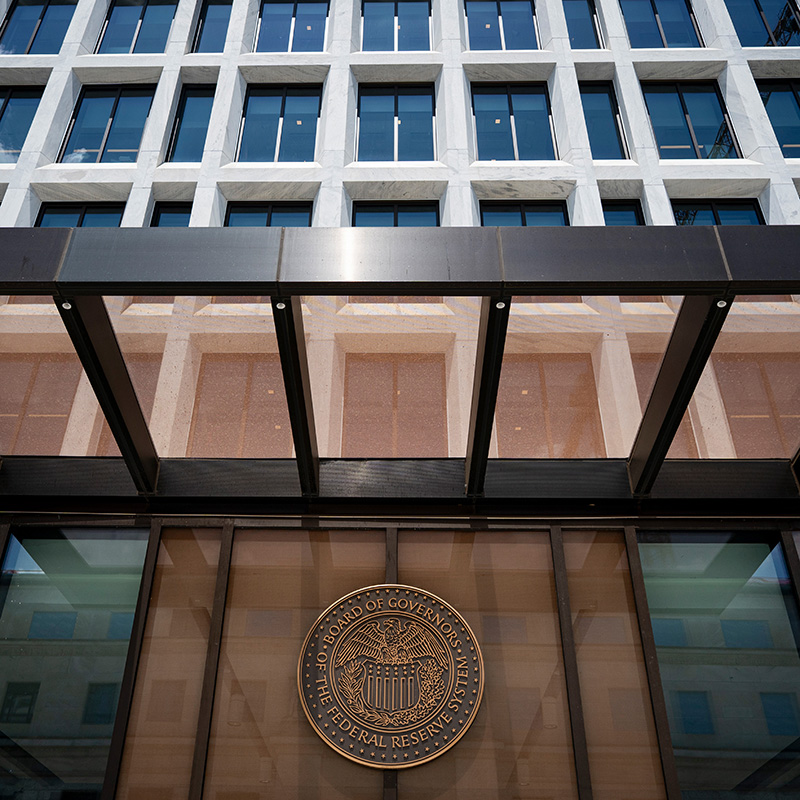
 The William McChesney Martin Jr. Federal Reserve building in Washington, D.C.
A growing number of Federal Reserve officials worried the Iran war could further stoke inflation and wanted to make clear following their March meeting that the central bank may have to consider raising interest rates.
Minutes of the Federal Open Market Committee's (FOMC's) meeting on March 17 and 18, released today in Washington, show that policymakers wrestled with starkly differing scenarios for the U.S. economy, and the policy reactions that might follow, after the outbreak of the Iran war. Most officials worried that a protracted war could hurt the labor market and warrant lower interest rates. At the same time, many policymakers highlighted the risk to inflation that might ultimately warrant rate increases.
Stephen Stanley, chief U.S. economist at Santander Capital Markets, said the minutes show the committee saw risks rising for both inflation and employment, and were wary of what a longer war may mean. "A protracted conflict, not the baseline, could further exacerbate both of these risks," Stanley said in a note to clients. "This left the FOMC firmly on the sidelines."
Officials who expressed more concern about inflation urged their colleagues to consider adding language to their post-meeting statement that raised the scenario of hiking rates under certain conditions. "Some participants judged that there was a strong case for a two-sided description of the committee's future interest rate decisions in the post-meeting statement, reflecting the possibility that upward adjustments to the target range for the federal funds rate could be appropriate if inflation were to remain at above-target levels," the minutes said.
A similar sentiment appeared in minutes to the Fed's January meeting, but the size of the group supporting it increased in March. In the Fed's lexicon of so-called counting words, "some" refers to a larger number of officials than "several," the word used in January. Echoing those concerns, the minutes noted the "vast majority" of officials thought it may take longer to return inflation to the Fed's 2 percent goal.
At the meeting, officials held the Fed's benchmark policy rate in a range of 3.5 percent to 3.75 percent.
Interest Rate Fallout from the War
The gathering occurred almost three weeks after war in the Middle East caused global energy costs to begin surging, putting upward pressure on inflation but also threatening to dampen economic growth. Several policymakers have since signaled a desire to hold rates steady as they gauge the war's fallout.
This week, President Donald Trump's announcement of a ceasefire pact with Iran and direct talks this weekend in Pakistan represented a dramatic climbdown from earlier threats to unleash massive devastation on the country. Yet sporadic fighting across the region, in addition to Iranian claims that there were already violations of that agreement less than a day later, exposed the fragility of the truce for the six-week war that's triggered a global energy crisis.
There are also lingering questions around whether and how the vital Strait of Hormuz will be opened for safe passage, while hundreds of freighters remain stranded inside the Gulf.
In projections released after the meeting, policymakers signaled an expectation for one interest rate cut in 2026, unchanged from their December forecast. But investors are skeptical that the Fed will cut at all this year, according to federal funds futures markets.
Most officials at the March meeting said they expected the unemployment rate to remain little changed, though the majority agreed that risks to the labor market are skewed to the downside. "In particular, many participants cautioned that, in the current situation of low rates of net job creation, labor market conditions appeared vulnerable to adverse shocks," the minutes said.
At the same time, policymakers noted that prolonged conflict in the Middle East would likely lead to more persistent increases in energy prices, which could, in turn, push up underlying inflation.
Some officials also highlighted the possibility that, with inflation already running above target for five years, "longer-term inflation expectations could become more sensitive to energy price increases."
————————————————————
Copyright 2026 Bloomberg. All rights reserved. This material may not be published, broadcast, rewritten, or redistributed.
© Arc, All Rights Reserved. Request academic re-use from www.copyright.com. All other uses, submit a request to TMSalesOperations@arc-network.com. For more information visit Asset & Logo Licensing.