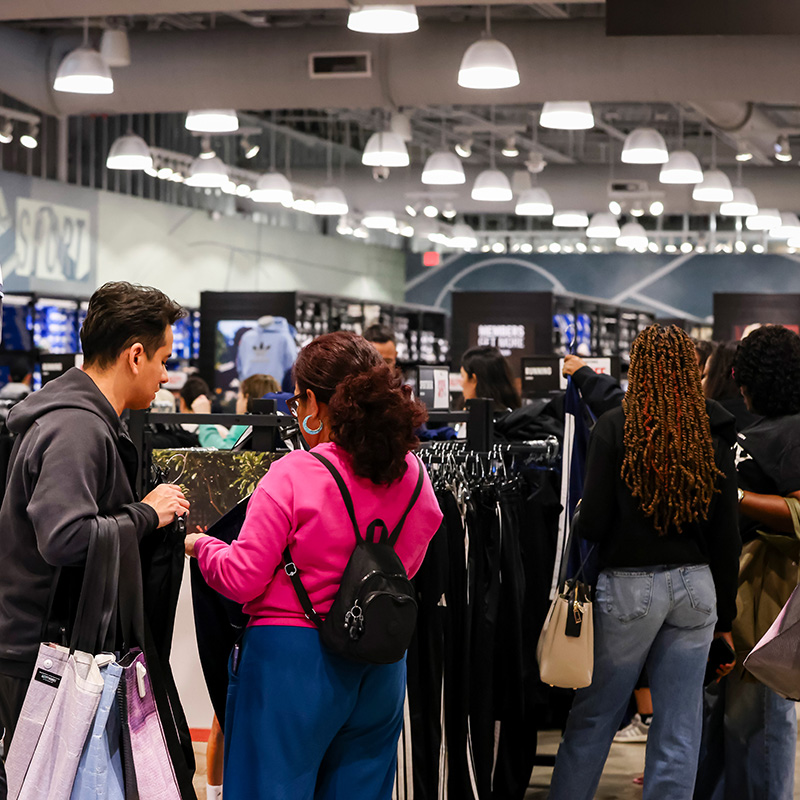
 Shoppers inside an store at an outlet mall in Sunrise, Florida.
U.S. consumer spending barely rose in February against a backdrop of persistent inflation that's set to accelerate due to the Iran war.
Inflation-adjusted consumer spending increased just 0.1 percent in February after stagnating in January, continuing an extended period of lackluster demand, a report from the Bureau of Economic Analysis (BEA) showed today. The so-called core personal consumption expenditures (PCE) price index, which excludes food and energy items, increased 0.4 percent from January. From the prior year, the Federal Reserve's preferred gauge of underlying inflation advanced 3 percent.

Spending on goods rose for the first time in three months, driven by a rebound in motor vehicle purchases. Services outlays edged up, fueled by transportation services.
The latest spending figures are consistent with a consumer who has grown more cautious over the past six months amid cost-of-living concerns and a sluggish job market. Real disposable income declined 0.5 percent, the most in nearly a year, according to the BEA.
Inflationary pressures have mounted more recently as the war is driving up the cost of fuels and materials. Some companies have already started to pass along those costs, or have announced plans to do so. Higher tax refunds helped support spending in February, but the increase in energy prices risks blunting that tailwind in the months ahead.
"When households are in the midst of or are anticipating financial hardship, they pull back on spending in an act of self-preservation," said Elizabeth Renter, senior economist at NerdWallet, a personal finance platform. "This can drive real changes to the larger economy, in the form of slower growth."
Delta Air Lines Inc. said it's "looking to do more" fare increases beyond what it has already levied. And the U.S. Postal Service plans to raise prices by 8 percent on some packages until mid-January of next year.
Although oil prices tumbled on yesterday, after the U.S. and Iran agreed to a two-week ceasefire in exchange for Tehran allowing safe passage through the Strait of Hormuz, Brent crude futures are still about $25 a barrel more expensive than before the war.
A more recently updated picture of inflation is due Friday, with the March consumer price index (CPI) report from the Bureau of Labor Statistics (BLS). Economists expect a 0.9 percent increase in the CPI—the sharpest one-month advance since 2022—since the war pushed gas prices up by more than $1 per gallon.
The BEA data also showed the firm PCE price index was concentrated in goods. Prices of recreational goods, clothing, and energy have picked up from the start of the year.
At the same time, a closely watched metric of services inflation that excludes energy and housing climbed 0.2 percent, the smallest advance since September.
Personal income, a metric not adjusted for inflation, decreased, primarily reflecting declines in dividend income and personal transfer receipts. Meanwhile, wages and salaries rose 0.2 percent, while income on assets—a key support for wealthier households—declined. The savings rate dropped to 4 percent.
Separate BEA figures showed the economy expanded at a slower pace than previously estimated in the final months of 2025. Inflation-adjusted gross domestic product (GDP), which measures the value of goods and services produced in the United States, increased at a 0.5 percent annualized rate in the fourth quarter.
Pre-tax corporate profits rose 6 percent in the fourth quarter, the most in more than three years.
————————————————————
Copyright 2026 Bloomberg. All rights reserved. This material may not be published, broadcast, rewritten, or redistributed.
© Arc, All Rights Reserved. Request academic re-use from www.copyright.com. All other uses, submit a request to TMSalesOperations@arc-network.com. For more information visit Asset & Logo Licensing.