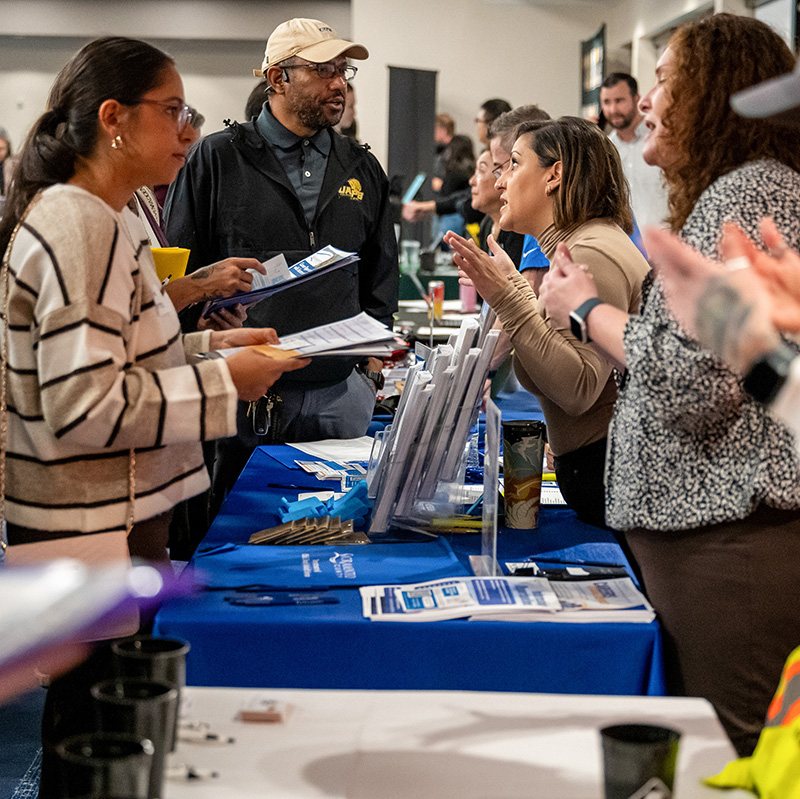
 Job seekers speak with recruiters during a job fair in Sacramento, California. Photographer: David Paul Morris/Bloomberg
U.S. employers added more jobs than expected for a second month and the unemployment rate held steady in April, indicating that the labor market is holding up despite rising energy costs sparked by the Iran war. Non-farm payrolls rose 115,000 last month after an even bigger surge in March, marking the strongest two-month increase since 2024, according to Bureau of Labor Statistics (BLS) data out today. The unemployment rate was unchanged at 4.3 percent.
The report showcases a labor market that may be gaining momentum after near-zero job growth last year. It showed hiring advanced across a variety of sectors, and it follows other data indicating that layoff activity remains low.

"After nearly a year of choppy hiring, back-to-back 100K–plus payroll gains are genuinely good news," Olu Sonola, head of U.S. economics at Fitch Ratings, said in a note. "The labor market is not booming, but it is proving harder to break than many feared."
The figures offer Federal Reserve policymakers space to keep interest rates unchanged for the foreseeable future as they focus on fresh inflationary risks from the war with Iran. Last week, Fed Chair Jerome Powell said the job market has shown "more and more signs of stability." A key question going forward is whether the Iran war, which has already driven inflation higher and pushed a gauge of consumer sentiment to record lows, will begin to weigh on hiring. Tax cuts are providing a tailwind for consumer spending and business investment, but a pullback in household demand or sustained rise in input costs may prompt companies to recalibrate by shedding hours or positions.
The advance in hiring was led by healthcare, which has been the primary driver of job growth over the past year. Transportation and warehousing and retail trade both added the most jobs since 2024. Employment in couriers and messenger services added almost 38,000 jobs, the most since 2020. Manufacturing employment fell slightly. Construction and leisure-and-hospitality payrolls rose for a second month after harsh winter weather likely disrupted hiring at the beginning of the year. Economists have pointed to the current spate of data-center buildouts as a possible driver of demand for construction labor in 2026, even as homebuilding continues to be restrained by elevated interest rates.
In 2025, "gains in healthcare overshadowed a loss across the rest of the labor market," Nicole Bachaud, an economist at ZipRecruiter, said in a note. "The labor market now is starting to become more balanced as employers across industries continue to see meaningful growth."
At the same time, Big Tech companies like Meta Platforms Inc. and Microsoft Corp. are reducing headcount, in part to offset heavy spending on artificial intelligence (AI). Employment in the information sector fell for a 16th straight month in April, according to the report.
.What Bloomberg economists say..."The most interesting detail in the jobs report came from the area that powered more than half the month's job gains: the freight sector. That confirms the improvement flagged by recent strong readings from PMIs and regional Fed manufacturing surveys: A strong recovery may be under way in the industrial sector."— Anna Wong, Stuart Paul & Eliza Winger |
The jobs report comprises two surveys, one of businesses and government agencies—which produces the payrolls figures—and another of households, which is the source of the unemployment rate. The household survey also has its own measure of employment, which fell for a fourth straight month.
Another data point from the household survey, the labor force participation rate—the share of the population that is working or looking for work—fell to 61.8 percent in April, the lowest since October 2021. The decline was driven by those 55 and older, while participation for younger age groups was little changed. A broader measure of unemployment, which includes people working part-time for economic reasons and discouraged job-seekers, rose to 8.2 percent, the highest this year. The unemployment rate for workers between the ages of 20 and 24 jumped to 7.6 percent, while Black unemployment rose to 7.3 percent.
Economists are paying close attention to how labor supply and demand dynamics are impacting wage growth, especially with renewed inflation posing a new threat to household incomes and spending. Separate data out today showed consumer sentiment has dropped to a fresh record low, as Americans' perceptions of their current financial situation slid to the lowest since 2009.
The jobs report showed average hourly earnings rose 0.2 percent from March and 3.6 percent from a year earlier. Average weekly hours worked also increased, bolstering take-home pay.
Other labor-market data this week mostly pointed to stabilization. Continuing filings for unemployment insurance remained low, while announced job cuts were also running below 2025 levels in the year to date. Further, ADP Research data indicated that April was the best month for hiring in more than a year, and a BLS measure of job openings was little changed in March.
————————————————————
Copyright 2026 Bloomberg. All rights reserved. This material may not be published, broadcast, rewritten, or redistributed.
© Arc, All Rights Reserved. Request academic re-use from www.copyright.com. All other uses, submit a request to TMSalesOperations@arc-network.com. For more information visit Asset & Logo Licensing.