 A pedestrian crossing in Shibuya district in Tokyo on September 17, 2025. Photographer: Noriko Hayashi/Bloomberg
Japan's economy grew much faster than expected at the start of the year, supporting the case for further Bank of Japan (BOJ) interest rate hikes, though the outlook remains highly uncertain due to the Middle East conflict.
Real gross domestic product (GDP) expanded 2.1 percent on an annualized basis in the first quarter, according to a Cabinet Office report out yesterday. The reading topped economists' forecast for a 1.7 percent increase and marked an acceleration from a downwardly revised growth pace of 0.8 percent in the previous quarter. Stronger-than-expected private consumption and trade helped power the acceleration.
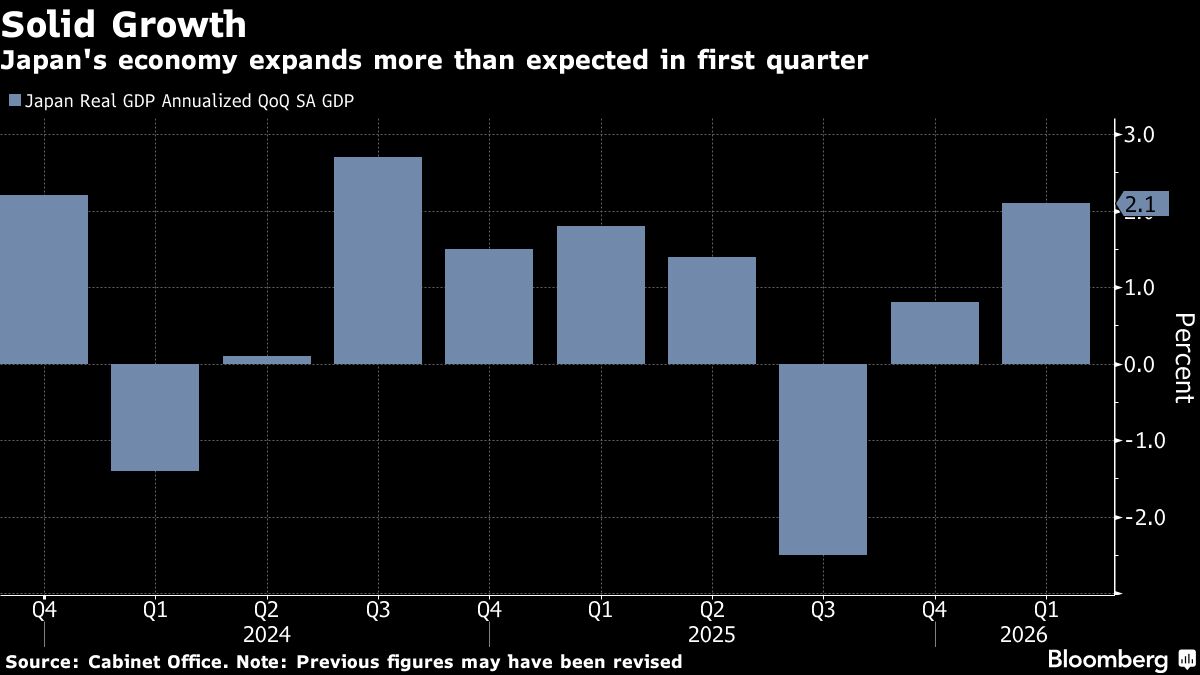
The report shows that the economy picked up steam in the January-to-March period, before the full impact of the war in Iran started to play out. The solid expansion gives policymakers scope to argue that the economy is resilient enough to withstand higher borrowing costs as the central bank looks to continue its normalization of policy and address upward inflation risks. That's a move policymakers may want to make before the indirect impact of the Mideast conflict starts to show more signs of weighing on growth.
"The government side may become more open to accepting further rate hikes based on these figures," said Takayuki Toji, senior economist at Japan Post Insurance. "That could leave room for the BOJ to raise rates even before the next GDP release, and as early as June or July."
Despite the bullish growth figures, the yen edged a fraction weaker against the dollar after the release. Overnight swaps were largely unchanged, showing around a 77 percent likelihood that the central bank will hike rates in June.
.What Bloomberg economists say..."Japan's solid first-quarter GDP growth strengthens the case for the BOJ to keep withdrawing stimulus through further rate hikes. ... We still expect the BOJ to raise its policy rate to 1.0 percent in June, but the call is far from certain."— Taro Kimura, economist |
The result comes at a particularly sensitive time for Prime Minister Sanae Takaichi as she looks to keep the public and investors on her side. While her call for an extra budget to pay for emergency relief measures and renewed energy subsidies will be largely welcomed by a public struggling to cope with inflation, her flip-flop on the need for more funding for the measures may feed into uncertainty about her fiscal plans among investors.
Yesterday's report showed private consumption, which accounts for more than half of Japan's GDP, increased 0.3 percent on a non-annualized basis, exceeding a 0.1 percent growth forecast. That was likely supported by government utility subsidies and wage growth finally starting to outpace inflation. Still, consumer confidence has been waning since the Iran war broke out. Net exports also supported the economy by more than expected. March trade data showed that Japan's exports grew at a faster clip as demand in China rebounded.
Growth in business investment slowed to a 0.3 percent gain from the previous quarter. The Finance Ministry's March corporate survey showed a fifth consecutive quarterly increase in ordinary profits. The global artificial intelligence (AI) boom, along with rising demand for digitalization amid labor shortages, continued to support companies' appetite for investment.
| Component | Actual | Estimate |
|---|---|---|
| Private consumption (quarter-over-quarter) | +0.3% | +0.1% |
| Business spending (quarter-over-quarter) | +0.3% | +0.3% |
| Net exports contribution (as a % of GDP) | +0.3% | +0.1% |
| Inventory contribution (as a % of GDP) | -0.1% | 0.0% |
On his recent visit to Japan, U.S. Treasury Secretary Scott Bessent spoke of the economy's strength, hinting that the time was ripe for interest rates to go up. He said the "strong and resilient" fundamentals of Japan's economy will end up reflected in the exchange rate, and that he has full confidence in the job done by BOJ Governor Kazuo Ueda. Still, it remains to be seen how the war in Iran will continue to impact the Japanese economy, since the conflict has no end in sight. The BOJ has already halved its growth forecast for the current fiscal year, to 0.5 percent, while raising its inflation forecast to 2.7 percent.
Near-term action may be preferable to a later move that might be criticized should evidence of strain on the economy emerge. Holding off on a hike may also heap pressure on a yen that the government has needed to prop up with as much as $64 billion of intervention in recent weeks.
Measures that Takaichi takes to support households dealing with elevated energy prices affected by the crisis in the Middle East should help consumption hold up over the coming months. But economists point to the potential for higher inflation and weaker business confidence to dent growth.
"With those kinds of support measures, Japan can avoid slipping into negative growth in the second quarter," Toji said. "But inflation can still weigh on real consumption and investment."
————————————————————
Copyright 2026 Bloomberg. All rights reserved. This material may not be published, broadcast, rewritten, or redistributed.
© Arc, All Rights Reserved. Request academic re-use from www.copyright.com. All other uses, submit a request to TMSalesOperations@arc-network.com. For more information visit Asset & Logo Licensing.