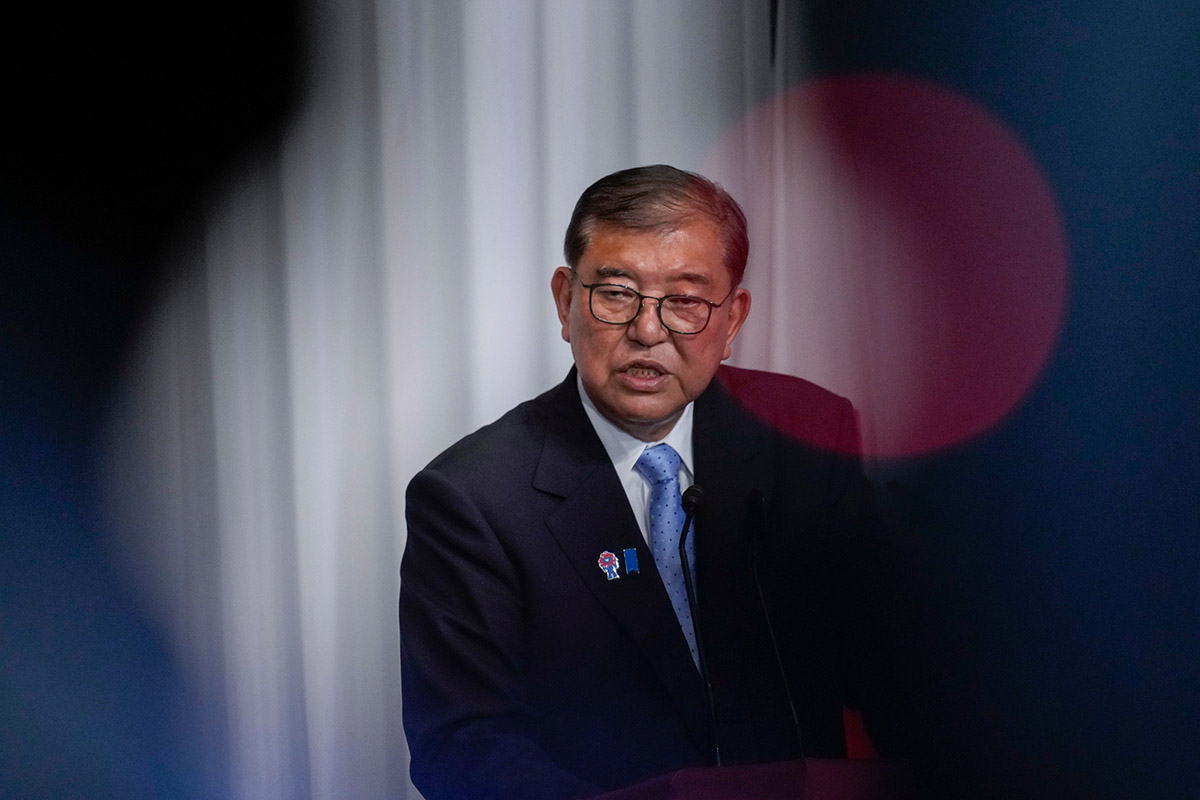
 Shigeru Ishiba in Tokyo on July 21. Photographer: Toru Hanai/Bloomberg.
President Donald Trump reached a trade deal with Japan that will impose 15 percent tariffs on imports to the U.S. from the key American ally, including automobiles, while creating a $550 billion fund to make investments in the United States.
The agreement, touted by Trump after he secured breakthroughs in a final 75-minute Oval Office meeting Tuesday with Japanese negotiators, spares the nation from a threatened 25 percent tariff that was set to take effect next week. “They had their top people here, and we worked on it long and hard, and it’s a great deal for everybody,” Trump said at a White House event Tuesday evening.
Under the deal, automobiles and parts would be subjected to the same 15 percent tax rate as Japan’s other exports, Prime Minister Shigeru Ishiba said in Tokyo, amid local media reports that he’s planning to step down in the wake of the agreement following a poor showing for his party in an election on Sunday. In return, Japan will accept cars and trucks built to U.S. motor vehicle safety standards, without subjecting them to additional requirements—a potentially major step to selling more American-built vehicles in the country. The auto sector tariff had been one of the main sticking points in the negotiations.
A centerpiece of the pact with Japan is the $550 billion investment pledge. A senior U.S. administration official, speaking on condition of anonymity to outline the agreement, said the pledge was akin to a sovereign wealth fund under which Trump himself could steer investments inside the United States. Final terms of the agreement still need to be enshrined in a formal proclamation. Legal particulars and other details surrounding the pledge are still being hammered out, according to the official. The investment timeline is not certain, and it’s not clear whether Trump would be able to allocate the full sum during his term.
Commerce Secretary Howard Lutnick advocated for and helped design the investment fund as a core pillar of the deal, according to an official familiar with the talks. Trump’s previous trade deals haven’t included that mechanism.
The source of the Japanese funding was also not immediately available. Ishiba said the investment sum would reach as much as $550 billion and would partly come in the form of loan guarantees.
Trump played the role of closer after eight rounds of negotiations, pressing for more concessions and securing better terms for the U.S. in that final Oval Office meeting with Japan’s chief trade negotiator, Ryosei Akazawa, the official said. Lutnick and Treasury Secretary Scott Bessent joined in the final talks.
Trump has a track record of making last-minute demands in talks, including before the United States inked its agreement with the United Kingdom. Previously, U.S. and Japanese officials were said to be discussing a fund of around $400 billion, with profits equally split. But under the terms hashed out in the Oval Office meeting, Japan agreed to provide $550 billion to invest in projects in America through vehicles returning 90 percent of the profits to the United States. A photo shared by Trump aide Dan Scavino on social media showed the initial figure was $400 billion, which appears to have been crossed out by Trump and replaced by a hand-written $500 billion, before they settled at $550 billion.
The official pointed to one hypothetical scenario of how the investments might work. The president could, for instance, select a semiconductor manufacturing project that could be built with Japanese funds, leased to operating companies, and the resulting leasing profit divided 90-10 between the U.S. and Japan.
Japan also agreed to buy 100 Boeing Co. aircraft, boost rice purchases from the United States by 75 percent, and buy $8 billion in agricultural and other products while hiking defense spending with American firms to $17 billion annually, from $14 billion, the senior official said. Japan will also participate in a liquid natural gas (LNG) pipeline project in Alaska, the official said, an apparent reference to a long-stalled $44 billion venture designed to export the state’s gas around the globe. Trump told lawmakers at the White House Tuesday evening that Japan is “forming a joint venture” on a proposed Alaskan LNG project. “They’re all set to make that deal now,” Trump said.
Akazawa didn’t mention those details when he outlined the trade deal in Washington. He said defense spending wasn’t part of the deal, an indication that some of the specifics may still be under discussion or getting characterized in different ways.
In Tokyo, Ishiba lauded the progress made. “Japan and the U.S. have been conducting close negotiations with our national interests on the line,” Ishiba said. “The two nations will continue to work together to create jobs and good products.”
Trump also pledged to give Japan a safety clause on forthcoming sectoral tariffs, including levies expected on semiconductors and pharmaceuticals—effectively agreeing to not treat the country worse than any other nation when it comes to those goods, the official said. In effect, that means Japan will be guaranteed whatever the lowest global rate is on those tariffs. U.S. negotiators have so far resisted efforts to make exceptions and carve-outs for sectoral tariffs, though the UK deal included a plan for limited relief from levies on steel.
Trump has repeatedly zeroed in on the auto trade as he criticizes trade imbalances with Japan. Around 80 percent of the country’s trade surplus with the U.S. is in cars and auto parts.
Deadline Looming
The deal with Japan comes hours after Trump announced he had reached an agreement with the Philippines, setting a 19 percent tariff on that country’s exports. The flurry of activity comes days before the president’s August 1 deadline for imposing so-called “reciprocal” tariffs that will hit dozens of trading partners.
Trump first announced the plan for sweeping tariffs on nearly every U.S. trading partner in April, only to quickly put them on hold for 90 days amid market backlash in order to work out agreements. But that stretch saw the U.S. finalize only a handful of deals, and Trump instead moved to unilaterally impose import tax rates on countries and blocs before the looming deadline.
While the U.S. president and his advisers initially suggested they planned to hold concurrent talks with trading partners, Trump has shown little patience for back-and-forth negotiations, instead saying his preference is to just set rates for other economies. In recent weeks, he has sent a slew of letters setting tariff levels and is also moving ahead on industry-specific levies that will target sectors such as copper, semiconductors, and pharmaceuticals.
Talks continue with major economies, including the European Union and India, but Trump has said that imports from some 150 smaller countries will be hit with a blanket rate of between 10 percent and 15 percent.
————————————————————
Copyright 2025 Bloomberg. All rights reserved. This material may not be published, broadcast, rewritten, or redistributed.
© Arc, All Rights Reserved. Request academic re-use from www.copyright.com. All other uses, submit a request to TMSalesOperations@arc-network.com. For more information visit Asset & Logo Licensing.