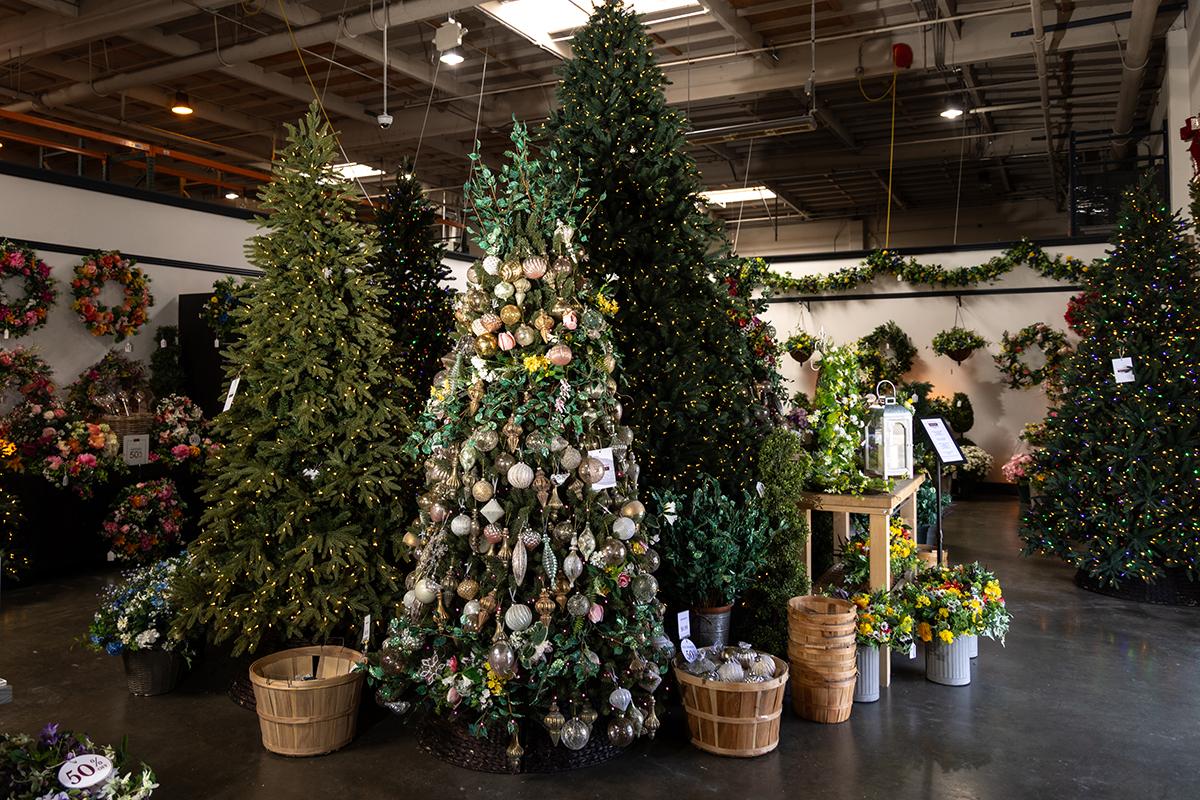
 Balsam Hill holds an annual Christmas-in-July sale. Photographer: Rachel Bujalski/Bloomberg.
The vast majority of artificial Christmas trees, lights, and other decor is imported—mostly from China. And because seasonal items typically need to be shipped months ahead of time, stiffer import taxes have already added millions of dollars in unexpected costs.
Jared Hendricks, founder and CEO of Village Lighting Company in West Valley City, Utah, had to take on a line of credit, leveraged by his house and office, to help cover the $1.5 million in extra tariff costs. “This is the most stressful year I’ve ever had,” said Hendricks, whose business sells lights, garlands, and wreaths to consumers and professional installers. “Over the last 20-some-odd years, we’ve been through a lot, and I’m just kind of operating on faith that we’ll find a way.”
As President Donald Trump’s ever-changing announcements on tariffs rolled in during the crucial shipping period for the industry, managers from across the country said they had to cancel shipments, cut down on orders, and lay off workers to be able to pay the duties. Some expressed concerns about staying in business.
For shoppers this holiday season, the shipping disruptions will mean less choice of products in stores and prices that could be 10 percent to 20 percent higher than last year, said Jami Warner, executive director of the American Christmas Tree Association. An artificial tree that cost $299 in 2024, say, could fetch as much as $359 this year as a result of tariffs.
“This is a happy industry, and this is a pretty unhappy time to be in it,” Warner said.
By the end of August, much of the year's imported Christmas trees and other decorations have been shipped, and retailers are busy preparing for the holiday season when they make the bulk of their sales. Another question this year is whether uncertainty about the direction of the economy will weigh on holiday spending. “It’s going to be a challenging holiday season for lots of retailers,” said Natalie Kotlyar, a retail analyst at advisory firm BDO.
U.S. companies imported $3.4 billion in artificial Christmas trees, ornaments, and other holiday decorations last year. Eighty-seven percent of them came from China, according to U.S. Census Bureau trade data. In addition, roughly $420 million in light strings came from abroad—a majority from Cambodia, a country that also faces a high tariff rate.
Trump often says that companies can avoid import levies by making their products in the U.S. The administration’s America First policies, including tariffs, are focused on unleashing prosperity for American workers with good-paying jobs, “not cheap imports,” White House spokesman Kush Desai said in an emailed statement.
Craig Batten, president of S4 Lights in Toano, Virginia, said he has explored making Christmas lights in the United States but “found that that was about impossible.” The only place to get many raw materials is in China and Southeast Asia, and finding enough workers here is a problem, he said. Batten added a line item to his invoices called “tariff impact,” but he can’t pass along the entire cost of the duties because that would raise prices too high. “We’re taking a hit hoping that our existing inventory that we got pre-tariff helps offset the sticker shock,” he said.

When tariffs on goods imported from China temporarily reached 145 percent in April, American Christmas LLC stopped shipments and canceled 10 percent of its orders, said CEO Dan Casterella. The Mount Vernon, New York–based company, which installs holiday displays in places such as retail stores, corporate headquarters, and Christmas sites like the Rockefeller Center, resumed shipping when the duties were temporarily reduced to 30 percent in May as part of a trade-war truce with China. After another 90-day extension earlier this month, the new deadline for a trade deal is November 10. The rate could go up or down, depending on negotiations between the U.S. and China.
Casterella said it’s impossible to plan for next year without knowing what the tariff rates will be. He usually starts ordering in October or November for the following Christmas. “I don’t necessarily disagree with the mindset of having tariffs,” he said. “It’s just the uncertainty right now of that around them is making it difficult to run a business.”
Three Kings Gifts in Cockeysville, Maryland, specializes in nativity sets and small chests of gold, frankincense, and myrrh—the three gifts given to baby Jesus in the Bible. Rich Terlep says he’s relied on contractors in China ever since starting the company in 2005. For instance, workers use a tiny tip of a peacock feather to put the pupils in the eyes of figurines. It’s a low-wage job that wouldn’t be filled in the U.S., he said.
Terlep scurried to get 11 containers, carrying about 700 sets each, shipped so that they would land in the United States before the initial August 12 deadline. He’s decided to eat the tens of thousands of dollars in additional cost from tariffs. “Everyone is hoping against hope that somehow sanity is going to emerge out of this, because it is unsustainable,” Terlep said.
At Balsam Hill, one of the leading companies in the holiday-decorations business, the cost of tariffs is expected to come to about $15 million this year—up from $1 million last year, according to Mac Harman, founder and CEO of parent company Balsam Brands. To preserve cash to pay tariffs, the California-based firm scaled back orders, cut 10 percent of its global workforce of 350 employees, and froze raises and travel. But none of those actions comes close to covering the cost of the tariffs, Harman said.
The Christmas Trade Group, which represents small and midsize decorations firms, has requested a tariff exemption from the Trump administration. The group argues that domestic production is impossible, decorations are critical to holiday retail sales, and tariffs effectively force businesses to choose between operating at a loss and closing.
Jonathan Gold, vice president of supply chain and customs policy at the National Retail Federation, said he’s heard from a number of company owners who are concerned about the viability of their business.
The Christmas Trade Group has been encouraged by conversations it’s had with both members of Congress and the administration, said Josh Fendrick, a principal with Williams & Jensen representing the coalition. The White House didn’t say whether the exclusion request would be considered. There is a precedent for relief. In his first term, Trump delayed some tariffs on Chinese imports, saying at the time “so it won’t be relevant to the Christmas shopping season.”
“We sell joy, we sell memories,” said Chris Butler of National Tree Company in New Jersey. “If any industry had a shot at getting some kind of exemption from the administration, it would be us.”
————————————————————
Copyright 2025 Bloomberg. All rights reserved. This material may not be published, broadcast, rewritten, or redistributed.
© Arc, All Rights Reserved. Request academic re-use from www.copyright.com. All other uses, submit a request to TMSalesOperations@arc-network.com. For more information visit Asset & Logo Licensing.