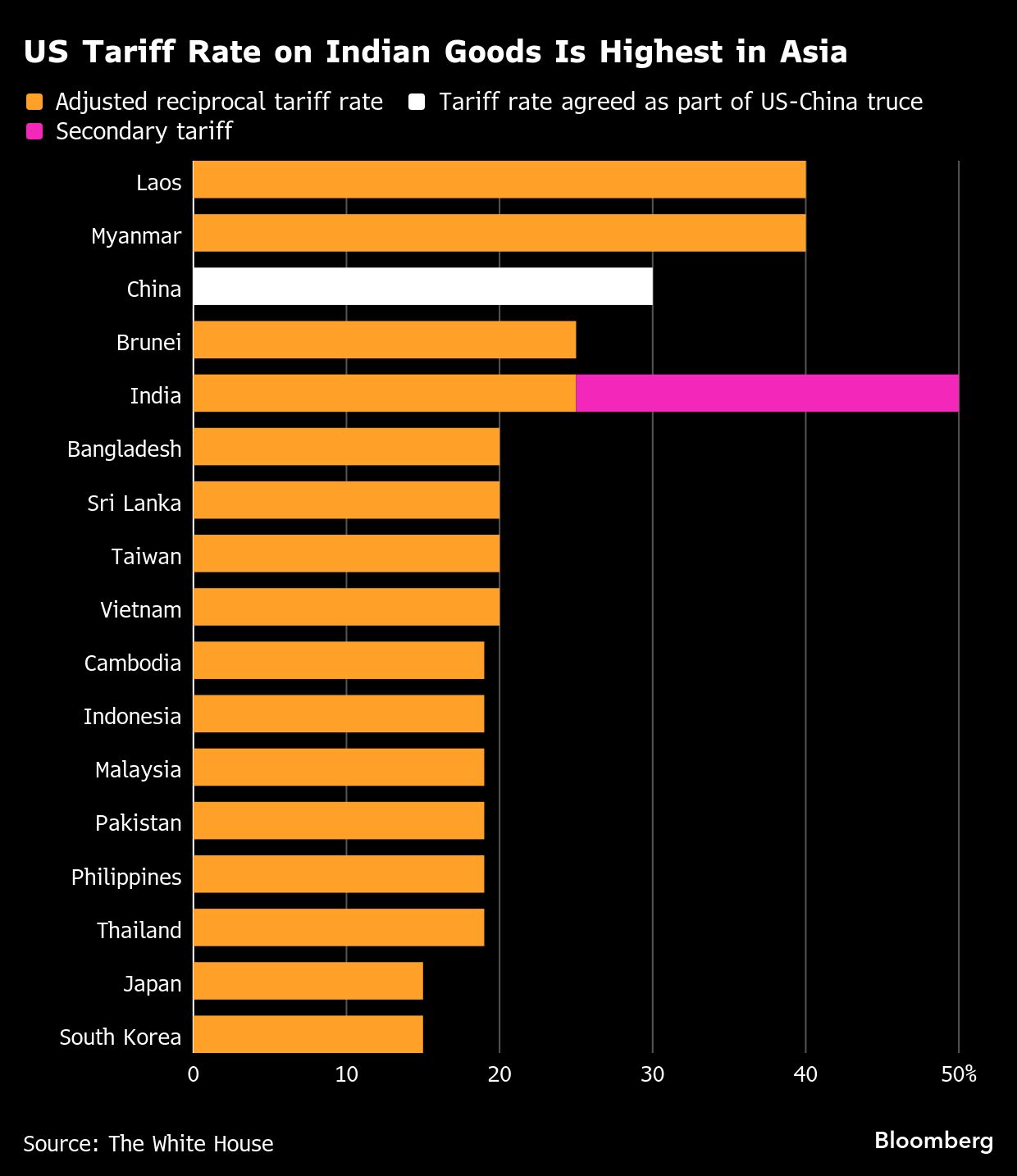
President Donald Trump imposed a crushing 50 percent tariff on Indian goods to punish the country for buying Russian oil, up-ending a decades-long push by Washington to forge closer ties with New Delhi.
The new tariffs, the highest in Asia, took effect at 12:01 a.m. in Washington yesterday, doubling the previous 25 percent duty on Indian exports. The levies will hit more than 55 percent of goods shipped to the United States—India’s biggest market—and hurt labor-intensive industries like textiles and jewelry the most. Key exports such as electronics and pharmaceuticals are exempt, sparing Apple Inc.’s massive new factory investments in India, for now.
The move marks a sharp deterioration in ties between the two nations and an about-face in Washington’s strategy over the years to court India as a counterweight to China. Trump has slammed India for buying Russian oil, which he said was funding President Vladimir Putin’s war in Ukraine. New Delhi has defended its ties with Russia and has called the U.S.’s actions “unfair, unjustified, and unreasonable.”
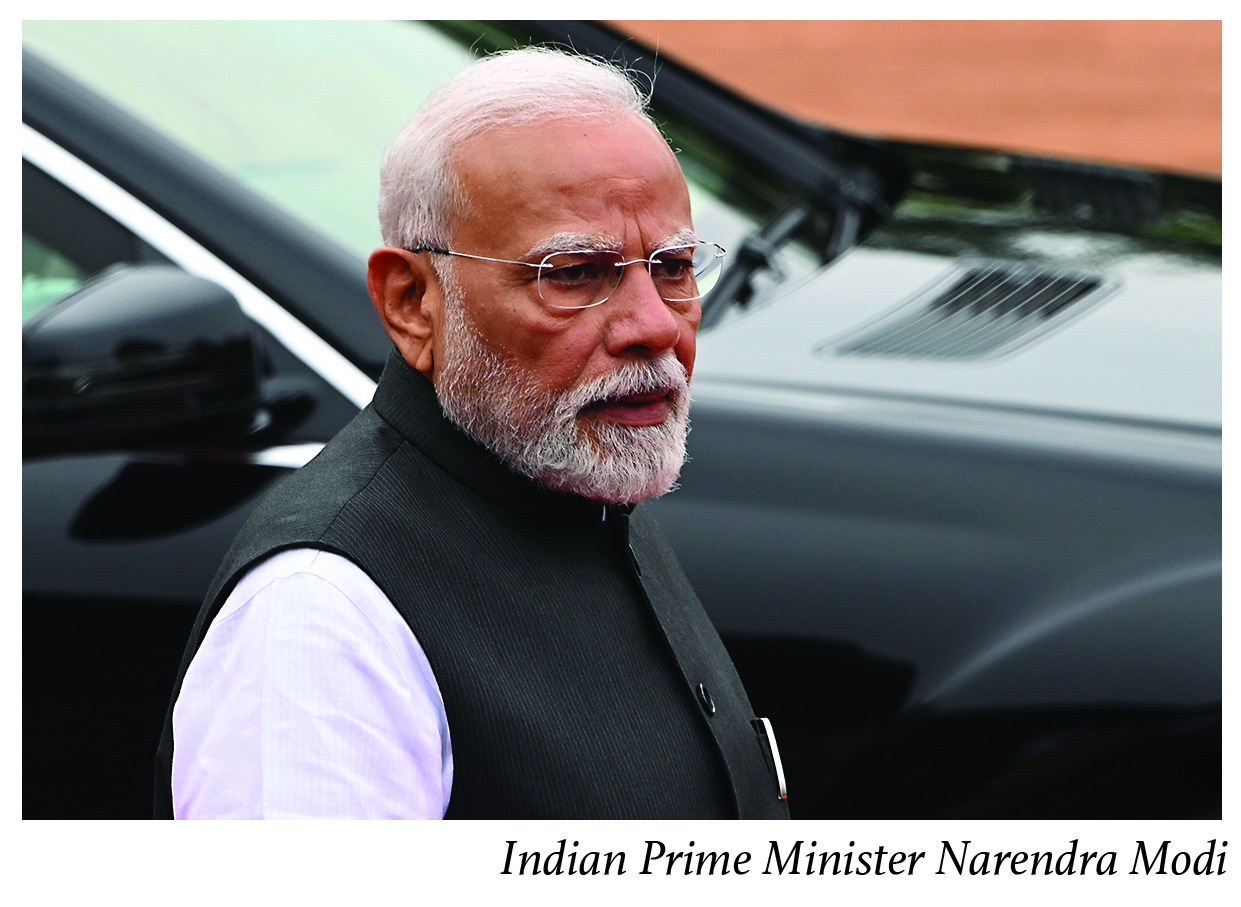
The sky-high tariffs threaten India’s export competitiveness against rivals like China and Vietnam, while raising questions about Prime Minister Narendra Modi’s ambitions to transform the South Asian nation into a major manufacturing hub. Exporters of clothing, footwear, and small manufactured goods like toys are bracing for falling orders and possible job cuts.
“This is going to be a very big impact on Indian exporters because 50 percent tariffs are not workable for the clients,” said Israr Ahmed, managing director of Farida Shoes Pvt. Ltd., which depends on the U.S. for 60 percent of its business. He said buyers have asked exporters to share specification of goods with suppliers in other nations, increasing the threat of orders being diverted to countries like Bangladesh and Vietnam. India’s Ministry of Commerce and Industry didn’t respond to a request for comment.
The tariffs, which follow months of trade talks between New Delhi and Washington, have stunned Indian officials. India was among the first countries to open trade talks with the Trump administration, but its own high tariffs and protectionist policies in sectors such as agriculture and dairy frustrated U.S. negotiators. Relations further soured after Trump lashed out at India over its buying of Russian oil. New Delhi has argued the purchases stabilize energy markets and has said it will keep buying Russian oil “depending on the financial benefit.”
Tensions have also simmered over Trump’s repeated claims that he brokered a ceasefire between India and Pakistan after a four-day armed conflict in May. The U.S. president has said he used trade deals as a bargaining chip in the truce, comments that Modi and his top officials have consistently denied. Trump repeated those assertions at the White House on Tuesday, describing Modi as a “terrific man,” whom he said he called to prevent the India-Pakistan conflict from escalating to a nuclear war.
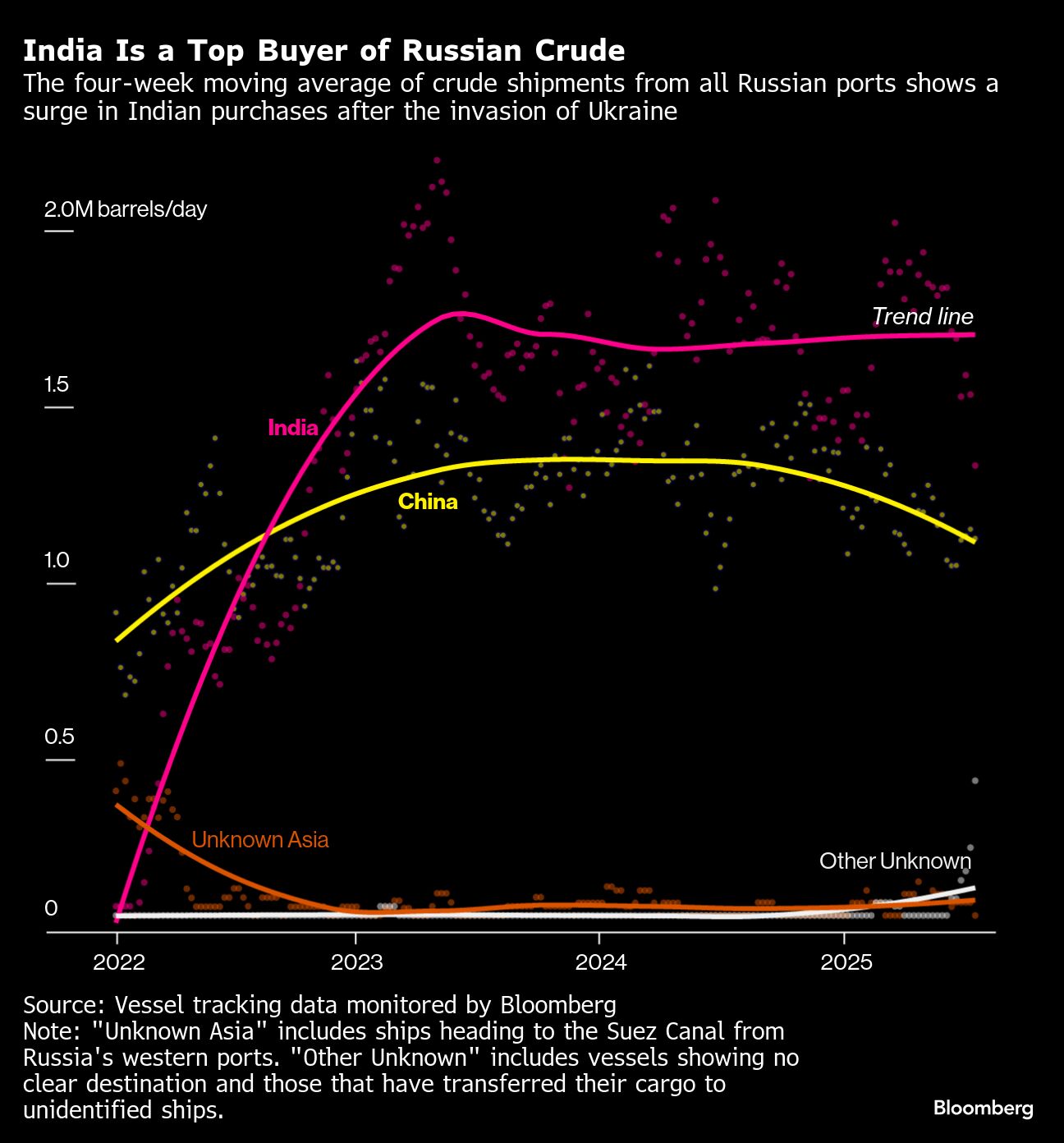
The fraying relationship has pushed India to edge away from the United States and forge deeper ties with fellow members of the BRICS bloc. Beijing and New Delhi have, in recent months, sought to patch up ties that plummeted after violent border clashes in 2020. Modi is expected to meet President Xi Jinping on the sidelines of a security summit in China next week—his first visit there in seven years. At the same time, India and Russia have pledged to increase their annual trade by 50 percent, to $100 billion, over the next five years. India has ramped up oil imports from Russia since the full-scale invasion of Ukraine began in 2022 and now accounts for about 37 percent of Russia’s oil exports, according to Moscow-based Kasatkin Consulting.
A U.S. trade team that was scheduled to arrive in India this week for a sixth round of trade talks has deferred its visit, raising further concerns over whether the two sides can clinch a trade deal by fall—a goal set during Modi’s visit to the White House in February.
Citigroup Inc. estimates that the combined 50 percent tariff poses a downside risk to India’s annual gross domestic product (GDP) growth of 0.6 to 0.8 percentage point. India’s economy is largely driven by domestic demand, rather than exports, so shoring up consumer and business sentiment is key to faster growth. Private consumption makes up about 60 percent of India’s GDP—and although the United States is India’s biggest export market, with shipments of $87.4 billion in 2024, that still amounts to only 2 percent of India’s total GDP.
To shore up confidence, Modi’s government has pledged “next-generation reforms,” beginning with a major overhaul of the consumption tax. Officials in New Delhi are also huddling to come up with measures for supporting sectors such as textiles and footwear, which are likely to be hit hard by higher tariffs.
“This is a strategic shock that threatens India’s longstanding foothold in U.S. labor-intensive markets, risks mass unemployment in export hubs, and could weaken India’s participation in global value chains,” said Ajay Srivastava, founder of New Delhi-based think tank Global Trade Research Initiative.
————————————————————
Copyright 2025 Bloomberg. All rights reserved. This material may not be published, broadcast, rewritten, or redistributed.
© Arc, All Rights Reserved. Request academic re-use from www.copyright.com. All other uses, submit a request to TMSalesOperations@arc-network.com. For more information visit Asset & Logo Licensing.