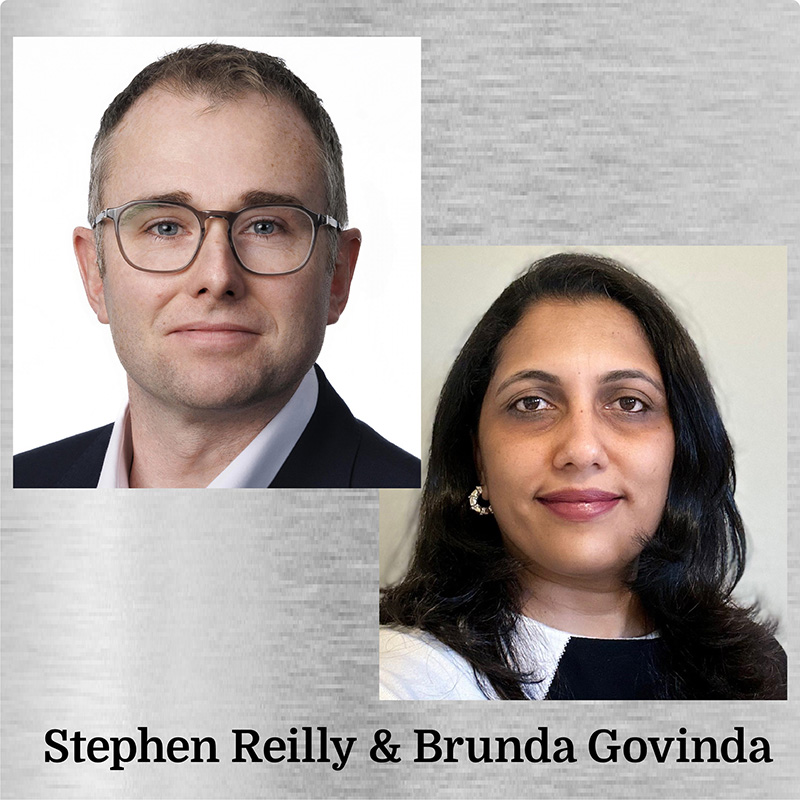
Global insurer AIG has experienced a great deal of change through its more than 100 years in business. When the company decided to spin off its life insurance and retirement business unit as Corebridge Financial, the treasury team saw the opportunity to transform operations. “Our treasury technology was approaching
end of life, and the separation of the companies highlighted that urgency,” explains Stephen Reilly, head of treasury operations oversight and strategy. “We created a business case to secure the support of our senior leadership team to get the right level of priority.”
AIG treasury had a large ecosystem of internally built tools, highly customized data sources, siloed applications, and complex upstream and downstream integrations. The heavy customization and fragmented systems had resulted, over time, in pockets of treasury-related knowledge throughout the company. “Every single process within AIG treasury had a manual component to it,” Reilly says. “The infrastructure was complex, and we did not have a central place to process or leverage data.”

The treasury group wanted to standardize companywide, so they launched a process and system redesign in which, according to Brunda Govinda, director of treasury technology, “we questioned what we wanted to be. The easiest option would have been to replicate how we were operating at the time, but that was not efficient.” They enlisted the company’s CFO and CIO as sponsors of the initiative. “We landed on the mandate of: Go and build the best treasury processes we can over a specific period of time,” Reilly says.
The company chose to deploy a treasury management system that the treasury group could use as a single source of truth and could leverage to streamline processes across the function. Then they put together a steering committee that included AIG’s treasurer, CIO, and operational leaders, as well as representatives of both the technology vendor and the system implementation partner.
“We stood up each workstream at a process level,” Reilly says. “We grouped cash positioning, cash management, and liquidity operations together. FX [foreign exchange], payments, and banking were their own workstreams. And for each workstream, we designated a leader who would take responsibility for the initiative’s success in that area.” These workstream leaders worked with other groups throughout AIG—including IT, internal audit, internal controls, and subject matter experts within treasury—to ensure that every decision made during the initiative supported the company’s desired outcomes.
Previously, AIG’s global capital markets (GCM) team oversaw investment of excess cash. “In insurance, the investments function oversees the long-term investment portfolio, but even our short-term investments were in the GCM function,” Reilly says. “Our cash management teams would forecast and pass excess cash over to the short-term investment team, who would go invest it. Today, most of those short-term investment decisions sit within our cash management team.”
The end result, Reilly says, “is a huge leap forward in decision-making around what to do with excess cash. Those decisions now sit with the team that is best positioned to make them, rather than hopping, skipping, and jumping over to another group.” Despite the massive improvement, the work is not finished. “Now that we have a centralized and standardized process, our focus is on looking for ways to improve accuracy and produce more timely forecasts,” Reilly adds.
Payments are another area in which the initiative moved processes forward. “Our previous landscape split our payment infrastructure from our treasury management infrastructure,” Reilly says. “We had payment applications that were built up over many years.”
Within the new treasury management system, AIG implemented a payment hub that centralized end-to-end payment controls. Now the treasury team has two methods for initiating a payment. One is mostly automated in the treasury system. “Payments go through our controls and straight out to the bank, with oversight by the treasury team directly in the system,” Govinda explains. The other is more manual. “We provide manual payment services to many of our business unit users, and those transactions go through a structured framework for payment controls.”

As the team centralized, standardized, and streamlined processes in every area of treasury, change management stayed front and center. “Anticipating that this project might impact many non-treasury teams, we did impact assessments, and we were very intentional in how we communicated,” Reilly says. “We spent a lot of time with impacted stakeholders, mapping out the changes to their workflows. We also held regular companywide meetings to keep everyone updated on progress. And we conducted significant onboarding and training on the new platform for more than 1,000 treasury and business-unit users around the globe, providing resources in different formats because people have different ways of learning.”
The new treasury platform now has users in about 36 countries around the world. It connects to 29 payment banks and more than 180 reporting banks, while offering real-time cash visibility to nearly 100 percent of the company’s 4,500 accounts. Moreover, it enabled the treasury team to reduce the number of treasury applications they use from 17 to just 7.
“Yes, we implemented a new technology. More important, we drove global standardization across all the treasury functions,” Govinda says. “So today, whether you’re in New York, Dublin, Tokyo, or India, you will take the same steps in the same standard system and processes. That has created significant capacity gains and efficiencies across the treasury function.”
Reilly says the initiative also changed the way other groups within AIG view treasury. “Since transforming treasury processes, our team is now seen as value creators within our organization, and we’re continuing to work on more innovative ways to serve our internal and external clients.”
He adds that the team encountered a number of roadblocks along the way, but he thinks their ultimate success had a lot to do with their careful and thorough preparations for transformation. “I keep coming back to the emphasis we put on our design phase,” he says. “The design phase was very time-consuming and took a lot of effort, but it was crucial in making sure every single stakeholder had a voice. During the execution phase, every change was refined through many, many sessions. Things did get tense at times because we’re all on tight timelines, but we made sure that every person impacted by a change had a chance to give feedback and get comfortable with it. And now we’re seeing the rewards of that effort.
“The project garnered a lot of benefits, but the biggest benefit is the long-term foundation that it’s created,” Reilly concludes. “Treasury is now seen as a strategic partner internally. That allows us to be more impactful in terms of what we do for the company. When we were getting started, it was difficult to imagine that the project would create such a strong foundation for our treasury group to continue to grow, but that is what we’re seeing a year after finishing the project.”
© Arc, All Rights Reserved. Request academic re-use from www.copyright.com. All other uses, submit a request to TMSalesOperations@arc-network.com. For more information visit Asset & Logo Licensing.