 The AI signage during the AI Festa in Seoul, South Korea, on September 30, 2025.
A flood of debt sales from Big Tech risks overwhelming buyers and could weaken the credit market on both sides of the Atlantic. That’s the warning from Wall Street and investors, if the recent pace of mega-bond offerings from the likes of Alphabet Inc. and Meta Platforms Inc. continues in 2026. These sales have capped a record year of global issuance.
Tech firms are expected to turn to debt for as much as $1.5 trillion by 2028 to fund expansion in artificial intelligence (AI) and data centers, which could widen spreads across the whole market, Morgan Stanley argues. Bond buyers are starting to worry about being compensated for the risks of a bubble in the sector, given recent turmoil in tech stocks.
“Our biggest concern is that a flood of data-center financing could cause supply indigestion, particularly in dollars, but with euro markets also absorbing part of the funding needs,” said JPMorgan Chase & Co. strategist Matthew Bailey.
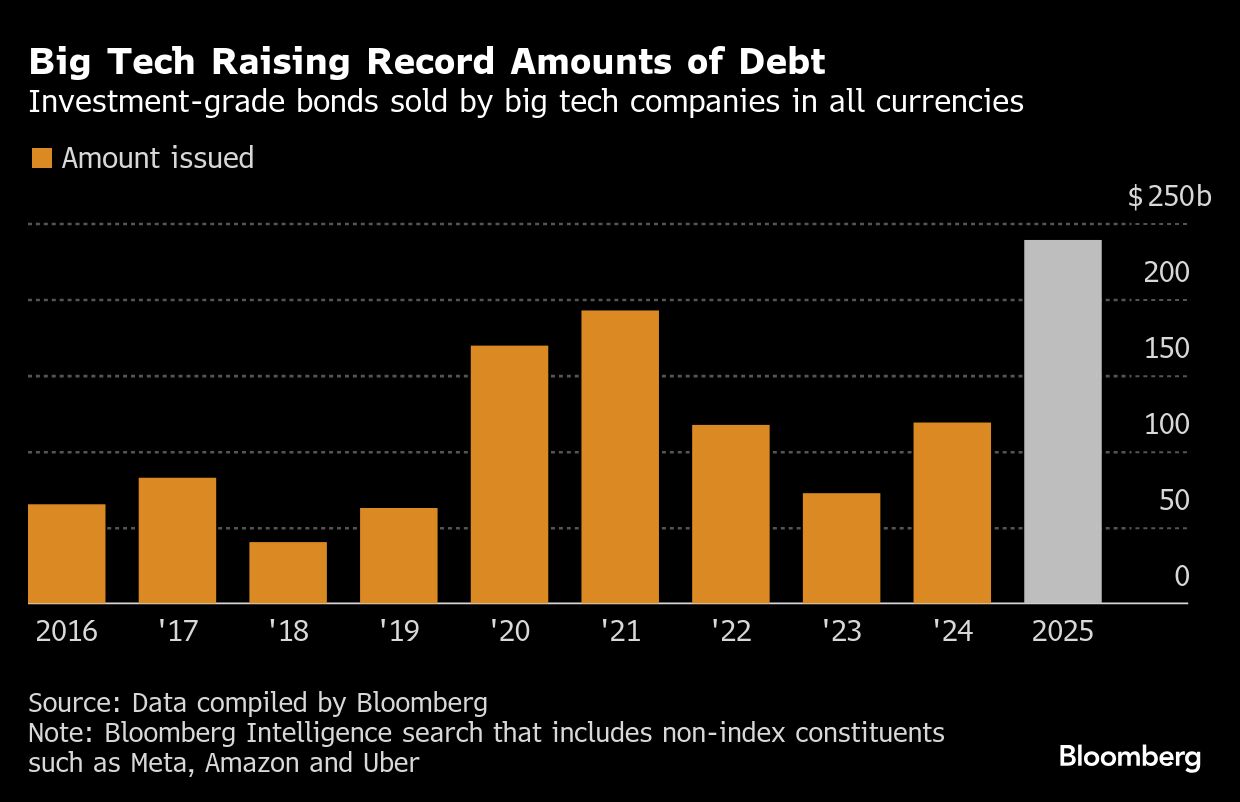
Investors are now questioning whether these massive investments in AI will pay off. There are no broad signs of panic in credit, with many of the sales so far having come from top-tier names. Alphabet raised $17.5 billion in the United States and €6.5 billion (US$7.5 billion) in Europe, the second-largest corporate deal in the region this year, while Meta sold $30 billion and Oracle Corp. did $18 billion. Demand was huge, with Meta getting a record peak order book of $125 billion.
Hedge fund Man Group Plc noted that high-yield firms are also issuing, including former bitcoin miners. These companies’ data-center plans come with “aggressive deadlines” and a heavy reliance on the supporting lease contracts, it said in a blog post titled “Why Bond Investors Aren’t Totally Buying the AI Hype.”
“A glut of supply of lower-quality names in the AI space might be too much for markets to stomach,” Man Group’s Jon Lahraoui and Hugo Richardson wrote. “The hyperscaler frenzy continues, but we remain watchful of future AI slop,” they added.
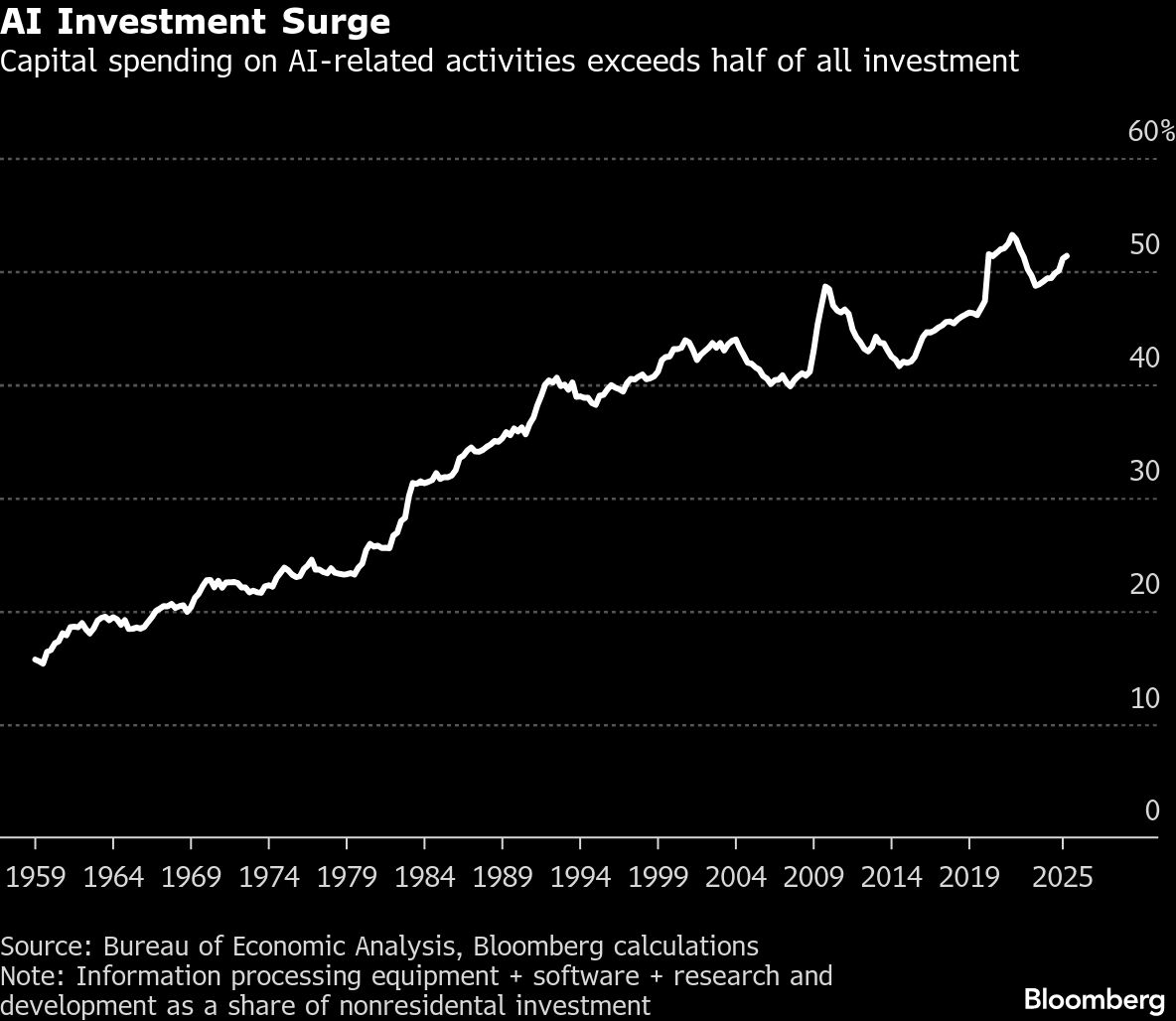
JPMorgan’s Bailey estimates that Alphabet, Meta, Amazon.com Inc., Microsoft Corp., and Oracle alone have capital expenditure needs of around $570 billion for 2026, up from $125 billion back in 2021. Meanwhile UBS Group AG sees total tech debt supply at over $900 billion next year.
The fact that the big players have strong balance sheets and significant capacity to take on debt means they can offer new issue premiums to appeal to investors that other borrowers may be forced to match, Morgan Stanley analysts warned. “Tech issuers have also shown themselves to be less price-sensitive given the strategic importance of these projects—a dynamic that can still reprice the broader market,” the U.S. bank said in its recent Global Insights outlook report. “Large issuers who are less sensitive to price is a new dynamic credit markets haven’t contended with for a long time.”
TD Securities strategist Hans Mikkelsen expects investment-grade credit spreads to widen to a “base range” of 100 to 110 basis points (bps) in 2026, up from 75 to 85 bps this year, partly driven by the surge in U.S. investment-grade bond issuance, which he estimates could reach a record $2.1 trillion.
Spreads in the corporate bond market have been mostly range bound this year after recovering from the blowout on April’s U.S. tariff announcements. Driving this have been the huge swathes of cash flowing into the asset class, chasing yields at high levels compared with recent years.
For European investment-grade investors, the rise in issuance from Big Tech and its diversification for the euro market gives an opportunity for exposure that is currently still underrepresented, according to Marco Stoeckle, head of credit strategy at Commerzbank AG. “Euro investors are essentially underinvested in high-quality U.S. tech issuers,” he said. “Demand therefore should not be the main problem, as long as credit profiles remain on the right track.”
Even the record overall bond supply in Europe this year hasn’t been enough to satiate this demand. Next year, global investment-grade bond issuance is expected to rise by 3 percent in euros and 13 percent in dollars, skewed toward non-financial companies and AI-related spending from tech firms and utilities, HSBC Holdings Plc wrote in its market outlook.
Financing AI capex is becoming a defining feature of the fixed-income world, according to Brandywine Global Investment Management portfolio manager Tracy Chen. While she likes data center asset-backed securities for stable credit fundamentals and relative insulation from any consumer fragility, she highlighted future monetization risk, or the potential to generate enough revenues.
A Massachusetts Institute of Technology initiative this year released a report indicating that 95 percent of organizations are getting zero return from generative AI projects. Investors and lenders are already hedging their bets by trading more derivatives that offer payouts if individual tech companies default on their debt. “Refinancing risk and the maturity wall will become more acute if the macro market destabilizes,” Chen said.
————————————————————
Copyright 2025 Bloomberg. All rights reserved. This material may not be published, broadcast, rewritten, or redistributed.
© Arc, All Rights Reserved. Request academic re-use from www.copyright.com. All other uses, submit a request to TMSalesOperations@arc-network.com. For more information visit Asset & Logo Licensing.