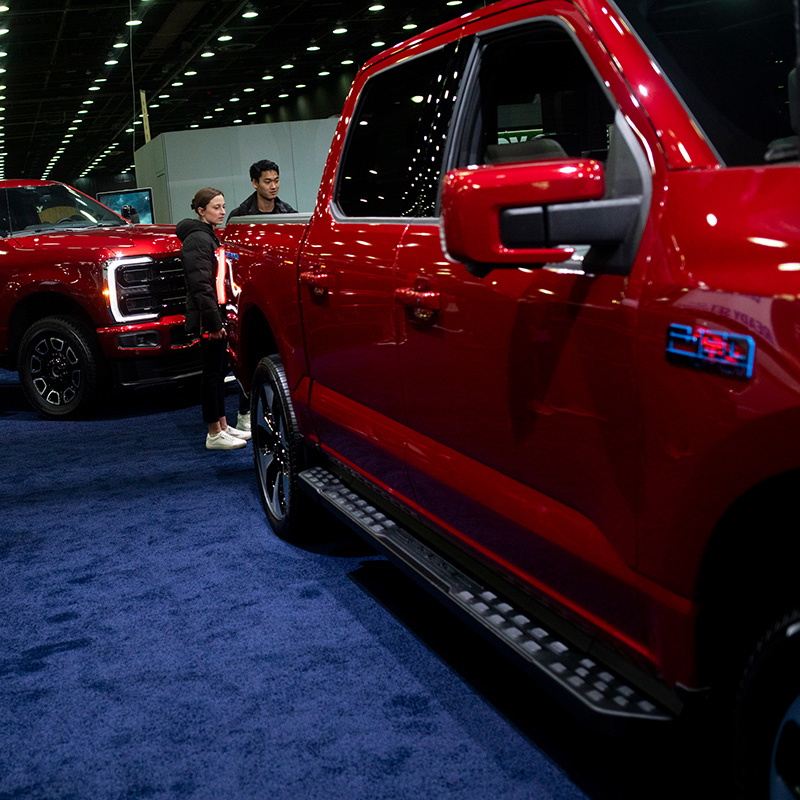
 Ford vehicles during the 2026 Detroit Auto Show in Detroit, Michigan, US, on Wednesday, Jan. 14, 2026. The event opens to the public on January 17th and runs through the 25th.
Ford Motor Co.’s top executive said there’s urgent need to update the North American trade agreement critical to the region’s automotive industry, the USMCA—a sharp contrast to comments by President Donald Trump this week expressing indifference toward brokering a new deal.
“We built our entire vehicle business as an industry between Canada, Mexico, and the U.S.,” Ford CEO Jim Farley said Thursday in a Bloomberg TV interview. “We have to get this revised.”
The comments underscore the importance of the pact to U.S. automakers, which until Trump imposed new tariffs on imported vehicles and parts last year could ship their products and components between the United States, Canada, and Mexico duty-free. Trump earlier this week said he sees as the agreement as “irrelevant,” suggesting a renegotiation of the deal due this year may be thorny.
“We could have it or not. It wouldn’t matter to me,” Trump said earlier this week of the USMCA. “I don’t really care about it.”
Farley has previously said the administration’s trade deal with Japan—which lowered tariffs to 15 percent—gave Toyota Motor Corp. a $5,000 to $10,000 cost advantage on SUVs over Ford, despite Ford building its SUVs in the United States.
Revising the trade agreement is on a “long list” of issues the company needs to work through with Trump’s administration, Farley said, in addition to more relief from tariff costs and keeping Chinese cars out of the U.S. “The administration’s been great to work with; they always answer the phone,” Farley said in the interview. “There’s always a lot of big topics for the car industry because it’s so important for our country.”
Farley said he discussed some of Ford’s needs with Trump when the president toured the automaker’s F-150 truck factory in Michigan earlier this week. Farley said he warned the president of the threat posed by Chinese automakers, which are rapidly grabbing market share in Europe with gas and electric vehicles whose low prices result from Chinese government subsidies. “They pose a lot of threat to labor locally, they have huge subsidies from the government that they’re exporting,” Farley said. “As a country, we need to decide what is a fair playing field.”
Ford also needs more relief on tariffs, especially on aluminum, which the automaker uses for the body panels of its top-selling F-Series pickups. “We’ve made progress on mitigating some of the tariffs, but we have more work to do,” Farley said. “We have a high exposure to aluminum.”
Farley praised Trump’s moves to zero out penalties for not meeting fuel-economy regulations, which enables automakers to sell more fuel-thirsty SUVs and trucks without balancing those sales with electric vehicles. Farley has called that regulatory relief a “multi-billion–dollar opportunity.” He says that is helping to boost Ford’s stock, which is up nearly 40 percent over the past year.
Those regulatory changes “are really welcome, frankly, and we’re seeing that play out really in our business,” Farley said. “Part of the reason why our valuation’s increasing is because people understand we can build more profitable vehicles now.”
————————————————————
Copyright 2026 Bloomberg. All rights reserved. This material may not be published, broadcast, rewritten, or redistributed.
© Arc, All Rights Reserved. Request academic re-use from www.copyright.com. All other uses, submit a request to TMSalesOperations@arc-network.com. For more information visit Asset & Logo Licensing.