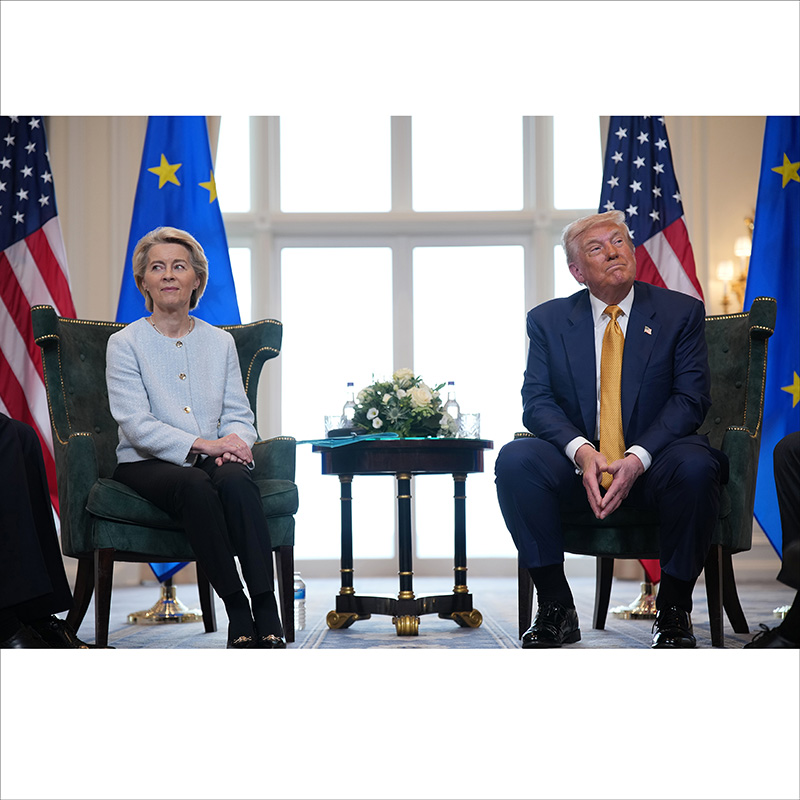
 President of the European Commission Ursula von der Leyen meets with U.S. President Donald Trump in Turnberry, Scotland on July 27.
European officials agreed on one thing in the hours after U.S. President Donald Trump pulled back from the brink over Greenland: The continent’s economy and defenses must stand on their own, fast. But when it came to opinions on how to do that, and how strongly to confront the United States in the future, that unity dissolved.
The head-spinning events of the past week have underscored the European Union’s (EU’s) vulnerabilities to U.S. aggression. Trump’s threats to take Greenland and pile tariffs on those opposing him showed his willingness to defy Europe at any moment, even if doing so up-ends a global order that has kept Western allies mostly safe for decades.
On Thursday night, EU leaders gathered in Brussels for an emergency summit to try and sort through what it all means.
“When we are clear and strong, also in our willingness to stand up for ourselves, then the results will show,” Danish Prime Minister Mette Frederiksen said as she arrived in Brussels. “So I think we have learned something from the last couple days and weeks.”
Yet while officials and leaders were unanimous that EU unity and swift preparations to retaliate are crucial, they diverged when it came to how to treat the United States moving forward. Some described the episode as a permanent shift in the relationship that should prompt the EU to constantly remain ready to retaliate. Others emphasized that the EU didn’t have the luxury of ditching such a vital economic and military partner, particularly as Ukraine enters its fifth year trying to fight off Russia’s invasion.
“What’s critical is that we work now to maintain that relationship, because the alternatives really can’t be contemplated,” Irish leader Micheal Martin said during a panel discussion at the World Economic Forum in Davos, Switzerland, before leaving for Brussels.
German Chancellor Friedrich Merz, who urged his colleagues this week to react calmly to Trump’s provocations, argued the focus should be on boosting Europe’s own economy. The EU’s independence and geopolitical sway, he said, would hinge on its financial health, suggesting several measures to further unify the bloc’s markets in each country.
“I will insist that rapid progress be made, including on the capital markets union,” he said before leaving for Brussels. “We cannot allow our European champions to continue being dependent on the U.S. capital markets.”
Merz’s measured temperament stands in contrast to leaders like Emmanuel Macron. The French president forcefully rebuffed Trump throughout the week and implored the EU to deploy its most powerful trade weapon, the anti-coercion instrument, which allows the bloc to impose fees and tariffs or to restrict foreign investments and business.
Merz said earlier this week that German’s heavier dependence on exports means it’s less willing to unleash such forceful countermeasures. And at Thursday’s summit, he encouraged Europe not to drop the concept of an EU–U.S. bond. “We cannot simply abandon this trans-Atlantic alliance,” he said before entering the meeting. “It is the most successful political alliance that has ever existed between Europe and America.”
A key question is whether Macron will make the case during Thursday’s meeting that the EU should still explore deploying the anti-coercion tool. The measure could do significant damage, potentially enabling the EU to slap fees on services provided by U.S. tech giants, for instance, or ban American firms from bidding for public contracts.
“We remain vigilant,” Macron said upon arrival. “When Europe reacts in a united fashion with the instruments it has, it can make itself respected. It’s a very good thing.”
While EU officials were seriously considering such steps earlier this week if Trump followed through on his tariff pledge, that appetite has mostly dissipated in the wake of the president’s climb-down, according to officials, who spoke on the condition of anonymity to discuss the sensitive talks.
Similarly, there is now little desire to trigger €93 billion ($109 billion) in counter-tariffs against the U.S.—another measure that seemed likely just a few days ago.
Even the European Parliament indicated that it would revisit a decision on Wednesday to freeze ratification of an EU trade deal with the United States, reached last summer but never finalized. Hours later, Trump announced his reversal.
Still, faith in the U.S. has taken a hit over the past week. Despite his Greenland U-turn, Trump’s tirade against Europe during a speech in Davos was a reminder of his unyielding animosity toward the EU and and his belief in big-power politics.
As she arrived at the EU leaders’ meeting on Thursday, Frederiksen, the Danish leader, was asked whether Europe can still trust the U.S. Before she answered, Frederiksen took a deep breath and paused. “We have been working very closely with the U.S. for many years,” she offered, “but we have to work together respectfully without threatening each other.”
————————————————————
Copyright 2026 Bloomberg. All rights reserved. This material may not be published, broadcast, rewritten, or redistributed.
© Arc, All Rights Reserved. Request academic re-use from www.copyright.com. All other uses, submit a request to TMSalesOperations@arc-network.com. For more information visit Asset & Logo Licensing.