More than $3 trillion. That's the staggering price tag to build the data centers needed to prepare for the artificial intelligence (AI) boom.
Not even the world's biggest technology companies—not Amazon.com, not Microsoft, nor Meta Platforms—are prepared to foot the bill with only their own cash. The massive equity investments in private companies such as OpenAI and Anthropic don't come close to this Industrial Revolution–size cost. And government payments and subsidies can ease the financial burden only so much.
So where will the money come from? Debt markets.
Which ones? All of them.
Blue-chip bonds, junk debt, private credit, and complex asset-backed pools of loans. "The numbers are like nothing any of us who have been in this business for 25 years have seen," says Matt McQueen, who oversees global credit, securitized products, and municipal banking and markets at Bank of America Corp. "You have to turn over all avenues to make this work."
Last year, AI-related companies and projects tapped debt markets for at least $200 billion—likely a significant undercount, as many deals are private. Projections are in the hundreds of billions of dollars of issuance for 2026 alone. The added demand for cash could nudge borrowing costs up across the rest of corporate America. And whether you're an institutional investor or an individual saver, the fixed-income side of your portfolio is getting more and more AI-heavy.
At the same time, stock portfolios are bulging with richly valued AI-related stocks. (The so-called "Magnificent 7" group of the biggest tech stocks—which also includes Alphabet, Apple, Nvidia, and Tesla—now accounts for about a third of the S&P 500's value.) Diversification is getting more challenging. "Portfolio managers are going to have to decide what level of AI exposure they're willing to stomach in their portfolios," says JPMorgan Chase & Co. credit strategist Tarek Hamid. "Your bond portfolio, which historically traded much more correlated with rates and banks' performance, is now going to be correlated with technology companies' performance."
Still, for credit investors and other lenders, AI is hard to resist—even if it comes with a sense of unease. The more conservative estimates from Morgan Stanley and Moody's Ratings peg data center–related capital expenditures (capex) at $3 trillion or more in the coming years, whereas JPMorgan projects more than $5 trillion of spending for the data center and AI boom, including related power supplies.
Borrowers are eager to build and to build now, and that means they're willing to pay attractive rates to lenders. Morgan Stanley expects $250 billion to $300 billion of issuance in 2026 from just the "hyperscalers"—tech giants such as Microsoft Corp. and Meta Platforms Inc.—and related joint ventures that are building computing capacity which will require gigawatts of power. This boom could help push the overall investment-grade bond market to record-high volumes in 2026.
There are plenty of sci-fi-sounding dreams for AI, but many of the companies piling in don't seem as speculative as the startups of the dot-com build-out. Corporate bond investors take comfort in the blue-chip status of the hyperscalers. "The vast majority of the investment is supported by companies that have very profitable existing lines of business that aren't going to go away as they're investing in this new growth area," says John Medina, senior vice president on the global project and infrastructure finance team at Moody's Ratings.
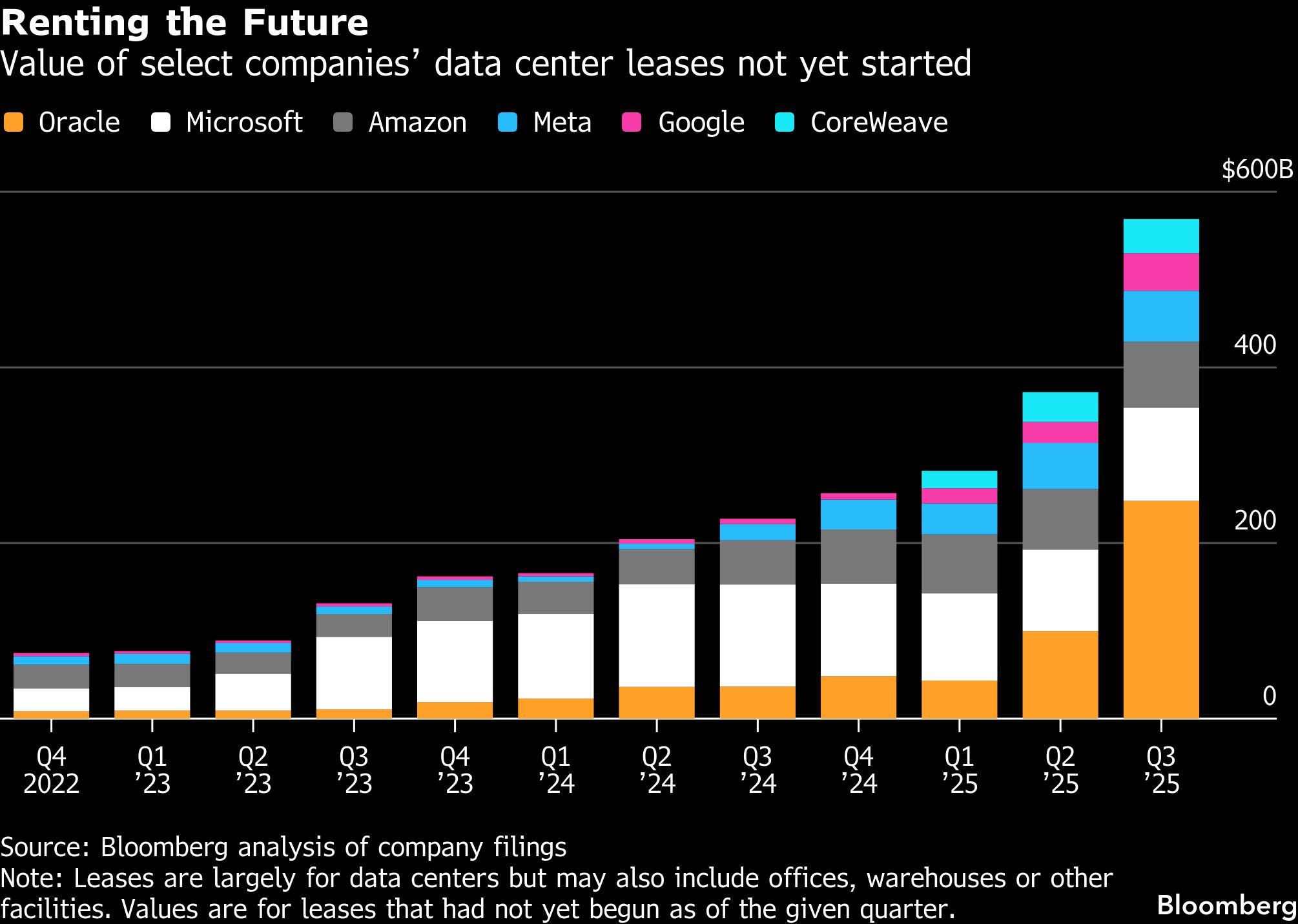
Beyond corporate bonds, there's a universe of loans that blend features found in real estate debt and construction project finance. The AI infrastructure boom, at its simplest level, is largely a matter of buying land, putting up buildings, connecting them to power, and finding tenants to sign leases. Developers are using those leases to convince fixed-income investors of a data center's creditworthiness. The ultimate example: Beignet, the name of a $30 billion deal to finance the construction of a Meta data center in Louisiana. The debt isn't on Meta's balance sheet. Instead, it's payable by a separate entity—a special purpose vehicle (SPV) set up for the deal—which will pay back the loan from its long-term lease with Meta.
"The investment-grade market has never seen this quantum of issuance to fund capex," says John Hines, global head of investment-grade debt capital markets at Wells Fargo & Co. "The result is a convergence of asset classes in both the public and private markets where investors will toggle to where they see the most value."
But even with all this big-name backing, there are risks in the lending boom. What if not enough people and businesses end up using AI? What if the revenue does materialize but more slowly than expected? "AI firms, traditionally reliant on internal cash flows and equity, now face higher leverage, which could amplify shocks and affect the health of financial intermediaries," according to a recent bulletin from the Bank for International Settlements (BIS) in Switzerland, a kind of central bank for the world's central banks. And it's not just blue-chip companies borrowing—riskier players are piling in too.
"There's a view that if you can build a data center, there's so much demand for data centers that you just can't lose—it's like selling beer to sailors," says Andrew Kleeman, co-head of private fixed income for SLC Management. "But anytime there's truly innovative technology, there's usually a massive overinvestment, and then there's a correction."
While some of the project finance-style deals are structured to be paid off over the life of the loan, other types of debt come due mostly at the end, and obligations must then be refinanced or repaid. If AI doesn't change the world as quickly as hoped (and make money while doing so), the fervor could subside by the time much of this new debt comes due. Then borrowers could struggle to find participants to refinance it. A few things could happen: Borrowing costs could rise to entice investors‚ but this would hit at a time when revenue is already pressured. Big corporate borrowers could outright pay down some of the debt, assuming they have the cash to do so. For off-balance-sheet borrowing, the equity owners of SPVs could kick in more cash to reduce the amount of debt that needs to be refinanced, lowering their own returns. And, in an extreme situation, there's always bankruptcy.
There are subtler risks. Technology is advancing rapidly in the AI arms race. A data center built today, and the graphics processing units (GPUs) and other chips that go inside, could become obsolete quickly and unexpectedly—long before the debt to finance them is paid off.
Leases could become hard to renew. For the biggest deals, investors want to lend money to a data center only if it has a long-term lease that matches the debt's maturity. But data center deals have traditionally involved multiple tenants that rolled on and off throughout the life of the debt. Lenders have to decide whether to take on lease renewal risk and hope someone else will replace any tenant that leaves. But if today's build-out causes an oversupply later, landlords might struggle to find new tenants.
Or lenders may become overexposed to just a few companies. Banks are already grappling with counterparty risk to Oracle Corp. after the company backed tens of billions of dollars of project finance loans with leases. And portfolio managers typically want only so many of their investments to be with a single business or sector.
There are also operational risks to the build-out frenzy. So many data centers are in the process of being built that the United States is facing a shortage of skilled workers and supplies. Some leases allow the tenant to get out of a contract if there's a long delay. Alternatively, lenders' exposure to AI could morph into a bet on power plants. The biggest bottleneck to creating data centers is access to power. More developers are exploring "behind-the-meter" electricity—building a power plant that directly serves the data center—and are beginning to look for financing. Warehouse-like data centers are relatively straightforward to construct. Power plants are not.
Here's a guide to all the places AI debt is coming from:
Investment-grade bonds. Alphabet, Amazon.com, Meta, and Oracle borrowed $93 billion in the U.S. investment-grade corporate bond market in 2025, accounting for about 6 percent of all debt issued last year. The roughly $8 trillion market comfortably absorbed this first round of AI-related issuance, but more is on the horizon. JPMorgan projects about $300 billion of AI– and data-center–related bond deals every year for the next five years.
The U.S. investment-grade bond market is one of the deepest sources of cash for companies in the world, so a lot of the AI build-out has to be funded through it. But the market doesn't view all the hyperscalers equally. Oracle is considered riskier, as it is more indebted relative to its earnings, is rated only two steps above junk, and is investing so much in AI that it's burning cash. The cost and volume of traded insurance contracts against its debt spiked at the end of last year, as banks and other investors hedged their exposure.
High-yield bonds and leveraged loans. These markets—about $3 trillion in total in the United States—are meant for riskier companies. Last year, three junk bond deals worth about $7 billion total were sold to finance the construction of specific new data centers. While the investment-grade–rated companies sold debt with coupons in roughly the 4 percent to 4.5 percent range for five-year notes, these high-yield-rated issuers had to pay around 7 percent to 9 percent.
Other AI-related companies also tapped the market, such as Elon Musk's xAI Corp., which used $5 billion of bonds and loans to add cash to the balance sheet as it spent billions to build data centers. The fixed-rate portions of the debt bear a coupon of 12.5 percent. AI-focused cloud computing and infrastructure provider CoreWeave Inc. went public last year, then tapped the high-yield bond market for $3.75 billion across two transactions, borrowing at around 9 percent each time, to refinance existing debt. Morgan Stanley expects about $20 billion of AI-related deals in leveraged finance markets in 2026, and JPMorgan projects $150 billion over the next five years.
Convertible bonds. Like a cross between debt and equity, convertible bonds typically enable a company to borrow with the option of converting the debt into equity if the stock price rises to a preset level (at the expense of shareholders, who become diluted). This equity upside leads to significantly cheaper borrowing costs: CoreWeave sold a $2.25 billion convertible bond in December with a coupon of only 1.75 percent. The risk is that if the equity price never appreciates, the company will eventually have to refinance or pay back the debt. The AI bump drove global total issuance to a 24-year high of $167 billion in 2025.
Project finance loans. Too much debt for a hyperscaler could cause the headache of a ratings downgrade and higher borrowing costs, and not everyone wants to be in the data center real estate business. So instead, they may work with a developer to build a data center that is owned by an SPV created for this purpose. The hyperscaler will sign a lease with the SPV, and the SPV will then borrow the debt—typically for three to five years—to fund the construction. The point of all this: Investors lend only against the project itself, and those assets are ring-fenced if the developer ever goes through bankruptcy. The first stop for this type of financing is typically a group of banks.
For decades, the bank project finance market has funded airports, bridges, roads, natural gas power plants, wind farms, and much more. Banks provide the construction loan and syndicate portions of that loan to other banks (and sometimes other investors) to spread the risk, and then a final group of lenders hold the debt until maturity. Data centers have been a familiar but small part of this world for years. But in 2025 the requests for money suddenly became magnitudes higher. Of the market's roughly $950 billion of debt issuance in 2025, about $170 billion was for data-center–related loans, an increase of 57 percent from the prior year, according to IJGlobal, a Green Street company.
No one has ever before made use of the market like Oracle. Over the past year, banks put together tens of billions of dollars worth of deals for data centers where Oracle is the intended tenant, such as $38 billion in loans for new facilities in Wisconsin and Texas to be developed by Vantage Data Centers, part of the company's massive Stargate AI infrastructure contract with OpenAI.
Lenders are eagerly waiting for other hyperscalers to follow Oracle's lead. One banker, who asked to remain anonymous because he wasn't authorized to speak publicly, says the market already has a pipeline of about $100 billion more in data center deals. Once the data center is generating revenue, in the form of rent payments, other debt markets should be willing to refinance the loans.
Structured finance. In structured finance, loans or other receivables are pooled together and then sliced and diced into different levels of risk for bond investors. This setup requires consistent cash flows from the underlying assets to pay interest to the investors. Commercial mortgage-backed securities (CMBS) pool together mortgages, while the broader asset-backed securities (ABS) market can be thought of as the "everything else" bucket. Both can securitize data center debt. Across the U.S. CMBS and ABS markets, JPMorgan projects annual data center securitization issuance could reach $30 billion to $40 billion in both 2026 and 2027, which could represent 7 percent to 10 percent of combined issuance in those years, up from about $27 billion in 2025.
Historically, these markets have mostly financed data centers for traditional cloud services, not heavy AI workloads, and deal sizes have ranged from a few hundred million dollars to, at most, about $3 billion to $4 billion, says Chong Sin, head of CMBS research at JPMorgan. Sin is skeptical these markets can absorb the mega AI deals of the past year when the debt may need to be refinanced, but higher yields and conservative structuring could attract more investors. "There's a price for everything," he says.
"End markets will have to evolve and grow," says Quynh Tran, deputy head of global structured finance, Americas, at Sumitomo Mitsui Banking Corp. The bank is already structuring today's project finance deals to lay the groundwork for the eventual refinancing, such as by parceling out each part of a data center campus into smaller segments. "If one $10 billion project has 10 buildings, when one building is done, we can then put it into an ABS or U.S. private placement, for example, and refinance $1 billion at a time," she says.
Beignet bonds. The Meta Beignet deal is in a category of its own—for now. Think of it as a project finance loan on bond market steroids. Morgan Stanley arranged over $27 billion of debt, with Pacific Investment Management Co. (PIMCO) as the anchor investor, and about $2.5 billion of equity, provided by Blue Owl Capital Inc., into a special purpose vehicle to finance construction of the data center campus dubbed Hyperion—a facility so big that, in a mid-July announcement, Mark Zuckerberg shared a fanciful picture of it superimposed over the island of Manhattan. That's a cast of characters including a top investment bank, a classic liquid fixed-income investor, and a major private markets investor. The debt covered both the construction period and 20 years after the facility is up and running. Blue Owl owns 80 percent of the facility, with Meta retaining 20 percent.
The complexity allowed Meta to raise the money off balance sheet, but investors got comfortable because the social media giant essentially backed the debt through a lease and a protection called a residual value guarantee. To the ratings agencies, that shows up as a lease liability, not debt. The debt was ultimately sold to public corporate bond investors, who bid up the deal to trade well above par, hitting a high of 110 cents on the dollar at one point. That enthusiastic reception suggests it may not be the last of its kind.
Private placements. Insurance companies, the predominant lenders in this market, are on the lookout for deals they can buy and hold to match the duration of their insurance liabilities. These deals are typically the equivalent of investment grade, and lending against a lease from a highly rated hyperscaler for a data center for 15 to 20 years at a time is especially appealing. Since the assets don't trade, insurers can get extra yield to compensate for the illiquidity. "We've been investing in data centers for years, so this isn't new to us," says Laura Parrott, head of private fixed income at Nuveen. "But these huge megadeals where you've got a hybrid capital stack with some private and then public debt, the quantum of the deal size, that's new to our market."
Private credit. In private credit, asset managers directly lend money raised from pensions, insurers, and other investors. They can finance the AI build-out through corporate direct lending, infrastructure debt, real estate debt, and asset-based finance, and can lend money to a company or to a data center project. Blackstone, Apollo Global Management, Ares Management, and others have identified AI and data centers as a big growth area. There are already more than $200 billion of outstanding private credit loans to AI-related companies. That could reach $300 billion to $600 billion by 2030, according to the Bank for International Settlements. Some private lenders are also backing the early stages of projects by financing developers to get land and power connections ready before locking in a lease. Others are starting to lend against the chips that go in the data centers.
GPU financing. The buildings are only the first step. Companies need to fill them with the microchips that perform the computations, typically GPUs. Last year, Valor Equity Partners, one of xAI's key backers, looked to arrange about $20 billion of equity and debt for an SPV to buy Nvidia Corp. processors and rent them to xAI for its Colossus 2 project. "Increasingly, there's going to be an equally large, maybe even larger, demand for financing GPUs," says Nasir Khan, head of real assets and global trade at Natixis CIB.
The maturity of such debt is typically five years, which matches the expected depreciation of the chips down to zero. The value of the chips is a big unknown: If new, better technology emerges soon, those chips could become worthless in just a few years. For debt investors, that shouldn't matter. They're counting on the lease payments to cover the interest and pay down the debt over the life of the loan. But it's notable that the closer you get to the guts of this still-new technology, the more speculative the bet becomes.
— With Jeannine Amodeo, Carmen Arroyo, Laura Benitez, Pablo Mayo Cerqueiro, Brody Ford, Bailey Lipschultz, Caleb Mutua & Abhinav Ramnarayan
————————————————————
Copyright 2026 Bloomberg. All rights reserved. This material may not be published, broadcast, rewritten, or redistributed.
© Arc, All Rights Reserved. Request academic re-use from www.copyright.com. All other uses, submit a request to TMSalesOperations@arc-network.com. For more information visit Asset & Logo Licensing.