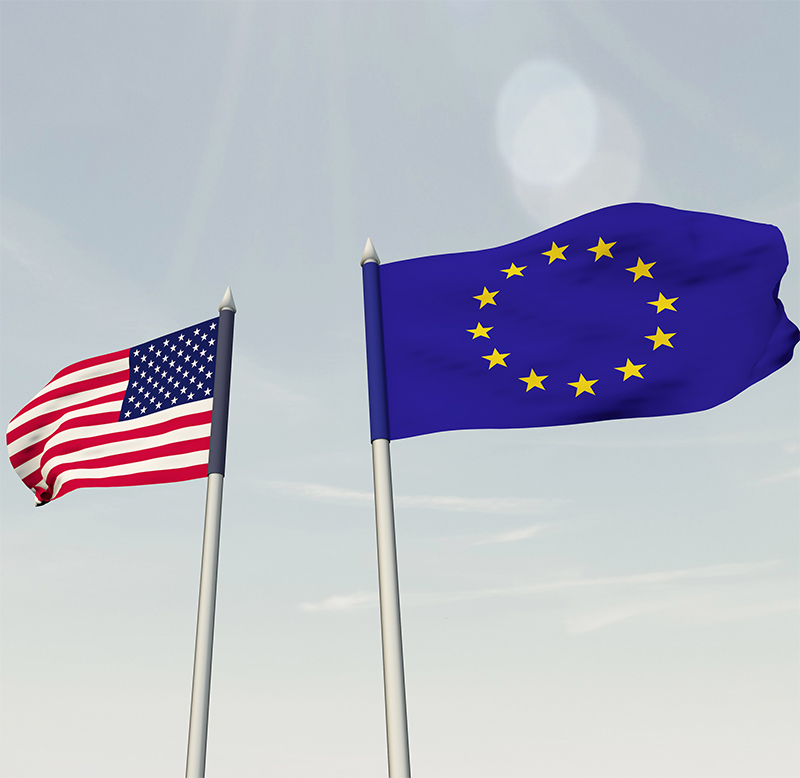
 Flags of United States and European Union, waving in different directions. Credit: alexx_60/Adobe Stock.
The European Parliament has agreed to restart the ratification process for a frozen trade deal with the U.S. after President Donald Trump walked back his threats to seize Greenland. European Union (EU) lawmakers on the trade committee made the move today, rescheduling a canceled committee vote to adopt the EU's trade pact with the United States, which was struck last summer but never fully implemented. The vote could take place on February 24, committee chair Bernd Lange said on X.
The decision does not guarantee easy passage for the free-trade agreement. There are still prominent EU lawmakers expressing skepticism. If the deal gets committee signoff, it will then face a full Parliament vote.
Within minutes of the announcement, Parliament's second-largest group, the center-left Socialists and Democrats, vowed to not support the deal unless it includes a clause suspending the agreement if the U.S. threatens EU sovereignty. "We will not rubber-stamp any deal," Lange said in a statement. "We still have negotiations ahead of us to improve it."
Conversely, Parliament's largest group, the center-right European People's Party came out emphatically in favor of the deal, arguing that continuing to block it would only pile more costs on EU businesses. "Our businesses cannot wait, and neither can our economy," said Zeljana Zovko, the group's lead EU lawmaker on U.S. trade relations, in a statement. "We must move forward now."
The EU–U.S. trade pact was put on pause last month, with EU lawmakers citing Trump's "coercive" actions over Greenland, a Danish territory. But after Trump retracted his vow to hit European countries with tariffs until they ceded the Arctic island, European Parliament President Roberta Metsola said she wanted to resume the approval process.
The trade deal was initially clinched last July. The EU agreed to remove nearly all tariffs on American products, while accepting a 15 percent duty on most exports to the United States and a 50 percent levy on steel and aluminum. The imbalanced accord prompted criticism in Europe, but numerous leaders defended it as a way to stabilize the relationship with the bloc's largest trading partner. The EU was also hoping to keep Trump on its side in Ukraine.
But even before Trump's Greenland tariff threat, the EU–U.S. trade deal faced a rocky path in the European Parliament. A group of EU lawmakers opposed the deal from the start, and criticism mounted after the U.S. extended its 50 percent metals tariff to hundreds of additional products. The U.S. then demanded changes to EU tech rules in exchange for rolling back the expanded tariffs, drawing further ire from opponents.
The Socialists and Democrats said they will reject the trade pact if the expanded 50 percent tariffs aren't reduced to 15 percent. Until then, Lange said, "there can be no tariff-free access for U.S. steel and aluminum to the European market."
—————————————————————
Copyright 2026 Bloomberg. All rights reserved. This material may not be published, broadcast, rewritten, or redistributed.
© Arc, All Rights Reserved. Request academic re-use from www.copyright.com. All other uses, submit a request to TMSalesOperations@arc-network.com. For more information visit Asset & Logo Licensing.