 Job seekers speak to recruiters during a career fair in Seattle on February 10. Photographer: David Ryder/Bloomberg.
U.S. payrolls rose in January by the most in more than a year, suggesting the labor market is continuing to stabilize. Employers added 130,000 jobs last month, and the unemployment rate declined to 4.3 percent, according to Bureau of Labor Statistics (BLS) data out today. That follows revisions to last year's data, which show a marked slowdown in hiring. Job gains averaged just 15,000 a month last year, down from the initially reported pace of 49,000 jobs per month.
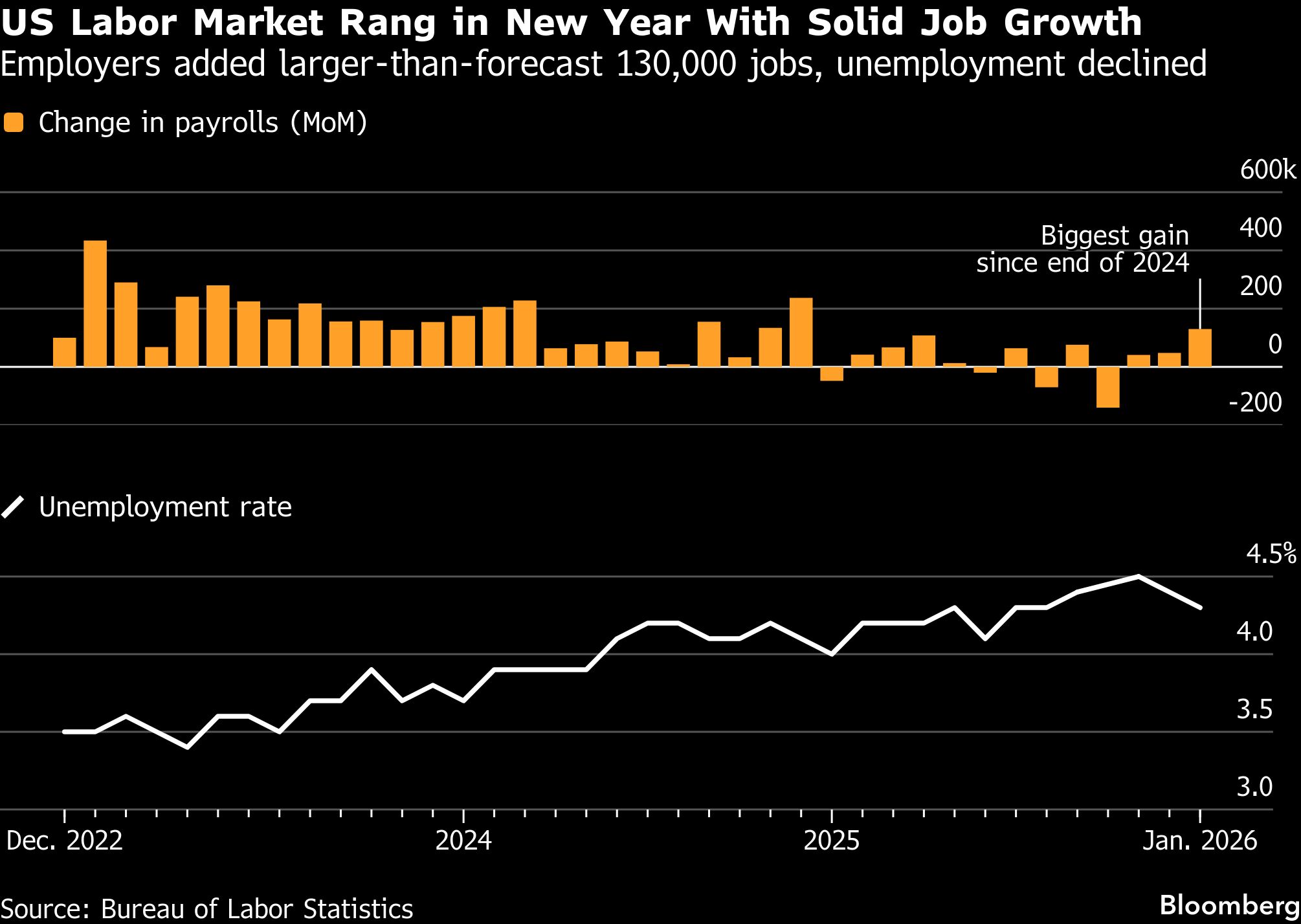
The report suggests that the labor market is finding its footing after a year marked by rising unemployment and minimal hiring. While economists expect hiring to remain generally sluggish in 2026, more clarity around the impact of President Donald Trump's economic policies and lower borrowing costs could encourage some employers to boost headcount.
The January data reinforces Federal Reserve officials' inclination to keep interest rates on hold for now. In leaving rates unchanged last month, Chair Jerome Powell cited signs of steadying in the job market.
"Coming off of a hiring recession in 2025, this is welcome news," said Heather Long, chief economist at Navy Federal Credit Union. "I think Fed Chair Powell was right—the labor market appears to be stabilizing."
| Metric | Actual | Median estimate |
|---|---|---|
| Change in payrolls (month-over-month) | +130,000 | +65,000 |
| Unemployment rate | 4.3% | 4.4% |
| Average hourly earnings (month-over-month) | +0.4% | +0.3% |
Trump praised the numbers in a social media post today and said the United States should have the lowest interest rates globally, adding to previous calls for rate reductions. "GREAT JOBS NUMBERS, FAR GREATER THAN EXPECTED!" he wrote.
With the release of each January employment report, the BLS benchmarks payrolls prior periods to a more accurate but less timely series called the Quarterly Census of Employment and Wages. That data is based on state unemployment insurance tax records and covers most U.S. jobs. This year, that adjustment shows that in the 12 months through March 2025, job growth was nearly 900,000 lower than initially reported. The figure roughly aligns with what the BLS's preliminary estimate suggested.
The pickup in January hiring was led by healthcare, which added the most jobs since 2020 and accounted for the majority of overall job growth in 2025. Construction and professional and business services also added jobs, while manufacturing saw the first monthly gain in employment in more than a year. Federal government payrolls continued to decline.
"It's great that healthcare is growing the way it is, but I would feel much better if we were seeing broader strength," said Laura Ullrich, director of economic research at Indeed Hiring Lab. "It is quite lopsided growth."
Though layoffs remain generally constrained, there's been a wave of job-cut announcements by companies from Amazon.com Inc. to United Parcel Service Inc. in recent weeks. And heading into this year, job openings across the economy dropped to the lowest level since 2020.
.What Bloomberg economists say..."The surprisingly robust reading for January's payrolls, along with a falling unemployment rate, suggests the labor market may be turning a corner."— Anna Wong, Stuart Paul & Eliza Winger |
The jobs report is comprised of two surveys, one of businesses—which produces the payrolls figures—and another of households, which is the source of the unemployment rate. Within the household survey, the labor force participation rate—the share of the population that is working or looking for work—edged up to 62.5 percent in January.
There were other positive aspects, including the biggest drop in people working part-time for economic reasons since June 2022. More workers left their jobs, suggesting some confidence in their ability to find a new one. There was also a notable drop in the number of people out of work for at least 27 weeks.
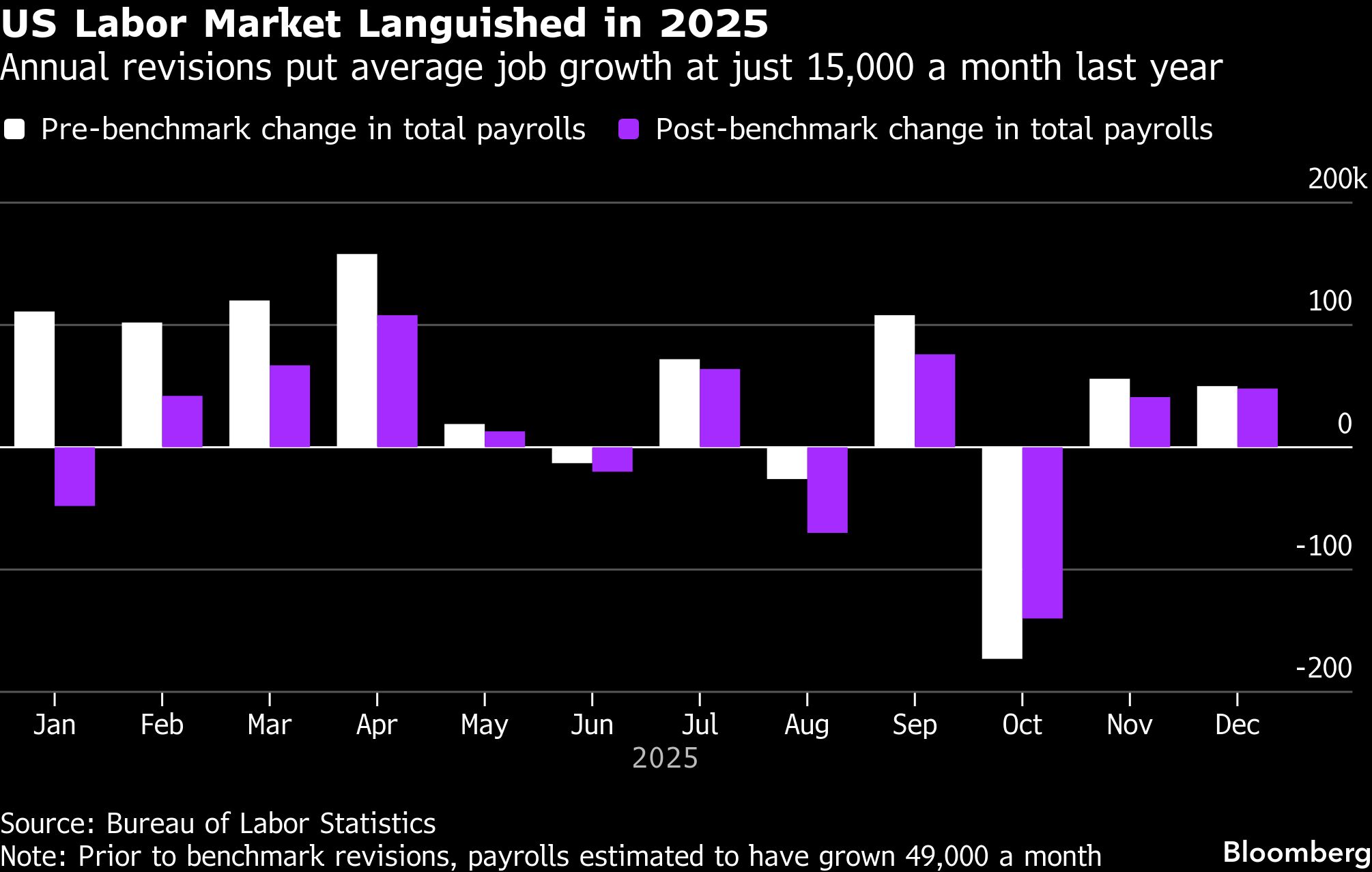
Today's release also included widespread revisions to the employer survey. With the release of the January 2026 data, the BLS updated its so-called birth-death model, which accounts for the net number of businesses opening and closing. Economists have noted this change should improve the model's responsiveness to current economic conditions and reduce the size of benchmark revisions over time.
Adjustments to job numbers have been bigger than usual in recent years, which some economists attribute to unique post-pandemic dynamics. Revisions have also become highly politicized and were largely behind Trump's firing of the previous BLS commissioner, when he claimed without evidence the data had been manipulated for political purposes.
While the January jobs report usually incorporates new population estimates from the Census Bureau into the household survey, those figures were delayed by a month due to last year's record-long government shutdown. Officials from the Trump administration in recent days have tried to reset expectations for upcoming jobs numbers due to deportations and slower population growth.
Separately, the employment report showed average hourly earnings rose a solid 0.4 percent from December. Economists pay close attention to this metric as a driver of household spending.
————————————————————
Copyright 2026 Bloomberg. All rights reserved. This material may not be published, broadcast, rewritten, or redistributed.
© Arc, All Rights Reserved. Request academic re-use from www.copyright.com. All other uses, submit a request to TMSalesOperations@arc-network.com. For more information visit Asset & Logo Licensing.