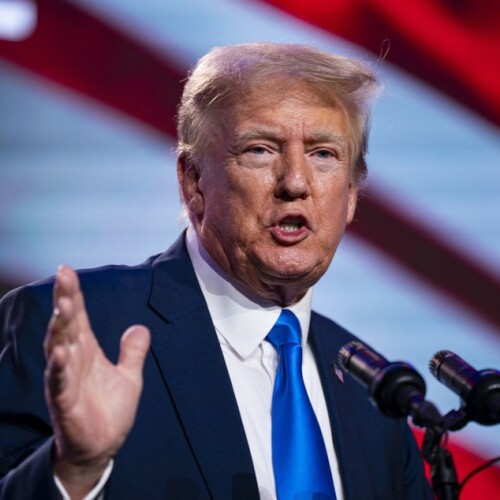
President Donald Trump rushed to salvage his signature tariffs after the Supreme Court struck down his global duties, pledging to use different tools to work around the ruling and preserve import taxes, which he has cast as essential to his economic and foreign policy. He said he plans to impose a flat 10 percent levy on foreign goods in the coming days, and that he will order a raft of trade investigations that should allow him to enact more permanent tariffs.
In a defiant and angry press conference hours after the Supreme Court decision, Trump vowed to forge ahead with his approach despite complaints from opponents who say it has undercut longtime trade partnerships and increased costs for Americans. The president has credited his tariff regime with driving substantial investments in the United States and preventing foreign conflicts.
Still, Trump's evident frustration underscored the immense logistical and legal challenges he now faces. It also offered a tacit acknowledgment that his hand has been weakened, even as he vowed to continue pursuing trade deals and implementing existing pacts.
"The Supreme Court did not overrule tariffs; they merely overruled a particular use of IEEPA tariffs," Trump told reporters, referencing the emergency authorities that the high court found illegal. "Now I'm going to go in a different direction, probably the direction that I should have gone the first time."
Trump said he will pursue the baseline duty under Section 122 of the Trade Act of 1974, which grants the president unilateral ability to impose tariffs. But the untested legal provision puts a 150-day limit on how long the duties can remain in place. Trump said he expects the new baseline rate to go into effect "three days from now." A White House official later said that the 10 percent rate will apply to all countries with trade agreements while new tariff authorities are worked out.
Trump also said existing tariffs under Section 301 and Section 232 will remain in place and vowed to launch additional investigations. The president has previously used those measures to tax imports from China, automobiles, and metals. He suggested that those investigations could be carried out while the 10 percent baseline was in place, and could eventually replace the flat rate—though he declined to rule out whether he might also seek an extension of the Section 122 levies. Trump said he is eyeing tariffs on foreign cars ranging from 15 percent to 30 percent.
The president's plan to impose a 10 percent global duty could lift the average U.S. effective tariff rate from 13.6 percent to 16.5 percent, or lower it to 11.4 percent if current exemptions are maintained, Bloomberg Economics estimated.
Trump opened his remarks by delivering a broadside against the Supreme Court, saying he was "ashamed of certain members" and that some of the justices were "frankly a disgrace to our nation." The court ruled 6-3 that Trump had exceeded his authority by invoking a federal emergency-powers law to impose his so-called "reciprocal" tariffs across the globe, as well as targeted import taxes the administration has said address fentanyl trafficking. Two justices appointed by Trump in his first term—Neil Gorsuch and Amy Coney Barrett—joined the majority in striking down the tariffs.
The justices didn't address the extent to which importers are entitled to refunds, leaving that question to a lower court to sort out those issues. If fully allowed, refunds could total as much as $170 billion—more than half the total revenue Trump's tariffs have brought in.
The decision invalidates Trump's April 2 tariffs, which imposed levies of 10 percent to 50 percent on imports from most countries. It also scuttles duties on goods from Canada, Mexico, and China in the name of addressing fentanyl trafficking, and it casts doubt on separate IEEPA tariffs placed on goods from Brazil and India.
Trump repeatedly voiced frustration throughout his remarks to the media. Even the usual bright lights of the James S. Brady Press Briefing Room were dimmed and colored for dramatic effect. He contended that the court's decision doesn't make sense because he has the power to fully embargo trade from a country—but not tariff its goods. He said he is irked that the ruling would allow him to issue licenses but not impose related fees. And he at times attacked the justices on remarkably personal terms, saying the decision by Gorsuch and Barrett was "an embarrassment to their families."
"They're very unpatriotic and disloyal to our Constitution," Trump said, suggesting the justices may have been swayed by foreign interests. The court's decision not to dictate how the tariffs would be refunded also earned Trump's ire. "We'll end up being in court for the next five years," the president said.
Trump also argued that his tariff program is essential not only to draw manufacturing back to the United States, but also as a foreign policy tool. He said tariff threats have helped him to pressure countries to de-escalate armed conflicts and credited negotiations over levies for attracting billions of dollars in planned foreign investments in the U.S. "Foreign countries that have been ripping us off for years are ecstatic. They're so happy, and they're dancing in the streets—but they won't be dancing for long," Trump said.
Trump said he will continue to pursue trade negotiations, using the looming tariffs as leverage with trading partners, and that he expected existing deals to remain in place—albeit some after being reworked. The president also said his team had already had spoken to some representatives from foreign governments—including Canada and Vietnam—who expressed concern that the case could result in a higher tariff rate.
"All we're doing is we're going through a little bit more complicated process, not complicated very much, but a little more complicated than what we had," Trump said. "We'll be able to take in tariffs, more tariffs."
The ruling ratchets up the drama for Tuesday night's State of the Union address, which the president has already said would focus on the economy. Many of the Supreme Court justices traditionally attend the speech; next week they could have a front-row seat to hear the president's reaction to their ruling.
Trump said the justices could still attend his address. "They're barely invited," Trump said. "Honestly, I couldn't care less if they come."
————————————————————
Copyright 2026 Bloomberg. All rights reserved. This material may not be published, broadcast, rewritten, or redistributed.
© Arc, All Rights Reserved. Request academic re-use from www.copyright.com. All other uses, submit a request to TMSalesOperations@arc-network.com. For more information visit Asset & Logo Licensing.