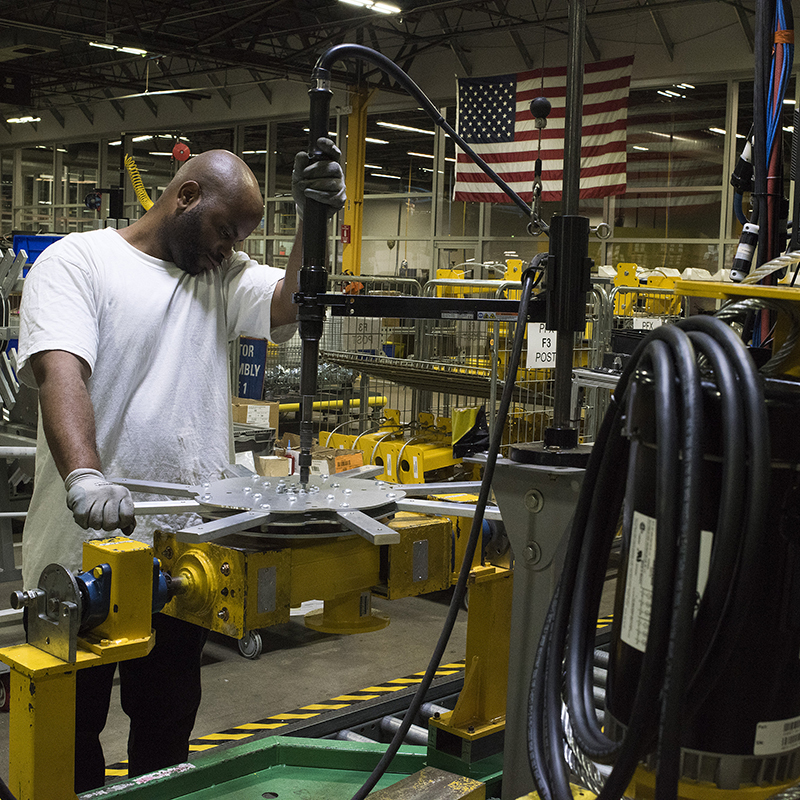
 An employee assembles industrial fans at a manufacturing facility in Lexington, Kentucky.
The U.S. economy grew less than expected at the end of last year, dragged down by a record-long government shutdown, consumer spending, and trade. Inflation-adjusted gross domestic product (GDP) increased at an annualized rate of 1.4 percent in the fourth quarter, after rising at an annualized rate of 4.4 percent in Q3, according to the government's initial estimate out today. Over all of last year, the economy expanded 2.2 percent, data from the Bureau of Economic Analysis (BEA) showed.
The weak quarterly result—which was below all forecasts in a Bloomberg survey of economists—came as the U.S. government was shut down for almost half of the fourth quarter. The BEA said the reduction in federal services during the shutdown subtracted about 1 percentage point from GDP, though the exact impact couldn't be determined.
Less than an hour before the data was released, President Donald Trump posted on social media that the shutdown cost the U.S. "at least two points in GDP."

Despite the year-end slowdown, the data still caps a solid year for the U.S. economy, which shrank in the first quarter amid a monumental pre-tariff surge in imports, only to bounce back later in the year. The turnaround came after Trump backed off of his most punitive levies and the Federal Reserve lowered interest rates, helping drive the stock market to record highs and enabling wealthier Americans to keep spending.
Trump reclaimed the White House last year with a promise to deliver a "golden age" for the United States, including by bringing manufacturing back to the country and lowering the cost of living. Factory activity only just started to pick up after an extended slumber, and the inflation rate barely budged in 2025—putting affordability front and center for this year's midterm elections.
Even with the drag from the shutdown, a gauge of underlying demand was still strong in the fourth quarter. Consumer spending slowed but remained solid, and investment in artificial intelligence (AI) data centers has set record after record in recent quarters.
"Strip out the shutdown drag, and growth looks closer to 2.5 percent, with the U.S. consumer still carrying the load and AI-linked investment doing real work," Olu Sonola, head of U.S. economics at Fitch Ratings, said in a note. "Zooming out to 2025, growth clearly cooled, but given the policy whiplash, coming in above 2 percent looks better than it had any right to."
Separate monthly BEA data out today showed the Fed's preferred measure of underlying inflation—known as the core personal consumption expenditures (PCE) price index—rose 0.4 percent in December, the most in nearly a year. On an annual basis, the core PCE, which excludes food and energy, climbed 3 percent, compared with 2.8 percent at the start of 2025.
| Indicator | Actual | Estimate |
|---|---|---|
| Q4 GDP | +1.4% | +2.8% |
| Q4 Personal consumption | +2.4% | +2.4% |
| December PCE price index, excluding food & energy | +3.0% | +2.9% |
GDP Details
Federal government spending excluding defense declined 24.1 percent at the end of last year, the most since 2020. During the shutdown, hundreds of thousands of workers went without pay, and other spending on benefits was disrupted. Bloomberg Economics estimated the closure reduced economic activity by about $100 billion.
Consumer spending, which comprises the largest share of economic activity, decelerated to a 2.4 percent pace in Q4, from 3.5 percent in Q3. The slowdown was mostly due to less spending on durable goods like cars. Healthcare services spending rose to a record as a share of GDP.
Net exports also weighed on fourth-quarter growth, barely adding to GDP after boosting growth in the middle of the year. Data out yesterday showed a widening in December's trade deficit.
Business investment grew by 3.7 percent, powered by information processing equipment, reflecting the boom in AI spending. That's expected to juice the economy even more this year, with four of the biggest U.S. technology companies forecasting they'll collectively spend about $650 billion in 2026 toward data centers and related equipment. Excluding computer equipment and software, business investment has declined in each of the past three quarters.
Because swings in trade and inventories distorted overall GDP last year, economists are paying closer attention to final sales to private domestic purchasers, a narrower metric of demand. This measure rose at a 2.4 percent pace in the fourth quarter, also a slowdown but still solid.
.What Bloomberg economists say..."The economy's substantial slowdown in the fourth quarter reflects the impact of the government shutdown. ... Overall, the economy remained resilient last year, despite headwinds from tariffs and trade-related uncertainty."— Eliza Winger |
Residential investment subtracted from growth throughout last year, though the hit was less severe in the fourth quarter. Separate data Friday showed new-home sales picked up toward the end of 2025.
What This Means for Interest Rates
With little to no progress on taming inflation last year, as well as recent signs of stabilization in the labor market, Fed officials are inclined to keep interest rates on hold for the time being. Minutes of the central bank's January meeting, released this week, showed several policymakers even suggested they may need to raise rates if inflation remains stubbornly high.
The economy is expected to grow at a 2.5 percent annualized pace, on average, in 2026, on the back of resilient consumer spending, according to the latest Bloomberg survey of economists out Friday. Trump's tax-cut package—which will deliver bigger refunds early this year—as well as more expected rate cuts should underpin spending, forecasters say.
Corporate America is a bit more hesitant on the outlook, as measures of consumer sentiment remain depressed. Walmart Inc., a bellwether of consumer spending, struck a cautious tone in its earnings call yesterday, citing unpredictable economic conditions even as spending has remained consistent. Food companies General Mills Inc. and Mondelez International Inc. have also said they're wary of budget-conscious households.
Consumers' attitudes have been pessimistic, given what's still an elevated cost of living and poor employment prospects. The economy is coming off of its worst non-recession year for hiring since 2003, making 2025's economic growth even more astounding and casting doubt on how much further the expansion can go.
Another report out today showed U.S. consumer sentiment rose less than expected in February. Although sentiment has improved in recent months, it remains low relative to the stronger readings seen in 2024.
————————————————————
Copyright 2026 Bloomberg. All rights reserved. This material may not be published, broadcast, rewritten, or redistributed.
© Arc, All Rights Reserved. Request academic re-use from www.copyright.com. All other uses, submit a request to TMSalesOperations@arc-network.com. For more information visit Asset & Logo Licensing.