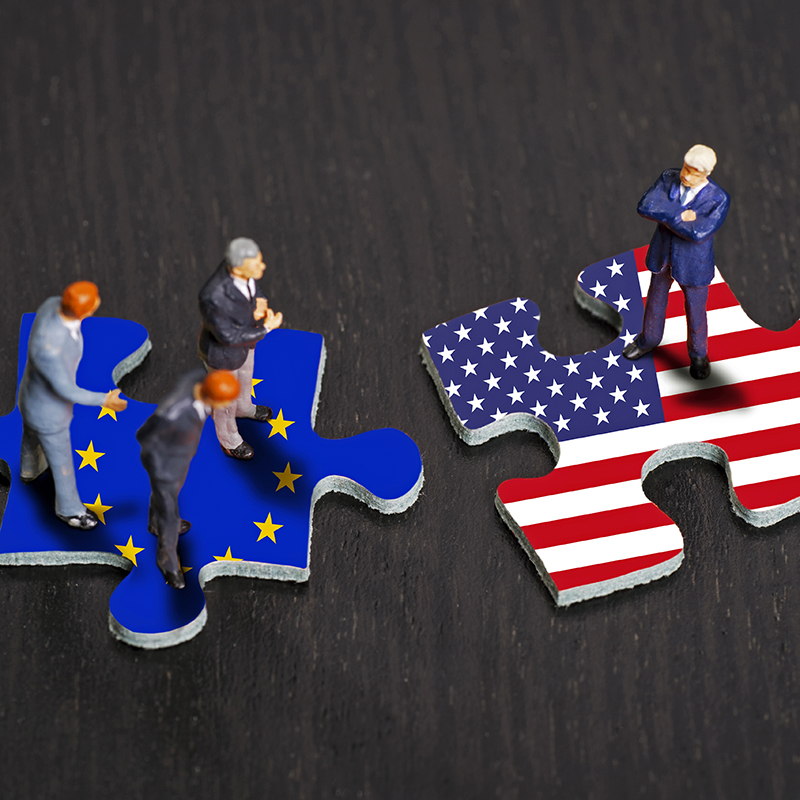
The European Union (EU) froze ratification of its U.S. trade deal until President Donald Trump solidifies his up-ended tariff plans, injecting economic turbulence into an already strained relationship.
Today EU lawmakers suspended legislative work on approving the deal. The move came days after the U.S. Supreme Court struck down Trump's use of an emergency-powers law to impose his so-called "reciprocal tariffs" around the world.
"We want to have clarity about the situation," European Parliament trade committee chair Bernd Lange said at a meeting today. "We want to have clarity from the U.S. that they are respecting the deal, because that's a crucial element."
The fresh delay extends an already long road for the trade deal, which was reached last summer but has never been fully implemented. If the pact falls apart, it threatens to reopen a wound in a trans-Atlantic relationship already suffering as Trump vacillates on Russia's war in Ukraine, pushes to control Greenland, and insults EU leaders.
"Any Country that wants to 'play games' with the ridiculous supreme court decision, especially those that have 'Ripped Off' the U.S.A. for years, and even decades, will be met with a much higher Tariff, and worse, than that which they just recently agreed to," Trump wrote this afternoon on Truth Social. "BUYER BEWARE!!!"
But European officials want answers about Trump's tariff strategy moving forward before making any decisions.
Within hours of Friday's court ruling, Trump said he would impose a 10 percent global tariff—which he then increased to 15 percent—leaving many questions unanswered for America's trading partners.
Trump also said he would preserve existing duties imposed under Sections 301 and 232, and ordered the U.S. trade representative to launch new Section 301 investigations on an accelerated timeline. Those probes require country-specific inquiries and findings of trade violations before tariffs can be imposed, and could eventually replace the baseline rate. The remarks left it unclear how such efforts might intersect with existing trade deals.
The European Commission, which reached the initial deal with Trump as the EU's executive arm, said it is trying to gather information from U.S. officials. "Full clarity on what these new developments mean for the EU–U.S. trade relationship is the absolute minimum that is required for us, as the EU, to make a clear-eyed assessment to decide on the next steps," Olof Gill, a commission spokesperson, told reporters today. "More is required for us to understand the full picture here."
The Group of Seven (G-7) nations' trade ministers also held a call today, where EU Trade Commissioner Maros Sefcovic said on X that he stressed "full respect" for the U.S. trade deal "is paramount." EU ambassadors are scheduled meet to discuss the U.S. trade relationship.
The latest trade upheaval comes at a raw moment for trans-Atlantic ties, as Europe increasingly charts its own course away from the United States. The EU is striking economic deals with other partners and instituting policies favoring its own companies and defense manufacturers—angering Washington in the process. The U.S. also accuses the bloc of imposing digital regulations tantamount to censorship.
Even before Friday's ruling, the U.S.–EU trade deal had faced a rocky path to ratification. Under the pact's initial terms, the EU agreed to a 15 percent tariff rate on most of its exports to the United States, while vowing to remove tariffs on American industrial goods heading into the bloc. The U.S. also said it would keep a 50 percent tariff on European steel and aluminum imports.
The bloc agreed to the lopsided deal in the hopes of avoiding a full-blown trade war with Washington and retaining U.S. security backing, particularly on Ukraine. Yet the U.S. soon expanded its 50% metals tariff to hundreds of additional products, angering EU lawmakers and European officials. The European Parliament didn't swiftly ratify the agreement, and it remained only partially implemented. Trump's Greenland threats then put further pressure on the deal, leading some to call for the deal to be canceled.
While that didn't happen, EU lawmakers did freeze the approval process, leaving the deal in peril. The bloc even considered imposing tariffs on €93 billion ($110 billion) worth of U.S. goods—a threat they had abandoned after striking the U.S. accord. When Trump backed down over Greenland, however, the European parliament restarted its ratification work, aiming to fully approve the agreement in March. But in the process, lawmakers also introduced several changes, like a sunset clause that would require further negotiations with EU capitals if parliament ultimately approves the deal.
This afternoon, the center-right European People's Party, parliament's largest political group, indicated that it still wants to see the agreement go into effect. "A short and strictly technical postponement may be acceptable to ensure full legal clarity," Zeljana Zovko, the EPP's lead lawmaker on the issue, said in a statement. "However, this must not become a pretext to reopen the substance of the agreement or to prolong uncertainty for our businesses and citizens."
————————————————————
Copyright 2026 Bloomberg. All rights reserved. This material may not be published, broadcast, rewritten, or redistributed.
© Arc, All Rights Reserved. Request academic re-use from www.copyright.com. All other uses, submit a request to TMSalesOperations@arc-network.com. For more information visit Asset & Logo Licensing.