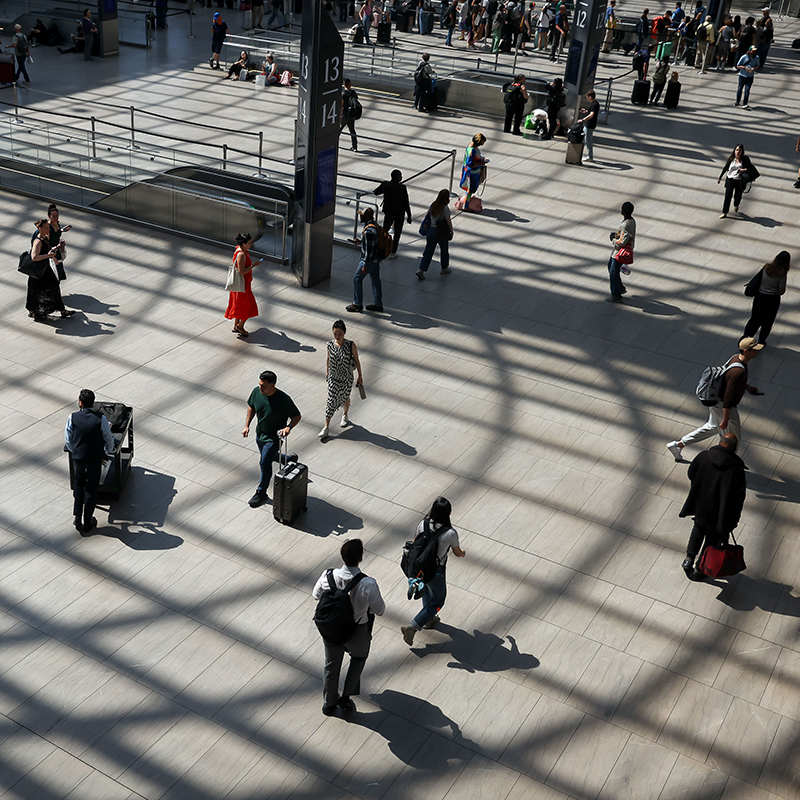
 Commuters in Moynihan Train Hall at Penn Station in New York. Photographer: Michael Nagle/Bloomberg
In May, U.S. job growth topped all forecasts, and the unemployment rate held steady at 4.3 percent, offering the clearest sign yet that the labor market may be breaking out of a prolonged period of lackluster hiring. Non-farm payrolls increased 172,000 last month, and hiring in March and April was stronger than previously reported, according to Bureau of Labor Statistics (BLS) data out today.
Taken together, the figures mark the strongest three-month advance in more than two years.

The figures boosted bets that the Federal Reserve will consider an interest rate increase this year in order to contain inflation. The report suggests the labor market is firming across multiple sectors after near-zero job growth last year, despite more recent concerns about rising energy prices due to the Middle East conflict that have driven consumer sentiment to a record low.
Friday's numbers are "further evidence that the labor market is not a concern," said Christopher Hodge, the chief U.S. economist at Natixis. "We are skeptical that this strength can continue indefinitely, but at least for now, the Fed's focus will remain squarely on inflation."
The advance in hiring was led by leisure and hospitality, which added 70,000 jobs—the most in more than three years—driven by a surge in hiring at restaurants and bars. Healthcare and social assistance, which has been the primary driver of job growth over the past year, also added jobs at a firm pace.
Roberto Torres, a co-founder of Blind Tiger Coffee Roasters, said he's hiring at least three new employees as he prepares to launch a catering business and open another store soon. Torres currently employs around 70 workers at eight locations in the Tampa Bay area, and he is paying close attention to how the Iran war is impacting prices. But strong sales at the start of the year and expectations for more tourists coming to Florida are encouraging him to move forward with expansion plans. "Obviously, we cannot ignore what's happening and put our head in the sand," he said. "We're not overly spending. But we do believe that the markets and the economy are strong, and our opportunity to shine is right now."
Some economists have said that the FIFA World Cup, which will take place across 11 American cities in June and July, may have boosted leisure and hospitality payrolls in May. Canada—which will co-host the event alongside the United States and Mexico—also saw a surge in payrolls last month, driven in part by strong hiring in the same sector, according to a separate report out today.
In the U.S., payroll growth was broad-based, with multiple sectors including manufacturing adding jobs in May. Recent reports have shown a pickup in U.S. factory activity thanks to strong demand from data centers, defense production, and broader stockpiling as customers have rushed to get ahead of war-related price increases.
B. Walter & Co., a small manufacturer of fabricated metal parts in Indiana with about 40 employees, is hiring a stamping press operator and welder even though its trucking costs are up and suppliers have imposed surcharges amid war-related supply-chain disruptions. The company's president, Scott Buehrer, said he's trying to staff back up after some attrition over the past couple of years. He feels confident enough about the direction of manufacturing and the economy to take on the new employees despite rising costs.
Today's numbers also show nonresidential construction employment rose for a seventh month, likely fueled by strong demand from the data center build-out. A separate report this week showed construction spending on data centers eclipsed $50 billion in April for the first time.

The U.S. economy still faces potential headwinds in the months to come, especially if the Middle East conflict isn't resolved soon and the Strait of Hormuz remains mostly shuttered, keeping oil prices elevated. In that scenario, consumer spending could come under more pressure as budgets get tighter—especially in lower-income families. A pullback in the stock market could dent spending among wealthier households, and ongoing deployment of artificial intelligence (AI) by businesses could pose a larger threat to hiring trends as the year goes on.
Employment in the information sector—which includes software publishers, social networks, and web search portals—fell again in May, for the 16th time in the last 17 months. Big Tech companies like Meta Platforms Inc. and Microsoft Corp. are reducing headcount, in part to offset heavy spending on AI.
Another note of caution in today's report: Average hourly earnings rose 3.4 percent from a year earlier, matching the slowest pace since 2021. Economists are paying close attention to how labor supply and demand dynamics are impacting pay—especially as inflation begins to outpace wage growth.
Other recent reports have sent mixed signals about whether the labor market might be exiting the "low-hire, low-fire" environment that has prevailed in recent years. Job openings jumped in April to the highest level since 2024, though the increase was narrowly concentrated. Layoffs have remained close to historically low levels, but consumers are still somewhat pessimistic about job opportunities relative to recent years, and small businesses are scaling back hiring plans.
.What Bloomberg economists say..."May's jobs report was extremely strong, with total job growth well above both expectations and underlying labor force growth. Gains were concentrated in leisure and hospitality, healthcare, and local government. Together with our view that inflation likely has peaked, overall conditions are consistent with the Fed holding rates steady until the final quarter of the year."— Andrew Sacher, Chris G. Collins & Stuart Paul |
The labor force participation rate—the share of the population that is working or looking for work—was unchanged at 61.8 percent, according to Friday's report. The rate for workers of ages 25 to 54, also known as "prime-age workers," edged higher. A broader measure of unemployment, which includes people working part-time for economic reasons and discouraged job-seekers, ticked lower.
Kevin Warsh, the Fed's new chairman, will preside over his first policy meeting on June 16 and 17. The central bank is widely expected to leave its benchmark rate unchanged at that meeting, but investors have marked up the odds of an increase in the second half of the year as more officials have called for the Fed to officially signal in its post-meeting statement that a rate hike is just as likely as a cut.
————————————————————
Copyright 2026 Bloomberg. All rights reserved. This material may not be published, broadcast, rewritten, or redistributed.
© Arc, All Rights Reserved. Request academic re-use from www.copyright.com. All other uses, submit a request to TMSalesOperations@arc-network.com. For more information visit Asset & Logo Licensing.